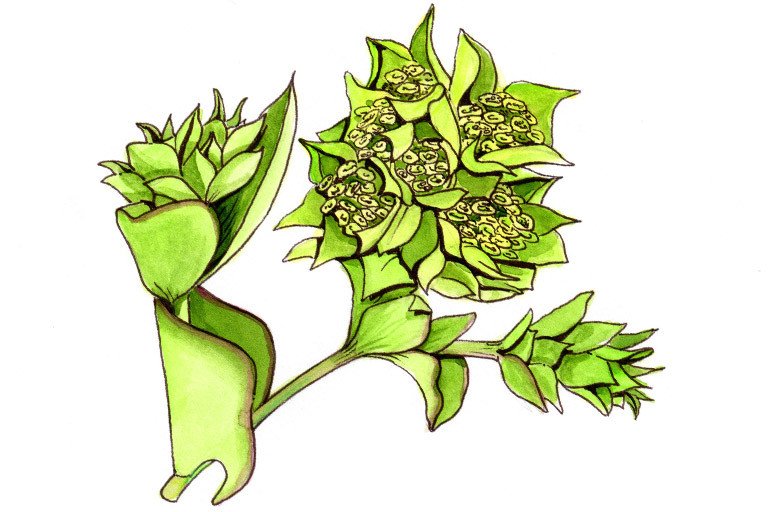
Health Care Professional Information
Scientific Name
Bupleurum chinense, Bupleurum scorzoneraefolium
Common Name
Chai Hu, hare’s ear root, thorowax root, saiko
Clinical Summary
Bupleurum is a common herb, the root of which is used in traditional Chinese and Japanese medicine. It is frequently prescribed in combination with other herbs to treat cold, fever, malaria, gastrointestinal disorders and chronic liver diseases (1).
The major components, saikosaponins, are believed to contribute to bupleurum's medicinal properties. In vitro studies show that Bupleurum has anti-inflammatory, antiviral (4) (7), antiproliferative (11), and chemopreventive (12) (13) properties, and saikosaponins were found to enhance the cytotoxicity of cisplatin against solid tumors (15). Further, Bupleurum demonstrated inhibitory effects against allergic asthma in animal studies (10).
Herbal formulas such as Xiao Chai Hu Tang (Sho-saiko-to), that contain bupleurum as major ingredient were found effective in treating hepatitis and liver cancers.
Large doses of bupleurum may cause nausea and vomiting (1).
Purported Uses
- Cancer treatment
- Cirrhosis
- Common cold
- Fever
- Hepatitis
- Infections
- Inflammation
- Liver disease
- Malaria
Constituents
- Saikosaponins (a, b1, b2, c, d)
- Bupleurumol
- Essential oils
- Fat
(2)
Mechanism of Action
The saikosaponins in bupleurum are mainly responsible for the plant's medicinal activities. In vitro studies indicate that saikosaponins exert anti-inflammatory effects by inhibiting arachidonic acid metabolism (4). Saikosaponin-d promotes interleukin-2 production and receptor expression as well as modulating T-lymphocyte function (3) (14). Bupleurum also shows a weak antihistamine activity in animals (10). Its in vitro apoptotic effect is thought to be partly mediated by increases in c-myc and p53 mRNA levels accompanied by a decrease in bcl-2 mRNA level (6) and by inhibition of telomerase activity (9). In addition, bupleurum demonstrates anti-adhesive and hemolytic effects in some solid tumor cells (5) (8).
Warnings
Bupleurum is the major ingredient in an herbal formula, Sho-saiko-to, which has been associated with interstitial pneumonitis.
Literature Summary and Critique
Many of the published clinical studies involving bupleurum were conducted in Japan using formulas such as Sho saiko to.
Dosage (Inside MSKCC Only)
This field is only visible to only Inside MSKCC users.
References
- Bensky D, Gamble A. Chinese Herbal Medicine: Materia Medica. Revised Ed. Seattle: Eastland Press; 1993.
- Huang KC. The Pharmacology of Chinese Herbs, Second Ed. New York: CRC Press; 1999.
- Kato M, et al. Characterization of the immunoregulatory action of saikosaponin-d. Cell Immunol 1994;159:15-25.
- Bermejo Benito P, et al. In vivo and in vitro antiinflammatory activity of saikosaponins. Life Sci 1998;63:1147-56.
- Wu W, Hsu H. Involvement of p-15(INK4b) and p-16(INK4a) gene expression in saikosaponin a and TPA-induced growth inhibition of HepG2 cells. Biochem Biophys Res Commun 2001;285:183-7.
- Hsu M, et al. Effect of saikosaponin, a triterpene saponin, on apoptosis in lymphocytes: association with c-myc, p53, and bcl-2 mRNA. Br J Pharmacol 2000;131:1285-93.
- Ushio Y, Abe H. Inactivation of measles virus and herpes simplex virus by saikosaponin d. Planta Med 1992;58:171-3.
- Ahn B. et al. Inhibitory effect of bupleuri radix saponins on adhesion of some solid tumor cells and relation to hemolytic action: screening of 232 herbal drugs for anti-cell adhesion. Planta Med 1998;64:220-4.
- Cheng YL, et al. Acetone extract of Bupleurum scorzonerifolium inhibits proliferation of A549 human lung cancer cells via inducing apoptosis and suppressing telomerase activity. Life Sci. 2003 Sep 19;73(18):2383-94.
- Park KH, et al. Effect of saikosaponin-A, a triterpenoid glycoside, isolated from Bupleurum falcatum on experimental allergic asthma. Phytother Res. 2002 Jun;16(4):359-63.
- Cheng YL, Lee SC, Lin SZ, et al. Anti-proliferative activity of Bupleurum scrozonerifolium in A549 human lung cancer cells in vitro and in vivo. Cancer Lett. 2005 May 26;222(2):183-93.
- Chen YL, Lin SZ, Chang JY, et al. In vitro and in vivo studies of a novel potential anticancer agent of isochaihulactone on human lung cancer A549 cells. Biochem Pharmacol. 2006 Jul 28;72(3):308-19.
- Lee CY, Hsu YC, Wang JY, et al. Chemopreventive effect of selenium and Chinese medicinal herbs on N-nitrosobis(2-oxopropyl)amine-induced hepatocellular carcinoma in Syrian hamsters. Liver Int. 2008 Jul;28(6):841-55.
- Wong VK, Zhou H, Cheung SS, et al. Mechanistic study of saikosaponin-d (Ssd) on suppression of murine T lymphocyte activation. J Cell Biochem. 2009 May 15;107(2):303-15.
- Wang Q, Zheng XL, Yang L, et al. Reactive oxygen species-mediated apoptosis contributes to chemosensitization effect of saikosaponins on cisplatin-induced cytotoxicity in cancer cells. J Exp Clin Cancer Res. 2010 Dec 9;29:159.
Consumer Information
How It Works
Bottom Line: Bupleurum is used in herbal formulas such as Sho-saiko-to that may be effective in treating heptatitis and liver cancer.
Compounds called saikosaponins, isolated from bupleurum, are considered responsible for the plant's medicinal activities. In laboratory studies, saikosaponins are able to interfere with the processes that cause inflammation, as well as cause cell death (apoptosis) in cancer cells by increasing the expression of tumor-suppressor genes. Saikosaponin-d in particular has shown ability to enhance mouse T-lymphocytes function in laboratory tests. It is not known whether these effects occur in the human body. Scientists also think that bupleurum may kill bacteria and viruses.
Purported Uses
NOTE: The following uses and descriptions of effectiveness apply to bupleurum only. Please see the Sho-saiko-to monograph for information regarding the effectiveness of bupleurum in combination with other herbs.
- To treat cancer
Components of bupleurum can cause cancer cell death (apoptosis) in laboratory experiments, but it is not known whether this effect occurs in humans. No clinical trials have been performed to test this use.
- To treat liver diseases, including hepatitis and cirrhosis of the liver
Although bupleurum is used in traditional Chinese medicine to treat liver diseases, no scientific evidence supports this use.
- To treat the common cold
Bupleurum may have antiviral activity, but clinical trials have not been conducted.
- As a fever reducer
Although bupleurum is used in traditional Chinese medicine to reduce fever, there are no clinical data to back this claim.
- To treat infections
Bupleurum may have anti-bacterial activity, but human studies are lacking.
- To reduce inflammation
Laboratory studies show that components of bupleurum interfere with the processes that cause inflammation. Human studies are needed.
- To treat malaria
Bupleurum may have anti-viral activity, but human data are lacking.
Research Evidence
Most of the clinical studies performed using bupleurum have been performed in Japan using formulas such as Sho-saiko-to.
Patient Warnings
- This product is regulated by the F.D.A. as a dietary supplement. Unlike approved drugs, supplements are not required to be manufactured under specific standardized conditions. This product may not contain the labeled amount or may be contaminated. In addition, it may not have been tested for safety or effectiveness.
- Bupleurum is the major ingredient in an herbal formula, Sho-saiko-to, which has been associated with interstitial pneumonitis.
Side Effects
- Large doses of bupleurum can cause nausea and vomiting, facial and extremity edema (swelling), abdominal distention and constipation.
Last updated: March 20, 2012
abdominal (ab-DAH-mih-nul)
Having to do with the abdomen, which is the part of the body between the chest and the hips that contains the pancreas, stomach, intestines, liver, gallbladder, and other organs.
Source: The National Cancer Institute's Dictionary of Cancer Terms
(http://www.cancer.gov/dictionary)
acid (A-sid)
A chemical that gives off hydrogen ions in water and forms salts by combining with certain metals. Acids have a sour taste and turn certain dyes red. Some acids made by the body, such as gastric acid, can help organs work the way they should. An example of an acid is hydrochloric acid. Acidity is measured on a scale called the pH scale. On this scale, a value of 7 is neutral, and a pH value of less than 7 to 0 shows increasing acidity.
Source: The National Cancer Institute's Dictionary of Cancer Terms
(http://www.cancer.gov/dictionary)
anti-inflammatory (AN-tee-in-FLA-muh-TOR-ee)
Having to do with reducing inflammation.
Source: The National Cancer Institute's Dictionary of Cancer Terms
(http://www.cancer.gov/dictionary)
antihistamine (AN-tee-HIS-tuh-meen)
A type of drug that blocks the action of histamines, which can cause fever, itching, sneezing, a runny nose, and watery eyes. Antihistamines are used to prevent fevers in patients receiving blood transfusions and to treat allergies, coughs, and colds.
Source: The National Cancer Institute's Dictionary of Cancer Terms
(http://www.cancer.gov/dictionary)
antiviral (AN-tee-VY-rul)
A drug used to treat infections caused by viruses.
Source: The National Cancer Institute's Dictionary of Cancer Terms
(http://www.cancer.gov/dictionary)
asthma (AZ-muh)
A chronic disease in which the bronchial airways in the lungs become narrowed and swollen, making it difficult to breathe. Symptoms include wheezing, coughing, tightness in the chest, shortness of breath, and rapid breathing. An attack may be brought on by pet hair, dust, smoke, pollen, mold, exercise, cold air, or stress.
Source: The National Cancer Institute's Dictionary of Cancer Terms
(http://www.cancer.gov/dictionary)
bacteria (bak-TEER-ee-uh)
A large group of single-cell microorganisms. Some cause infections and disease in animals and humans. The singular of bacteria is bacterium.
Source: The National Cancer Institute's Dictionary of Cancer Terms
(http://www.cancer.gov/dictionary)
cancer (KAN-ser)
A term for diseases in which abnormal cells divide without control and can invade nearby tissues. Cancer cells can also spread to other parts of the body through the blood and lymph systems. There are several main types of cancer. Carcinoma is a cancer that begins in the skin or in tissues that line or cover internal organs. Sarcoma is a cancer that begins in bone, cartilage, fat, muscle, blood vessels, or other connective or supportive tissue. Leukemia is a cancer that starts in blood-forming tissue such as the bone marrow, and causes large numbers of abnormal blood cells to be produced and enter the blood. Lymphoma and multiple myeloma are cancers that begin in the cells of the immune system. Central nervous system cancers are cancers that begin in the tissues of the brain and spinal cord. Also called malignancy.
Source: The National Cancer Institute's Dictionary of Cancer Terms
(http://www.cancer.gov/dictionary)
cell (sel)
The individual unit that makes up the tissues of the body. All living things are made up of one or more cells.
Source: The National Cancer Institute's Dictionary of Cancer Terms
(http://www.cancer.gov/dictionary)
cisplatin (sis-PLA-tin)
A drug used to treat many types of cancer. Cisplatin contains the metal platinum. It kills cancer cells by damaging their DNA and stopping them from dividing. Cisplatin is a type of alkylating agent.
Source: The National Cancer Institute's Dictionary of Cancer Terms
(http://www.cancer.gov/dictionary)
clinical (KLIH-nih-kul)
Having to do with the examination and treatment of patients.
Source: The National Cancer Institute's Dictionary of Cancer Terms
(http://www.cancer.gov/dictionary)
constipation (KON-stih-PAY-shun)
A condition in which stool becomes hard, dry, and difficult to pass, and bowel movements don’t happen very often. Other symptoms may include painful bowel movements, and feeling bloated, uncomfortable, and sluggish.
Source: The National Cancer Institute's Dictionary of Cancer Terms
(http://www.cancer.gov/dictionary)
edema (eh-DEE-muh)
Swelling caused by excess fluid in body tissues.
Source: The National Cancer Institute's Dictionary of Cancer Terms
(http://www.cancer.gov/dictionary)
extremity (ek-STREH-mih-tee)
A limb of the body, such as the arm or leg.
Source: The National Cancer Institute's Dictionary of Cancer Terms
(http://www.cancer.gov/dictionary)
fever (FEE-ver)
An increase in body temperature above normal (98.6 degrees F), usually caused by disease.
Source: The National Cancer Institute's Dictionary of Cancer Terms
(http://www.cancer.gov/dictionary)
gastrointestinal (GAS-troh-in-TES-tih-nul)
Refers to the stomach and intestines. Also called GI.
Source: The National Cancer Institute's Dictionary of Cancer Terms
(http://www.cancer.gov/dictionary)
hepatitis (HEH-puh-TY-tis)
Disease of the liver causing inflammation. Symptoms include an enlarged liver, fever, nausea, vomiting, abdominal pain, and dark urine.
Source: The National Cancer Institute's Dictionary of Cancer Terms
(http://www.cancer.gov/dictionary)
herbal (ER-bul)
Having to do with plants.
Source: The National Cancer Institute's Dictionary of Cancer Terms
(http://www.cancer.gov/dictionary)
in vitro (in VEE-troh)
In the laboratory (outside the body). The opposite of in vivo (in the body).
Source: The National Cancer Institute's Dictionary of Cancer Terms
(http://www.cancer.gov/dictionary)
inflammation (IN-fluh-MAY-shun)
Redness, swelling, pain, and/or a feeling of heat in an area of the body. This is a protective reaction to injury, disease, or irritation of the tissues.
Source: The National Cancer Institute's Dictionary of Cancer Terms
(http://www.cancer.gov/dictionary)
interleukin-2 (in-ter-LOO-kin...)
One of a group of related proteins made by leukocytes (white blood cells) and other cells in the body. Interleukin-2 is made by a type of T lymphocyte. It increases the growth and activity of other T lymphocytes and B lymphocytes, and affects the development of the immune system. Aldesleukin (interleukin-2 made in the laboratory) is being used as a biological response modifier to boost the immune system in cancer therapy. Interleukin-2 is a type of cytokine. Also called IL-2.
Source: The National Cancer Institute's Dictionary of Cancer Terms
(http://www.cancer.gov/dictionary)
liver (LIH-ver)
A large organ located in the upper abdomen. The liver cleanses the blood and aids in digestion by secreting bile.
Source: The National Cancer Institute's Dictionary of Cancer Terms
(http://www.cancer.gov/dictionary)
liver cancer (LIH-ver KAN-ser)
Primary liver cancer is cancer that forms in the tissues of the liver. Secondary liver cancer is cancer that spreads to the liver from another part of the body.
Source: The National Cancer Institute's Dictionary of Cancer Terms
(http://www.cancer.gov/dictionary)
M
In chemistry, M is the amount of a substance that has 6.023 x 10(23) atoms or molecules of that substance. Also called mole (chemical).
Source: The National Cancer Institute's Dictionary of Cancer Terms
(http://www.cancer.gov/dictionary)
medicine (MEH-dih-sin)
Refers to the practices and procedures used for the prevention, treatment, or relief of symptoms of a diseases or abnormal conditions. This term may also refer to a legal drug used for the same purpose.
Source: The National Cancer Institute's Dictionary of Cancer Terms
(http://www.cancer.gov/dictionary)
metabolism (meh-TA-buh-lih-zum)
The chemical changes that take place in a cell or an organism. These changes make energy and the materials cells and organisms need to grow, reproduce, and stay healthy. Metabolism also helps get rid of toxic substances.
Source: The National Cancer Institute's Dictionary of Cancer Terms
(http://www.cancer.gov/dictionary)
mRNA
A type of RNA found in cells. mRNA molecules carry the genetic information needed to make proteins. They carry the information from the DNA in the nucleus of the cell to the cytoplasm where the proteins are made. Also called messenger RNA.
Source: The National Cancer Institute's Dictionary of Cancer Terms
(http://www.cancer.gov/dictionary)
nausea (NAW-zee-uh)
A feeling of sickness or discomfort in the stomach that may come with an urge to vomit. Nausea is a side effect of some types of cancer therapy.
Source: The National Cancer Institute's Dictionary of Cancer Terms
(http://www.cancer.gov/dictionary)
pneumonitis (NOO-moh-NY-tis)
Inflammation of the lungs. This may be caused by disease, infection, radiation therapy, allergy, or irritation of lung tissue by inhaled substances.
Source: The National Cancer Institute's Dictionary of Cancer Terms
(http://www.cancer.gov/dictionary)
receptor (reh-SEP-ter)
A molecule inside or on the surface of a cell that binds to a specific substance and causes a specific physiologic effect in the cell.
Source: The National Cancer Institute's Dictionary of Cancer Terms
(http://www.cancer.gov/dictionary)
solid tumor (SAH-lid TOO-mer)
An abnormal mass of tissue that usually does not contain cysts or liquid areas. Solid tumors may be benign (not cancer), or malignant (cancer). Different types of solid tumors are named for the type of cells that form them. Examples of solid tumors are sarcomas, carcinomas, and lymphomas. Leukemias (cancers of the blood) generally do not form solid tumors.
Source: The National Cancer Institute's Dictionary of Cancer Terms
(http://www.cancer.gov/dictionary)
telomerase (teh-LOH-meh-rays)
An enzyme in cells that helps keep them alive by adding DNA to telomeres (the ends of chromosomes). Each time a cell divides, the telomeres lose a small amount of DNA and become shorter. Over time, the chromosomes become damaged and the cells die. Telomerase helps keep this from happening. Cancer cells usually have more telomerase than most normal cells.
Source: The National Cancer Institute's Dictionary of Cancer Terms
(http://www.cancer.gov/dictionary)
traditional Chinese medicine (truh-DIH-shuh-nul chy-NEEZ MEH-dih-sin)
A medical system that has been used for thousands of years to prevent, diagnose, and treat disease. It is based on the belief that qi (the body's vital energy) flows along meridians (channels) in the body and keeps a person’s spiritual, emotional, mental, and physical health in balance. Traditional Chinese medicine aims to restore the body’s balance and harmony between the natural opposing forces of yin and yang, which can block qi and cause disease. Traditional Chinese medicine includes acupuncture, diet, herbal therapy, meditation, physical exercise, and massage. Also called Oriental medicine and TCM.
Source: The National Cancer Institute's Dictionary of Cancer Terms
(http://www.cancer.gov/dictionary)