Health Care Professional Information
Scientific Name
Asparagus cochinchinensis
Common Name
Tian Dong, Tian Men Dong, Radix asparagi, tenmondo, asparagus root
Clinical Summary
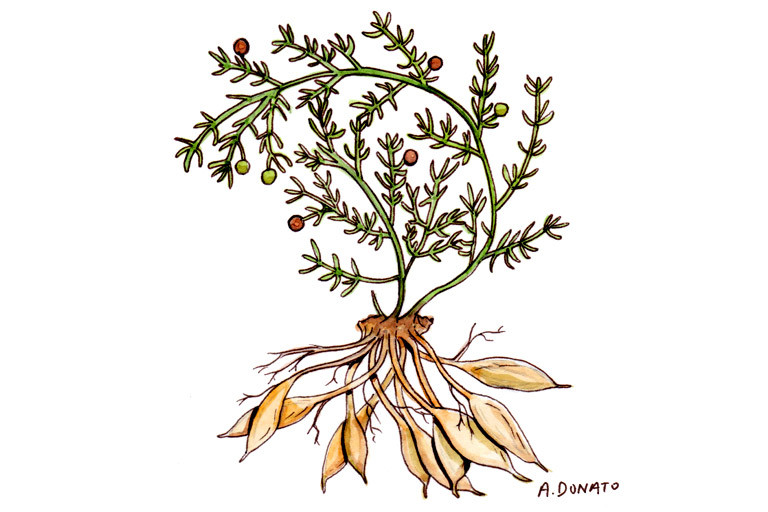
Derived from the root of the plant, Chinese asparagus is used in traditional Chinese medicine to treat a variety of conditions including breast cancer, liver disease, and as a tonic (1).
In vitro studies indicate that it has anti-inflammatory effects (5) (8) and can prevent ethanol-induced cytotoxicity (3). The root extract was shown to slow aging in mice via antioxidant effects (9). Chinese asparagus has not been studied in humans.
Adverse events or drug interactions have not been documented.
Purported Uses
- Cancer treatment
- Constipation
- Cough
- Health maintenance
- Hepatitis
Constituents
- Saponins: Officinalisnin I and II, asparasaponin I and II, asparagosides A-I, asparacoside
- Asparamide
- Beta-sitosterol
- Asparacosins A and B
- 3' '-methoxyasparenydiol
- 3'-hydroxy-4'-methoxy-4'-dehydroxynyasol
- Furostanol oligoglycosides: aspacochioside A, B and C
(1) (2) (6) (7)
Mechanism of Action
In vitro studies suggest that the beta-sitosterol constituent has activity against mouse s-180 leukemia and lung cancer. An aqueous extract of asparagus root inhibits tumor necrosis factor alpha (TNF-alpha) secretion in mouse astrocytes (4). Asparagus root also reduces alcohol-induced hepatotoxicity in Hep G2 cell lines (3).
Dosage (Inside MSKCC Only)
This field is only visible to only Inside MSKCC users.
References
- Huang KC. The Pharmacology of Chinese Herbs, 2nd ed. New York: CRC Press; 1999.
- Konishi T, Shoji J. Studies on the constituents of asparagi radix. I. On the structures of furostanol oligosides of asparagus cochinchinensis (loureio) merrill. Chem Pharm Bull 1979;27:3086-94.
- Koo HN, et al. Inhibition of tumor necrosis factor-alpha-induced apoptosis by asparagus cochinchinensis in Hep G2 cells. J Ethnopharmacol 2000;73:137-43.
- Kim H, et al. Inhibitory effect of asparagus cochinchinensis on tumor necrosis factor-alpha secretion from astrocytes. Int J Immunopharmacol 1998;20:153-62.
- Lee do Y, Choo BK, Yoon T, et al. Anti-inflammatory effects of Asparagus cochinchinensis extract in acute and chronic cutaneous inflammation. J Ethnopharmacol. 2009 Jan 12;121(1):28-34.
- Shi JG, Li GQ, Huang SY, et al. Furostanol oligoglycosides from Asparagus cochinchinensis. J Asian Nat Prod Res. 2004 Jun;6(2):99-105.
- Zhang HJ, Sydara K, Tan GT, et al. Bioactive constituents from Asparagus cochinchinensis. J Nat Prod. 2004 Feb;67(2):194-200.
- Lee do Y, Choo BK, Yoon T, et al. Anti-inflammatory effects of Asparagus cochinchinensis extract in acute and chronic cutaneous inflammation. J Ethnopharmacol. 2009 Jan 12;121(1):28-34.
- Xiong D, Yu LX, Yan X, Guo C, Xiong Y. Effects of root and stem extracts of Asparagus cochinchinensis on biochemical indicators related to aging in the brain and liver of mice. Am J Chin Med. 2011;39(4):719-26.
Consumer Information
How It Works
Bottom Line: Although Chinese asparagus has been used in traditional Chinese medicine for centuries, evidence of its effectiveness against cancer, hepatitis, or any other disease is lacking.Scientists are not sure how Chinese asparagus works, since little research has been performed on this botanical. In the laboratory setting, a Chinese asparagus extract has been shown to slow the growth of isolated leukemia and lung cancer cells, as well as protect liver cells from alcohol toxicity. However, it is not known whether these effects occur in the human body, and more research is needed to evaluate its safety and effectiveness.
Purported Uses
- To treat cancer
Limited laboratory research shows some activity against isolated leukemia and lung cancer cell lines. Human data are needed.
- To relieve constipation
There are no data to support this claim.
- To treat cough
No scientific evidence supports this use.
- To treat hepatitis
Limited laboratory research shows a protective effect against alcohol toxicity in isolated liver cells. Human studies have not been conducted.
Last updated: August 24, 2011
alcohol (AL-kuh-hol)
A chemical substance found in beer, wine, and liquor, and some medicines, mouthwashes, household products, and essential oils (scented liquid taken from plants). Alcohol contains a carbon atom attached to a hydroxyl group (a molecule made of an oxygen atom and a hydrogen atom).
Source: The National Cancer Institute's Dictionary of Cancer Terms
(http://www.cancer.gov/dictionary)
anti-inflammatory (AN-tee-in-FLA-muh-TOR-ee)
Having to do with reducing inflammation.
Source: The National Cancer Institute's Dictionary of Cancer Terms
(http://www.cancer.gov/dictionary)
antioxidant (AN-tee-OK-sih-dent)
A substance that protects cells from the damage caused by free radicals (unstable molecules made by the process of oxidation during normal metabolism). Free radicals may play a part in cancer, heart disease, stroke, and other diseases of aging. Antioxidants include beta-carotene, lycopene, vitamins A, C, and E, and other natural and manufactured substances.
Source: The National Cancer Institute's Dictionary of Cancer Terms
(http://www.cancer.gov/dictionary)
botanical (buh-TA-nih-kul)
Having to do with, or derived from, plants.
Source: The National Cancer Institute's Dictionary of Cancer Terms
(http://www.cancer.gov/dictionary)
cancer (KAN-ser)
A term for diseases in which abnormal cells divide without control and can invade nearby tissues. Cancer cells can also spread to other parts of the body through the blood and lymph systems. There are several main types of cancer. Carcinoma is a cancer that begins in the skin or in tissues that line or cover internal organs. Sarcoma is a cancer that begins in bone, cartilage, fat, muscle, blood vessels, or other connective or supportive tissue. Leukemia is a cancer that starts in blood-forming tissue such as the bone marrow, and causes large numbers of abnormal blood cells to be produced and enter the blood. Lymphoma and multiple myeloma are cancers that begin in the cells of the immune system. Central nervous system cancers are cancers that begin in the tissues of the brain and spinal cord. Also called malignancy.
Source: The National Cancer Institute's Dictionary of Cancer Terms
(http://www.cancer.gov/dictionary)
cell (sel)
The individual unit that makes up the tissues of the body. All living things are made up of one or more cells.
Source: The National Cancer Institute's Dictionary of Cancer Terms
(http://www.cancer.gov/dictionary)
drug (drug)
Any substance, other than food, that is used to prevent, diagnose, treat or relieve symptoms of a disease or abnormal condition. Also refers to a substance that alters mood or body function, or that can be habit-forming or addictive, especially a narcotic.
Source: The National Cancer Institute's Dictionary of Cancer Terms
(http://www.cancer.gov/dictionary)
extract (EK-strakt)
In medicine, a preparation of a substance obtained from plants, animals, or bacteria and used as a drug or in drugs.
Source: The National Cancer Institute's Dictionary of Cancer Terms
(http://www.cancer.gov/dictionary)
in vitro (in VEE-troh)
In the laboratory (outside the body). The opposite of in vivo (in the body).
Source: The National Cancer Institute's Dictionary of Cancer Terms
(http://www.cancer.gov/dictionary)
leukemia (loo-KEE-mee-uh)
Cancer that starts in blood-forming tissue such as the bone marrow and causes large numbers of blood cells to be produced and enter the bloodstream.
Source: The National Cancer Institute's Dictionary of Cancer Terms
(http://www.cancer.gov/dictionary)
liver (LIH-ver)
A large organ located in the upper abdomen. The liver cleanses the blood and aids in digestion by secreting bile.
Source: The National Cancer Institute's Dictionary of Cancer Terms
(http://www.cancer.gov/dictionary)
lung (lung)
One of a pair of organs in the chest that supplies the body with oxygen, and removes carbon dioxide from the body.
Source: The National Cancer Institute's Dictionary of Cancer Terms
(http://www.cancer.gov/dictionary)
lung cancer (lung KAN-ser)
Cancer that forms in tissues of the lung, usually in the cells lining air passages. The two main types are small cell lung cancer and non-small cell lung cancer. These types are diagnosed based on how the cells look under a microscope.
Source: The National Cancer Institute's Dictionary of Cancer Terms
(http://www.cancer.gov/dictionary)
pharmacology (FAR-muh-KAH-loh-jee)
The study of the origin, chemistry, and uses of drugs and their effects on the body.
Source: The National Cancer Institute's Dictionary of Cancer Terms
(http://www.cancer.gov/dictionary)
toxicity (tok-SIH-sih-tee)
The extent to which something is poisonous or harmful.
Source: The National Cancer Institute's Dictionary of Cancer Terms
(http://www.cancer.gov/dictionary)