For Patients & Caregivers
Tell your healthcare providers about any dietary supplements you’re taking, such as herbs, vitamins, minerals, and natural or home remedies. This will help them manage your care and keep you safe.
DMSO may help relieve pain but more studies are needed to confirm its safety and efficacy. There is no evidence that DMSO can treat cancer in humans.
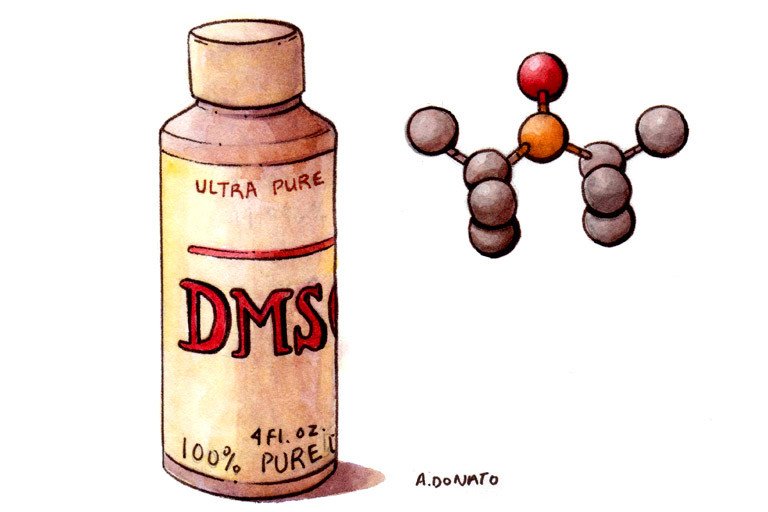
DMSO is a widely used chemical solvent. It is rapidly absorbed when applied to the skin, and has been shown to reduce pain and inflammation. DMSO is used as a prescription drug to treat inflammation and pain of the bladder. Small studies suggest that DMSO may help relieve peripheral neuropathy and post-thoracotomy pain. It has also been studied for its effects on painful bladder syndrome/interstitial cystitis, but definitive evidence is lacking. More research is also needed to determine its effects in patients with osteoarthritis.
DMSO is approved for the treatment of interstitial cystitis, when administered intravesically.
- As a cancer treatment
Some laboratory studies have shown that DMSO may slow down the progression of cancer; however, clinical studies have not been performed. - To treat chemotherapy extravasations (chemotherapy that has leaked and become trapped in surrounding tissue)
DMSO may be used to treat this condition in a hospital setting. - To reduce pain
Applying DMSO to the skin appears to reduce pain in humans. - To treat arthritis and osteoarthritis
A few studies show that application of DMSO to the skin reduces pain and inflammation in humans; however, more studies are needed to determine the optimal dose. - To treat interstitial cystitis (inflammation and pain of the bladder of unknown origin)
Intravesical DMSO is an accepted treatment for interstitial cystitis; however, more studies are needed to establish this use.
- Garlic taste in mouth, dry skin, erythema and pruritis, urine discoloration, halitosis, agitation, hypotension, sedation and dizziness have been reported following use of DMSO.
- A systematic review of 109 studies showed that the most common adverse effects of DMSO were mild, transient gastrointestinal and skin reactions, and that small doses appear to be safe.
- DMSO was shown to cause neural damage in mice. Clinical relevance is not known.
Patient Warnings:
DMSO is approved for the treatment of interstitial cystitis, when administered intravesically. But it is not approved for over-the-counter use in any form due to insufficient evidence of efficacy and potential toxicities. The industrial form of DMSO may be contaminated with other chemicals.
Do Not Take if:
- You are pregnant.
For Healthcare Professionals
Dimethylsulfoxide (DMSO) is a widely used chemical solvent because of its high polarity. It is also employed as a cryopreservative (15) (16). DMSO is readily absorbed by the skin and has been studied as a vehicle for topical drugs. It is thought to have analgesic and anti-inflammatory properties, and has been used topically to relieve pain and to treat arthritis.
Small studies suggest that DMSO may help relieve peripheral neuropathy (1) and post-thoracotomy pain (2). It has also been investigated for its effects on painful bladder syndrome/interstitial cystitis (17) (18), but definitive evidence is lacking (4) (5) (14). More research is also needed to determine its benefits in patients with osteoarthritis (3).
In oncology settings, DMSO has been used to prevent and manage extravasations of chemotherapeutic agents (6) (7). It may also slow down the progression of cancer cells, but data are inconsistent (2) (8).
DMSO is approved for the treatment of interstitial cystitis, when administered intravesically.
- Cancer treatment
- Chemotherapy side effects
- Pain
- Arthritis
- Interstitial cystitis
DMSO is diluted on exposure to air. Upon topical application, it rapidly penetrates the skin; however, unlike most penetrating solvents, it is not associated with irreversible membrane damage. DMSO can enhance the skin penetration of other drugs. Analgesic and anti-inflammatory effects may benefit patients with rheumatoid arthritis (2). In addition, DMSO traps free radical hydroxide; its antioxidant properties are thought to be responsible for the prevention of chemotherapy extravasations (7). A strong garlic taste in the mouth following DMSO administration is due to the exhaled dimethylsulfide (DMS) metabolite (11).
DMSO is approved for the treatment of interstitial cystitis, when administered intravesically. But it is not approved for over-the-counter use in any form due to insufficient evidence of efficacy and potential toxicities. The industrial form of DMSO may be contaminated with other chemicals.
Pregnant women should avoid DMSO (12).
- Garlic taste in mouth, dry skin, erythema and pruritis (2), urine discoloration, halitosis, agitation, hypotension, sedation and dizziness (13) have been reported following use of DMSO.
-
A systematic review of 109 studies showed that the most common adverse effects of DMSO were mild, transient gastrointestinal and skin reactions, and that small doses appear to be safe (19).
-
DMSO was shown to cause neural damage in murine models (9). Clinical relevance is not known.
- Recurrent cerebral hemorrhage: In a man in his 70s following use of DMSO for managing mood (20).