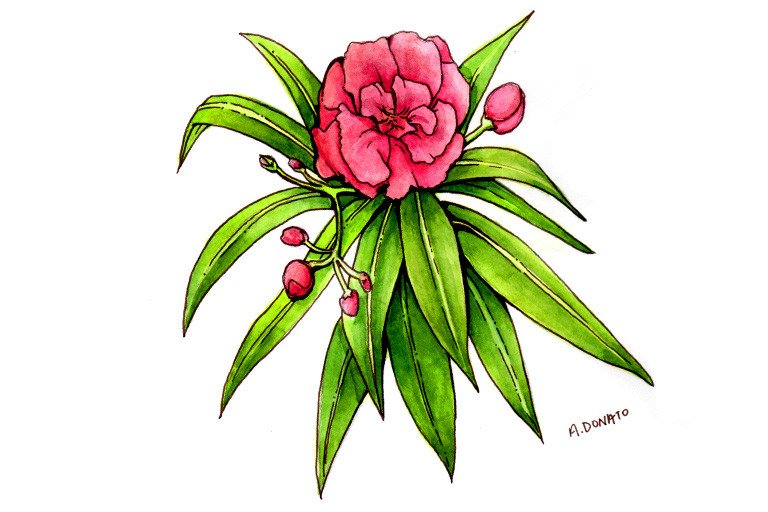
Common Names
- Rose laurel
- Adelfa
- Rosenlorbeer
- Karavira
For Patients & Caregivers
Tell your healthcare providers about any dietary supplements you’re taking, such as herbs, vitamins, minerals, and natural or home remedies. This will help them manage your care and keep you safe.
Oleandrin is an extract from a plant that is considered toxic, and studies in humans are lacking.
Oleandrin is an extract from the plant, Nerium oleander. This shrub is native to northern Africa, the eastern Mediterranean basin, and Southeast Asia and although it looks appealing, is considered toxic. It contains substances that are similar to the active chemical found in the heart medication, digoxin. Lab studies suggest that some products being tested may suppress cancer cell growth or make them more sensitive to treatment. However, it is unclear whether these effects can occur in the human body.
-
To treat cancer
Lab studies show some anticancer activity in cancer cell lines, but clinical trials to evaluate the anticancer activities of oleandrin in humans are lacking.
Scientific evidence is lacking to support the following claims: - To treat congestive heart failure
- To treat hepatitis C
- To treat AIDS
- To treat COVID-19
- Nausea, vomiting
- Diarrhea
- Fatigue
- Itching
- Pain at injection site
- Tumor pain
- Breast pain
- Abnormally high white blood cell counts
- Abnormally fast and irregular heart rate
Case Reports
- Death of an adult diabetic man: Due to consumption of oleander leaves.
- Death suspected from daily intramuscular injections: In a 43-year-old cancer patient, who used intramuscular injections of Nerium oleander extract for 2 months.
- Accidental poisoning: In a woman who attempted to self-medicate for thyroid disease.
Patient Warnings:
- The raw plant from which Anvirzel™ is extracted, Nerium oleander, is highly toxic. Consumption of this botanical may be fatal.
- Onset of toxicity occurs several hours after consumption and includes vomiting, abdominal pain, bluish skin discoloration, low blood pressure, low body temperature, dizziness, respiratory paralysis, and death.
Do Not Take if:
These products are not approved treatments in the United States and should not be used outside of clinical trials.
- You are taking digoxin: These products contain cardiac glycosides, the same active chemical in digoxin, so the two medications may have additive effects, causing toxicity.
- You are taking P-glycoprotein (P-gp) substrate drugs: Oleander leaf extract may increase the blood levels of these drugs.
- You have high blood levels of calcium
- You have low blood levels of potassium
- You have an abnormally slow or fast heart rate
- You have heart failure: These products contain cardiac glycosides, the same active chemical in digoxin, and are therefore contraindicated in people with these conditions.
Special Point:
A few products are being studied, but have not been approved for use. Until larger well-designed studies are published that demonstrate these products are effective and safe, they should not be used outside of clinical trials.
For Healthcare Professionals
Nerium oleander is an ornamental shrub native to northern Africa, the eastern Mediterranean basin, and Southeast Asia. It is used in traditional medicine to treat hemorrhoids, ulcers, leprosy, and as an abortifacient. The plant is poisonous because of oleandrin, a cardiac glycoside with structure and actions similar to those of digoxin, and both exert their effects by inhibiting membrane enzyme Na+, K+ -ATPase (1).
Most studies have focused on the anticancer activities of oleandrin because of its apoptotic effects in various cancer cell lines (2) (3) (4) (5) (6) (7) (8). It also increases sensitivity of PC-3 human prostate cells to radiotherapy (9) and reduces gentamycin toxicity (10). A study in glioma models suggest potential activity (27). In other studies, oleandrin demonstrated neuroprotective activity (11) and reduced infectivity of the HIV virus (24).
A hot water extract of the plant, known as Anvirzel™, has been developed as a potential treatment for cancer, AIDS, and congestive heart failure. It consists of a mixture of oleandrin and the glycone oleandrigenin. Preclinical experiments suggest that a combination of Anvirzel and cisplatin may be more effective than cisplatin monotherapy (28).
Studies in humans are quite limited. In one small study, Anvirzel appeared safe in humans when injected intramuscularly, although adverse effects such as injection site pain, fatigue, and GI symptoms were reported (12). In a small study in patients with advanced cancers, an oral N. oleander extract was well tolerated (29) but did not meet the primary endpoint of overall survival in patients with metastatic pancreatic adenocarcinoma (30). These treatments are still being studied and are not approved for cancer treatment in the United States. Until more data on efficacy and toxicity are available, these products should not be used outside of clinical trials.
Current scientific evidence is lacking to support the use of oleandrin products for any condition, including congestive heart failure, hepatitis C, AIDS, or COVID-19.
- Cancer
- Heart failure
- Hepatitis
- AIDS
Oleandrin may slow tumor growth by inhibiting the membrane enzyme Na+, K+ -ATPase (1), especially in cells that have higher ratios of alpha 3 to alpha 1 isoform expression (13). It improves cellular export of fibroblast growth factor-2 (4). Oleandrin also induces apoptosis through NF-kB suppression (2) (15). It selectively sensitized lung cancer cells to apoptosis-inducing ligand Apo2L/TRAIL via DR4/5 upregulation at both RNA and protein levels (16). Other proposed mechanisms include formation of superoxide radicals that cause tumor cell injury via mitochondrial disruption (7), IL-8 inhibition that mediates tumorigenesis (17), caspase-3 activation (9), induction of tumor cell autophagy (6), and P-gp inhibition (8). More recently, PBI-05204, an extract of N. oleander, inhibited pancreatic tumor proliferation partly via downregulation of PI3k/Akt and mTOR pathways (26).
- The Nerium oleander plant is highly toxic.
- Patients with hypercalcemia, hypokalemia, bradycardia, ventricular tachycardia, or heart failure should not use these products (12).
- These products should not be used outside of clinical trials.
-
Common (Raw botanical)
Consumption of Nerium oleander can be fatal (25). Onset of toxicity: Several hours after consumption. Symptoms include vomiting, abdominal pain, cyanosis, hypotension, hypothermia, vertigo, respiratory paralysis, and death. Can occur at serum oleandrin levels between 1.0 and 2.0 ng/mL (19). - With Anvirzel™: Pain at injection site, fatigue, transient erythema, nausea, vomiting, and diarrhea (12).
- With oral PBI-05204 extract: Fatigue, nausea, diarrhea, arrhythmia, and decreased appetite (29) (30)
Case Reports
- Death of an adult diabetic man: Due to consumption of oleander leaves. Oleandrin levels in the blood were roughly 10 ng/mL (20).
- Death suspected from daily intramuscular injections: In a 43-year-old patient with metastatic synovial sarcoma of the knee who used daily intramuscular injections of Nerium oleander extract for 2 months. Symptoms included nausea, vomiting, severe stomach pain and bloating followed by a gradual reduction in liver enzymes and cardiopulmonary arrest (21).
- Accidental poisoning: In a woman who attempted to self-medicate for thyroid disease (14).
- Fatal arrhythmia: In a 71-year-old male due to ingestion of an oleander leaf infusion (31).
- Digoxin: Theoretically, cardiac glycosides in Nerium oleander may have an additive effect with digoxin, causing toxicity.
- P-glycoprotein (P-gp) substrates: Oleander leaf extract inhibits P-gp and may increase the blood levels of substrate drugs. (8)