Health Care Professional Information
Scientific Name
Staurocucumis liovillei, Mensamaria intercedens Lampert
Clinical Summary
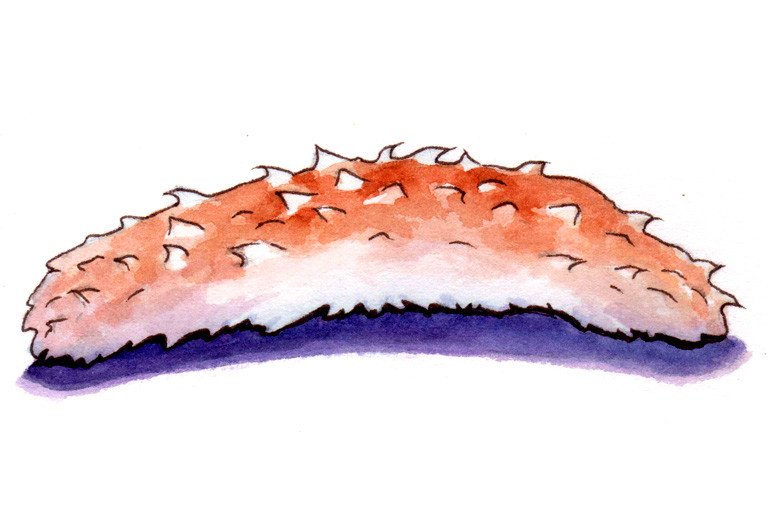
Sea cucumber is a marine invertebrate related to sea urchins and star fish. It is used in traditional Chinese medicine to treat fatigue, impotence, constipation, frequent urination, and joint pain. It is also a rich source of mucopolysaccharides, especially chondroitin sulfate, commonly used for arthritis. In vitro studies have shown that the saponins and fatty acids present in Sea cucumber are responsible for its anti-angiogenic, anti-tumor (2), antiproliferative (1), and antiviral properties (4) (3).
One study suggests that Sea cucumber extract is beneficial in treating chronic gingivitis (5).
Clinical trials have not been conducted to test the effectiveness of Sea cucumber for cancer.
No adverse effects have been reported from its use.
Food Sources
Sea cucumbers are considered a delicacy in Asian countries. They are cooked, dried and then used in soups and other dishes.
Purported Uses
- Antiaging
- Arthritis
- Cancer treatment
- Frequent urination
- Impotence
Constituents
- Mucopolysaccharides: Chondroitin sulfate
- Saponins: Triterpene glycosides, Philonopside A, Intercedensides
- Branched chain fatty acids: 12-methyltetradecanoic acid
(1) (2) (3) (6) (7)
Mechanism of Action
A branched-chain fatty acid known as 12-methyltetradecanoic acid, isolated from sea cucumber, is thought to inhibit prostate cancer cell proliferation by increasing caspase-3 activity (1). The proposed mechanism for the anti-angiogenic and anti-tumor effects of Philinopside A, a saponin derived from sea cucumber, is by inhibiting tyrosine kinase receptors (2).
Contraindications
Sea cucumber may not be appropriate for individuals who are allergic to seafood.
Herb-Drug Interactions
Anticoagulants: The polysaccharides sulfated fucan and fucosylated chondroitin sulfate may potentiate the actions of anticoagulants (8).
Literature Summary and Critique
Clinical trials have not been conducted to test the efficacy of sea cucumber for cancer.
References
- Yang P, et al. Inhibition of proliferation of PC3 cells by the branched-chain fatty acid, 12-methyltetradecanoic acid, is associated with inhibition of 5-lipoxygenase. Prostate 2003; 55(4):281-91.
- Tong Y, et al. Philinopside A, a novel marine-derived compound possessing dual anti-angiogenic and anti-tumor effects. Int J Cancer 2005; 114(6):843-53.
- Maier MS, et al. Two new cytotoxic and virucidal trisulfated triterpene glycosides from the Antarctic sea cucumber Staurocucumis liouvillei. J Nat Prod 2001; 64(6):732-36.
- Zou ZR, et al. Intercedensides A-C, three new cytotoxic triterpene glycosides from the sea cucumber Mensamaria intercedens Lampert. J Nat Prod 2003; 66(8):1055-60.
- Taiyeb-Ali TB, et al. Efficacy of 'Gamadent' toothpaste on the healing of gingival tissues: a preliminary report. J Oral Sci 2003; 45(3):153-59.
- Antonov AS, Avilov SA, Kalinovsky AI, et al. Triterpene glycosides from Antarctic sea cucumbers. 1. Structure of liouvillosides A1, A2, A3, B1, and B2 from the sea cucumber Staurocucumis liouvillei: new procedure for separation of highly polar glycoside fractions and taxonomic revision. J Nat Prod. 2008 Oct;71(10):1677-85.
- Antonov AS, Avilov SA, Kalinovsky AI, et al. Triterpene glycosides from Antarctic sea cucumbers III. Structures of liouvillosides A(4) and A(5), two minor disulphated tetraosides containing 3-O-methylquinovose as terminal monosaccharide units from the sea cucumber Staurocucumis liouvillei (Vaney). Nat Prod Res. 2011 Aug;25(14):1324-33.
- Fonseca RJ, Santos GR, Mourão PA. Effects of polysaccharides enriched in 2,4-disulfated fucose units on coagulation, thrombosis and bleeding. Practical and conceptual implications. Thromb Haemost. 2009 Nov;102(5):829-36.
Consumer Information
How It Works
Bottom Line: Sea cucumber has not been shown to treat cancer in humans.
Sea cucumber is a marine invertebrate related to sea urchins and star fish. It is dried and used in soups and other dishes and is considered a delicacy in Asian countries. Sea cucumber is used in traditional Chinese medicine to treat fatigue, impotence, constipation, frequent urination, and joint pain. It is also a rich source of chondroitin sulfate, commonly used for arthritis. There are no reports of adverse effects from use of sea cucumber.
Purported Uses
- Cancer Treatment
Laboratory experiments suggest a saponin component derived from sea cucumber may have antitumor effects by inhibiting formation of new blood vessels. This effect has not been studied in humans.
- Longevity
Sea cucumber is used in Chinese medicine to increase longevity, but there are no clinical data to support this use.
- Impotence
Although Sea cucumber in Chinese medicine used to treat impotence, there are no clinical data to support this use.
- Joint Pain
Sea cucumber is a rich source of chondroitin sulfate, shown to be effective for osteoarthritis.
- Frequent Urination
Sea cucumber is used in Chinese medicine to treat urinary problems. However, clinical data to support this use are lacking.
Research Evidence
Clinical trials have not been conducted to test the effectiveness of Sea cucumber in humans.
Do Not Take If
- You are allergic to seafood.
- You are taking anticoagulants: The polysaccharides present in sea cucumber may increase the effects of anticoagulants, increasing the risk of bleeding.
Last updated: September 28, 2012
acid (A-sid)
A chemical that gives off hydrogen ions in water and forms salts by combining with certain metals. Acids have a sour taste and turn certain dyes red. Some acids made by the body, such as gastric acid, can help organs work the way they should. An example of an acid is hydrochloric acid. Acidity is measured on a scale called the pH scale. On this scale, a value of 7 is neutral, and a pH value of less than 7 to 0 shows increasing acidity.
Source: The National Cancer Institute's Dictionary of Cancer Terms
(http://www.cancer.gov/dictionary)
antitumor (AN-tee-TOO-mer)
Having to do with stopping abnormal cell growth.
Source: The National Cancer Institute's Dictionary of Cancer Terms
(http://www.cancer.gov/dictionary)
antiviral (AN-tee-VY-rul)
A drug used to treat infections caused by viruses.
Source: The National Cancer Institute's Dictionary of Cancer Terms
(http://www.cancer.gov/dictionary)
arthritis (ar-THRY-tis)
A disease that causes inflammation and pain in the joints.
Source: The National Cancer Institute's Dictionary of Cancer Terms
(http://www.cancer.gov/dictionary)
blood (blud)
A tissue with red blood cells, white blood cells, platelets, and other substances suspended in fluid called plasma. Blood takes oxygen and nutrients to the tissues, and carries away wastes.
Source: The National Cancer Institute's Dictionary of Cancer Terms
(http://www.cancer.gov/dictionary)
cancer (KAN-ser)
A term for diseases in which abnormal cells divide without control and can invade nearby tissues. Cancer cells can also spread to other parts of the body through the blood and lymph systems. There are several main types of cancer. Carcinoma is a cancer that begins in the skin or in tissues that line or cover internal organs. Sarcoma is a cancer that begins in bone, cartilage, fat, muscle, blood vessels, or other connective or supportive tissue. Leukemia is a cancer that starts in blood-forming tissue such as the bone marrow, and causes large numbers of abnormal blood cells to be produced and enter the blood. Lymphoma and multiple myeloma are cancers that begin in the cells of the immune system. Central nervous system cancers are cancers that begin in the tissues of the brain and spinal cord. Also called malignancy.
Source: The National Cancer Institute's Dictionary of Cancer Terms
(http://www.cancer.gov/dictionary)
cell (sel)
The individual unit that makes up the tissues of the body. All living things are made up of one or more cells.
Source: The National Cancer Institute's Dictionary of Cancer Terms
(http://www.cancer.gov/dictionary)
chondroitin sulfate (kon-DROY-tin SUL-fayt)
The major glycosaminoglycan (a type of sugar molecule) in cartilage.
Source: The National Cancer Institute's Dictionary of Cancer Terms
(http://www.cancer.gov/dictionary)
chronic (KRAH-nik)
A disease or condition that persists or progresses over a long period of time.
Source: The National Cancer Institute's Dictionary of Cancer Terms
(http://www.cancer.gov/dictionary)
clinical (KLIH-nih-kul)
Having to do with the examination and treatment of patients.
Source: The National Cancer Institute's Dictionary of Cancer Terms
(http://www.cancer.gov/dictionary)
constipation (KON-stih-PAY-shun)
A condition in which stool becomes hard, dry, and difficult to pass, and bowel movements don’t happen very often. Other symptoms may include painful bowel movements, and feeling bloated, uncomfortable, and sluggish.
Source: The National Cancer Institute's Dictionary of Cancer Terms
(http://www.cancer.gov/dictionary)
efficacy (EH-fih-kuh-see)
Effectiveness. In medicine, the ability of an intervention (for example, a drug or surgery) to produce the desired beneficial effect.
Source: The National Cancer Institute's Dictionary of Cancer Terms
(http://www.cancer.gov/dictionary)
extract (EK-strakt)
In medicine, a preparation of a substance obtained from plants, animals, or bacteria and used as a drug or in drugs.
Source: The National Cancer Institute's Dictionary of Cancer Terms
(http://www.cancer.gov/dictionary)
fatigue (fuh-TEEG)
A condition marked by extreme tiredness and inability to function due lack of energy. Fatigue may be acute or chronic.
Source: The National Cancer Institute's Dictionary of Cancer Terms
(http://www.cancer.gov/dictionary)
FISH
A laboratory technique used to look at genes or chromosomes in cells and tissues. Pieces of DNA that contain a fluorescent dye are made in the laboratory and added to cells or tissues on a glass slide. When these pieces of DNA bind to specific genes or areas of chromosomes on the slide, they light up when viewed under a microscope with a special light. Also called fluorescence in situ hybridization.
Source: The National Cancer Institute's Dictionary of Cancer Terms
(http://www.cancer.gov/dictionary)
impotence (IM-puh-tents)
In medicine, refers to the inability to have an erection of the penis adequate for sexual intercourse. Also called erectile dysfunction.
Source: The National Cancer Institute's Dictionary of Cancer Terms
(http://www.cancer.gov/dictionary)
joint (joynt)
In medicine, the place where two or more bones are connected. Examples include the shoulder, elbow, knee, and jaw.
Source: The National Cancer Institute's Dictionary of Cancer Terms
(http://www.cancer.gov/dictionary)
kinase (KY-nays)
A type of enzyme that causes other molecules in the cell to become active. Some kinases work by adding chemicals called phosphates to other molecules, such as sugars or proteins. Kinases are a part of many cell processes. Some cancer treatments target certain kinases that are linked to cancer.
Source: The National Cancer Institute's Dictionary of Cancer Terms
(http://www.cancer.gov/dictionary)
medicine (MEH-dih-sin)
Refers to the practices and procedures used for the prevention, treatment, or relief of symptoms of a diseases or abnormal conditions. This term may also refer to a legal drug used for the same purpose.
Source: The National Cancer Institute's Dictionary of Cancer Terms
(http://www.cancer.gov/dictionary)
prostate (PROS-tayt)
A gland in the male reproductive system. The prostate surrounds the part of the urethra (the tube that empties the bladder) just below the bladder, and produces a fluid that forms part of the semen.
Source: The National Cancer Institute's Dictionary of Cancer Terms
(http://www.cancer.gov/dictionary)
saponin (SA-poh-nin)
A substance found in soybeans and many other plants. Saponins may help lower cholesterol and may have anticancer effects.
Source: The National Cancer Institute's Dictionary of Cancer Terms
(http://www.cancer.gov/dictionary)
urinary (YOOR-ih-NAYR-ee)
Having to do with urine or the organs of the body that produce and get rid of urine.
Source: The National Cancer Institute's Dictionary of Cancer Terms
(http://www.cancer.gov/dictionary)