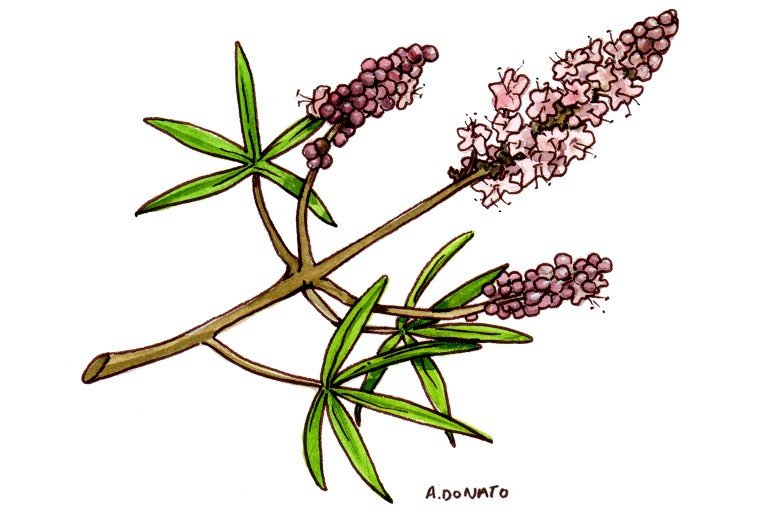
Common Names
- Chasteberry
- Vitex
- Chaste tree fruit
- Monk’s pepper
For Patients & Caregivers
Tell your healthcare providers about any dietary supplements you’re taking, such as herbs, vitamins, minerals, and natural or home remedies. This will help them manage your care and keep you safe.
What is it?
There is evidence to suggest that chasteberry helps improve premenstrual symptoms, but more studies are needed.
Chasteberry is used widely to treat infertility and premenstrual syndrome (PMS). Lab studies show chasteberry contains substances that can prompt hormonal changes in the body. Various studies in humans suggest chasteberry can help reduce breast pain and other PMS symptoms, but not menopause symptoms.
Because chasteberry has phytoestrogenic properties, patients with hormone-sensitive cancers should consult their physicians before using it.
What are the potential uses and benefits?
- To ease difficult and painful menstruation
A few studies support this use in women aged 20–40 whose ovarian function was not greatly impaired and who had no other hormone imbalances. - To prevent premenstrual symptoms
A few studies support this use in women aged 20–40 whose ovarian function was not greatly impaired and who had no other hormone imbalances. - To treat breast pain
A few clinical trials support this use for breast pain associated with menstruation. - To prevent menopausal symptoms
One study that evaluated chasteberry taken with St. John’s wort determined it did not help relieve menopausal symptoms.
What are the side effects?
Nausea, headache, GI disturbances, menstrual disorders, acne, itching, redness/rash
What else do I need to know?
Do Not Take if:
- You are taking CYP2C19 or CYP3A4 substrate drugs: Lab studies suggest chasteberry may increase the risk for side effects with these drugs. Clinical relevance has yet to be determined.
- You are taking psychiatric drugs such as chlorpromazine, haloperidol, or prochlorperazine: Lab studies suggest chasteberry may interfere with their effectiveness or enhance their side effects. Clinical relevance has yet to be determined.
- You are taking medicines for Parkinson’s disease: Chasteberry may interfere with their effectiveness or enhance their side effects.
- You are taking hormonal medications such as birth control pills: Lab studies suggest chasteberry may interfere with their effectiveness. Clinical relevance has yet to be determined.
- You are pregnant or nursing.
For Healthcare Professionals
Scientific Name
Clinical Summary
The fruit of chasteberry is widely used to relieve premenstrual symptoms and to treat infertility. It is said to have a normalizing action on the menstrual cycle and contain nonsteroidal progestins that can interact with and activate hormone receptors in the body (1).
Chasteberry has opioidergic (2), dopaminergic (3), hepatoprotective (4), and antiproliferative (5) properties in vitro. Clinical studies suggest it can reduce PMS symptoms (6) (7) (8) (22), but a systematic review highlighted the need for well-designed studies for definitive conclusions (23). Preliminary data also suggest chasteberry may help reduce mastalgia (9) (24), but in combination with St. John’s wort, it was ineffective for treating menopausal symptoms (10).
Because chasteberry has phytoestrogenic properties (11) (12) (13), patients with hormone-sensitive cancers should consult their physicians before using it.
Purported Uses and Benefits
- Dysmenorrhea
- Mastalgia
- Menopausal symptoms
Mechanism of Action
In vitro studies have identified several flavonoids in chasteberry, especially casticin, which exerts opioidergic effects through activation of mu- and delta-opioid receptor subtypes (2). Casticin reduced lung inflammation in a murine model by inhibiting numbers of neutrophils, macrophages, and lymphocytes, and by reducing levels of proinflammatory cytokines and chemokines (25).
Dopaminergic compounds, particularly clerodadienols, dose-dependently inhibited pituitary prolactin release, which could explain its effect during the premenstrual cycle when serum prolactin levels can be chronically elevated (3). Other diterpenes including rotundifuran also modulate dopamine receptors (14). Linoleic acid from chasteberry binds to estrogen receptors (ER) and can induce certain estrogen genes (12). The flavonoid apigenin was identified as the most active ER isoform-selective phytoestrogen (11), and can also induce progestogenic activity (13).
In human studies, chasteberry restores progesterone concentrations, prolongs the hyperthermic phase in the basal temperature curve, and restores the luteinizing hormone-releasing hormone test to normal. It is thought to act on the pituitary-hypothalamic axis rather than directly on ovaries (11).
Contraindications
Adverse Reactions
Herb-Drug Interactions
Antipsychotics (Phenothiazines, Dopamine D2-Antagonists): Preclinical studies suggest chasteberry may interfere with the action of these drugs or enhance their side effects (17) (20). Clinical relevance has yet to be determined.
Antiparkinson agents (Dopamine agonists): Preclinical studies suggest chasteberry may interfere with the action of these drugs or enhance their side effects (17) (20). Clinical relevance has yet to be determined.
CYP450 substrates: In vitro, chasteberry inhibits CYP2C19 and CYP3A4 and may affect drugs metabolized by these enzymes (21). Clinical relevance has yet to be determined.
Hormonal therapies: Preclinical studies suggest chasteberry may decrease the effects of hormone therapies (11) (12) (18). Clinical relevance has yet to be determined.
Oral contraceptives: Preclinical studies suggest chasteberry may decrease the effects of contraceptives (18). Clinical relevance has yet to be determined.