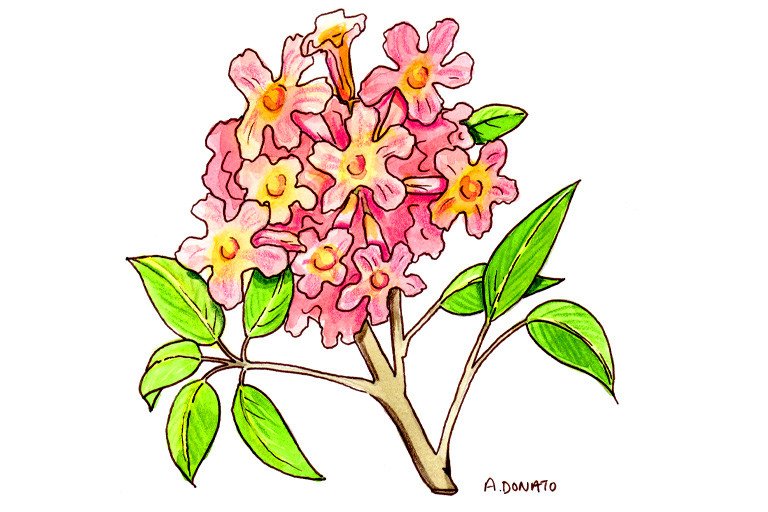
Common Names
- Ipe-Roxo
- Lapacho
- Trumpet bush
- Taheebo
For Patients & Caregivers
Tell your healthcare providers about any dietary supplements you’re taking, such as herbs, vitamins, minerals, and natural or home remedies. This will help them manage your care and keep you safe.
What is it?
Pau d'arco has antibacterial and anticancer activities in laboratory studies, but these effects have not been shown in humans.
Pau d'arco is derived from the inner bark of several species of Tabebuia trees native to South America. Also known as taheebo or lapacho, it is used as a tea in traditional medicine for a wide range of ailments. In laboratory studies, compounds extracted from pau d'arco showed antibacterial, antifungal, anti-inflammatory, antidepressant, and anticancer properties. However, data from human studies are limited. The safety and effectiveness of these compounds for treating cancer remain unclear.
What are the potential uses and benefits?
- To treat cancer
Small studies showed that a lapacho-based preparation may help prevent oral mucositis in patients with head and neck cancer undergoing radiotherapy. But lapachol, a compound present in Pau d'arco did not show clinical improvement in patients with chronic myelocytic leukemia. - To treat infections
Laboratory studies showed that pau d'arco has antibacterial and antifungal activities. It has not been tested in humans.
What are the side effects?
- Nausea, vomiting, urine discoloration.
- Animal studies reported anemia, and reproductive and chromosomal abnormalities.
What else do I need to know?
Do Not Take if:
- You are taking anticoagulants/antiplatelet drugs: Pau d’arco may increase the risk of bleeding with these drugs. Clinical relevance is not known.
For Healthcare Professionals
Scientific Name
Clinical Summary
Pau d’arco is derived from the inner bark of Tabebuia trees native to South America. Also known as taheebo or lapacho, it is used as a tea in traditional medicine for a wide range of ailments. Modern preparations in the form of oral tablets or capsules are marketed as dietary supplements to treat infections and cancer (1) (2) (3) (4).
In vitro and in vivo studies showed antibacterial (5) (6), antifungal (7), antipsoriatic (8), immunomodulatory (9) (10), anti-inflammatory (11) (12), antidepressant (13), anticoagulant (10) (14) and anticancer (1) (2) (3) (4) (15) (16) properties. Human studies are needed to validate these effects.
Preliminary findings suggest benefits of Pau d’arco in preventing oral mucositis in patients with head and neck cancer undergoing radiotherapy (26) and in reducing pain in women with primary dysmenorrhea (27) although lapachol, an active constituent, had no clinical affect in patients with chronic myelocytic leukemia (17).
Purported Uses and Benefits
- Cancer treatment
- Antibacterial
- Antifungal
Mechanism of Action
Lapachol and beta-lapachone, isolated from the inner bark of trees used to produce Pau d’arco, are thought to be the active constituents that are responsible for its pharmacological activities (20). Beta-lapachone downregulates cyclooxygenase (COX-2) and telomerase activities (1). It also induces apoptosis in cancer cells via mitochondrial signaling (2) or by activating caspases (5) (9) (2). The antimetastatic activity of beta-lapachone occurs by inducing Egr-1, known to suppress metastasis, thereby decreasing the invasive ability of cancer cells (4). A water extract of Taheebo showed anti-proliferative effects on hormone-sensitive MCF7 breast cancer cells by modulating gene expression, thereby interfering with cell cycle progression. At high doses, it also has anti-estrogenic effects through the inhibition of estrogen receptor signaling (16). A methanolic extract of taheebo inhibited cell proliferation through the extracelluar signal regulated kinase (ERK1/2) mitogen activated protein kinase (MAPK) pathway (10).
Lapachol’s anticoagulant activity is due to the inhibition of vitamin K epoxide and quinone reductases, an action similar to that of warfarin (14).
However, it is important to note that the clinical effects of Pau d’arco are difficult to predict because they are influenced by several factors including variation in plant species or plant parts, extraction methods, bioavailability of the active compounds, dosages and routes of administration.
Adverse Reactions
A clinical study reported nausea, vomiting and urine discoloration. (17)
Anemia: Animal models showed that large, chronic dosing of lapachol can cause anemia (21).
Reproductive toxicity: Short-term administration of lapachol caused significant reduction in the weight of seminal vesicle in mice (22).
Lapachol also has fetotoxic effects (23), and oral administration of lapachol caused chromosomal abnormalities in mice (24).