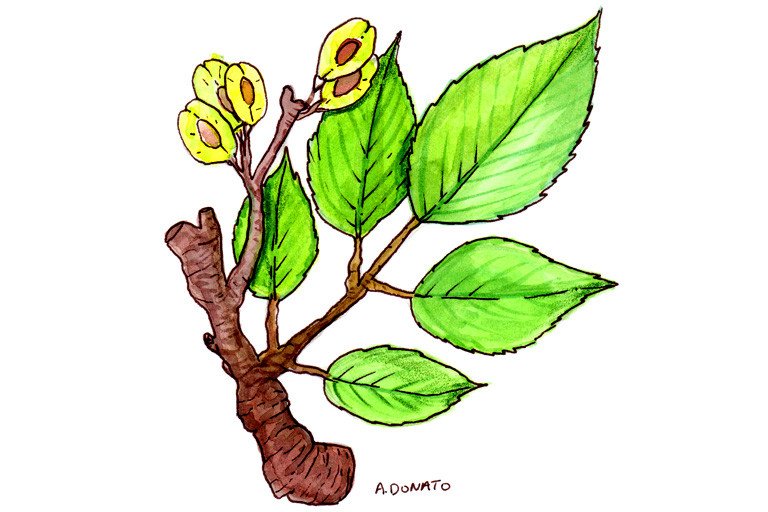
Common Names
- Indian Elm
- Red elm
- Gray elm
For Patients & Caregivers
Tell your healthcare providers about any dietary supplements you’re taking, such as herbs, vitamins, minerals, and natural or home remedies. This will help them manage your care and keep you safe.
What is it?
Slippery elm may help relieve minor cough or sore throat, but there is no evidence it can treat infections, cancer, or other serious medical conditions.
Slippery elm is a tree native to North America. Its bark is used to treat gastrointestinal disorders, sore throat, cough, and skin ulcers. A formula containing slippery elm improved bowel habits and symptoms in patients with constipation-predominant irritable bowel syndrome.
Slippery elm is one of the components in Essiac, an herbal formula used as an alternative cancer treatment.
What are the potential uses and benefits?
- To treat coughs and bronchitis
The mucilage content in slippery elm is thought to relieve coughs and throat irritation, but human data are lacking. - To treat cancer
Evidence is lacking to support this claim. - To treat diarrhea
Evidence is lacking to support this claim. - To treat irritable bowel syndrome
In a small study, a formula containing slippery elm improved bowel habits and symptoms in patients with IBS. - Topically, to treat skin sores
The mucilage content in slippery elm is thought to have a soothing effect when applied topically, but human data are lacking.
For Healthcare Professionals
Scientific Name
Clinical Summary
Slippery elm is a tree native to North America. Its bark is used to treat gastrointestinal disorders, sore throat, cough, and skin ulcers. Slippery elm is thought to have antioxidant and anti-inflammatory properties. The primary constituent mucilage has demulcent effects.
A small clinical study showed that a formulation containing slippery elm improved the bowel habits and symptoms of constipation-predominant irritable bowel syndrome (1).
Slippery elm is one of the components in Essiac, an herbal formula used as an alternative cancer treatment.
Purported Uses and Benefits
- Bronchitis
- Cancer
- Cough
- Diarrhea
- Fever
- Inflammation
- Ulcers
- Skin sores
- Sore throat
Mechanism of Action
Mucilage in slippery elm is responsible for its demulcent, emollient, and antitussive properties. Insoluble polysaccharides in mucilage (hexose, pentose, methylpentose) form a viscous material following oral administration or when prepared for topical use. The fiber content is thought to reduce gastrointestinal transit time, act as a bulk forming laxative, and adsorb toxins. Mucosal biopsies from patients with active ulcerative colitis incubated with slippery elm showed a dose-dependent reduction in oxygen free radicals (4). Another in vitro study also showed antioxidant scavenging activity (5). The tannin component can act as an astringent (2). Fatty acid esters such as oleic and palmitic acid may have antitumor activity (3), but specific mechanisms remain unclear.