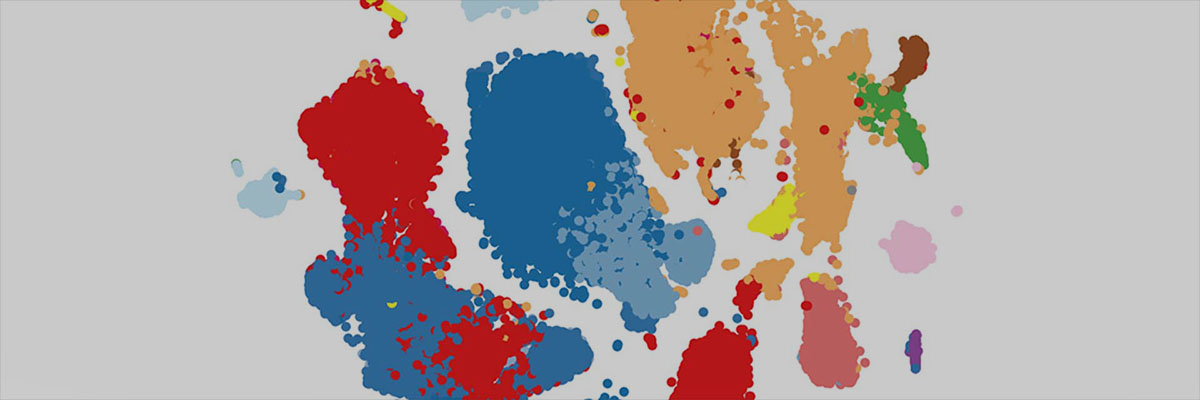

Scientists in the Computational & Systems Biology Program at SKI combine findings in biology with computer algorithms and databases to conduct biological research. Work in so-called “dry” laboratories, consisting of powerful computers running sophisticated software, complements and strengthens traditional laboratory and clinical research. The aim is to build computer models that simulate biological processes from the molecular level up to the organism as a whole and to use these models to make useful predictions.
Scientists in the program are leaders in bringing the enormous power of single cell sequencing to an array of challenging problems in contemporary biomedicine. They use their mathematical expertise to help interpret the massive amounts of data that are emerging from genomic techniques.
Our Faculty
-
Dana Pe'er, PhD
Chair, Computational & Systems Biology Program
Computational biologist Dana Pe’er combines single-cell and spatial profiling technologies with machine learning approaches to address fundamental questions in gene regulation, cellular plasticity and cell-cell communication in the contexts of cancer, immunity and development. -
Colin Begg, PhD
Biostatistician Colin Begg has research interests spanning cancer epidemiology and statistical methods that are applicable to clinical research more broadly. -
John Chodera, PhD
Computational chemist John Chodera uses statistical mechanics, molecular modeling, and automated biophysical experiments to help identify new potential therapeutics and investigate mechanisms of drug resistance in cancer. -
Kushal Dey, PhD
The Kushal Dey lab focuses on developing machine learning models and computational pipelines that integrate genomic and epigenomic data. -
Caleb Lareau, PhD
The Lareau Lab synthesizes computational and experimental genomics methods to study how immune cells in our bodies adapt, expand, differentiate, and evolve over an individual’s lifetime.
-
Christina Leslie, PhD
Computational biologist Christina Leslie focuses on developing machine learning algorithms for computational and systems biology. -
Quaid Morris, PhD
Computational biologist Quaid Morris uses artificial intelligence techniques and develops machine learning algorithms to study gene regulation, cancer evolution, clinical informatics, and other topics in systems biology. -
Thomas Norman, PhD
Systems biologist Thomas Norman develops new computational and functional genomics approaches for studying how genes interact to realize complex phenotypes. -
Joao Xavier, PhD
Systems biologist Joao Xavier combines experimental and computational approaches to study diverse problems relevant to cancer: how the microbiome influences cancer and cancer treatment, how cancer cells metastasize, and how metabolic fluxes command the behavior of living cells.
Resources & Collaborations
SKI offers a wide array of core facilities and other technologies, as well as significant opportunity for collaboration. Members of the Computational & Systems Biology Program derive particular benefit from close ties to the following:


