Liver Cancer: Treatment

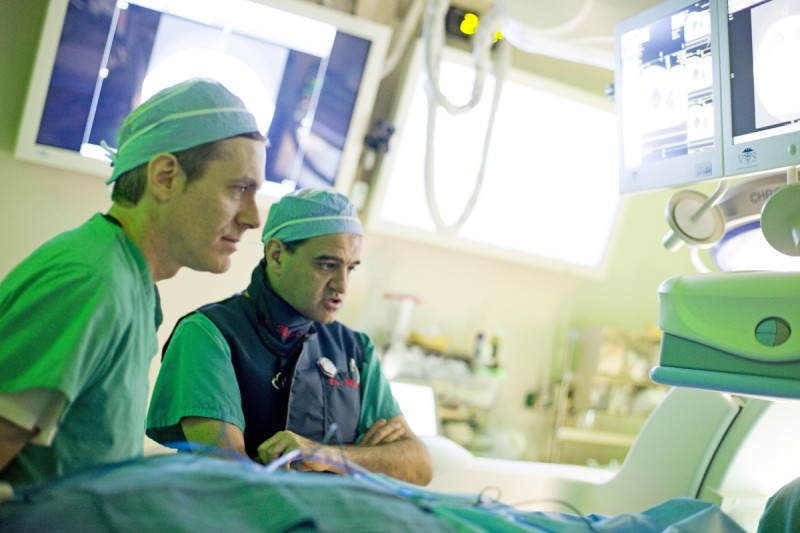
Pictured: Stephen Solomon & Majid Maybody Interventional radiologists Stephen Solomon (left) and Majid Maybody use CT, ultrasound, and MRI to guide minimally invasive procedures for removing liver tumors.

Several treatment options are available for patients with liver cancer, depending upon which organ is involved, how extensive the tumor is, and the patient's general health. Liver cancer is classified as one of the following types:

  • A tumor that is found in one area and can be removed.
  • A tumor that is found in one area but cannot be totally removed safely.
  • Cancer has spread throughout the liver and/or to other parts of the body.
  • Cancer has reoccurred in the liver or in another part of the body after initial treatment.
  • Extensive liver cirrhosis or liver failure prevents surgical treatment of the tumor.

Depending on the stage of the disease and other factors, such as the extent of cirrhosis and liver failure, the patient's treatment team will determine the most appropriate therapy, including surgery, minimally invasive therapies, chemotherapy and/or biologic therapy, and radiation therapy.

Surgery

Surgery to remove liver tumors is the gold standard in treating primary liver cancer. Liver surgery is a complicated procedure because many of the major blood vessels running to and from the heart pass behind or through the liver, essentially connecting these organs. In addition, the liver can tear easily and will bleed profusely when injured. Our surgeons have refined surgical techniques that significantly reduce blood loss and the need for transfusions.(1)

The liver is one of two organs in the human body that has the capacity to regenerate. Up to 80 percent of the liver can be surgically removed and, within several weeks, it will entirely rebuild itself. If one lobe — and its associated blood vessels — is surgically removed, the remaining lobe will compensate for the loss. Our surgeons routinely use a new technique called preoperative portal vein embolization, which redirects the blood supply to the healthy portion of the liver to stimulate cell growth before surgery. Our doctors also use liver-sparing surgical techniques that leave more of the healthy liver intact, reducing the need for regeneration and the possibility of complications.

Liver Transplant

Patients with liver tumors that are small in size and number, have not spread to nearby blood vessels, and who have cirrhosis or other liver conditions may be eligible for liver transplantation at another medical center. Our liver cancer team can identify which patients may benefit from transplantation and routinely coordinates liver transplantation at other area hospitals.

Minimally Invasive Therapies

Memorial Sloan-Kettering's liver cancer team offers a variety of minimally invasive therapies, including laparoscopic surgery and procedures that use imaging techniques such as CT and ultrasound to guide the delivery of treatments directly to the tumor site. These therapies are safe and effective in controlling liver cancer and extending survival. Many of these procedures may be used alone, with other minimally invasive therapies, or prior to surgery.

Minimally Invasive Surgery

When possible, our surgeons may use minimally invasive laparoscopic surgery to remove liver tumors. In this procedure, doctors insert a thin, lighted tube with a camera on its tip through a tiny incision in the patient's abdomen to remove tumors or, in selected cases, part of the liver. Our surgeons continue to evaluate the effectiveness of this approach in selected patients and its potential to reduce complications that can arise with traditional, open surgery.(2) Having minimally invasive surgery can significantly reduce patient recovery time compared with traditional surgery.

Embolization & Ablation Techniques

Many patients are not eligible for surgical removal (resection) of primary liver tumors because their cancer is too advanced. Others cannot have surgery because they have an underlying liver disease such as cirrhosis. In some cases, tumors may be so small that nonsurgical treatments may be equally effective.

Our team performs minimally invasive therapies that use imaging techniques such as CT, ultrasound, or MRI to guide the delivery of treatments directly to the tumor site. These therapies may be used alone, with other minimally invasive therapies, prior to surgery, or in combination with chemotherapy. In most cases, these procedures are performed on an outpatient basis or with a short hospital stay.

Thermal Ablation

Thermal ablation involves destroying tumors with heat or cold. Using image guidance, this therapy is delivered through a probe that is inserted directly into the tumor without a large incision. There are several types of thermal ablation, including radiofrequency ablation, which uses radio waves to superheat the tumor, and cryoablation, which freezes the tumor. Other types of thermal ablation use lasers, microwaves, and focused ultrasound waves to kill tumor cells. These therapies can be delivered through a laparoscope or more rarely, during open surgical procedures.

The selection of heat or cold depends on the size, location, and shape of the tumor that is targeted. Thermal ablation is typically indicated for patients with up to three liver tumors.

Embolization

The hepatic artery is the main source of blood for most liver tumors. Embolization involves injecting tiny particles through a small tube, or catheter, threaded into the hepatic artery. The particles block the flow of blood to the tumor, depriving it of the nutrients and oxygen it needs to survive. Embolization also can be used to deliver particles that are laced with chemotherapy drugs, such as doxorubicin.

Chemical Ablation

Another, less commonly used form of ablation involves the injection of cancer-killing chemicals such as pure alcohol (ethanol) or acid directly into the tumor. As with thermal ablation, chemical ablation may be recommended for patients with up to three liver tumors. Chemical ablation is selected only for patients who are not candidates for thermal ablation.

Chemotherapy, Biologic Therapy & Investigational Approaches

Even after successful surgery or other localized treatments, liver cancer can spread, or metastasize, to another part of the body. Additional (adjuvant) treatment with chemotherapy drugs has not been shown to improve overall survival for patients with liver cancer. However, many medical oncologists believe that chemotherapy or biologic therapy can play an important role in treating primary liver cancer.

In some cases, chemotherapy is given before surgery (neoadjuvant therapy) to shrink liver tumors. Doxorubicin is the most commonly used chemotherapy for primary liver cancer. Studies suggest that response rates to this treatment vary widely. Used alone or in combination with cisplatin, 5-fluorouracil and interferon (a combination known as PIAF), is a chemotherapeutic approach that has improved survival for some patients.

General side effects, such as fatigue, nausea, and diarrhea, can be expected from any chemotherapy drug or combination of drugs, but side effects vary from patient to patient. Talk to your doctor about possible side effects before starting a chemotherapy treatment regimen.

Chemotherapy with Hepatic Arterial Infusion (HAI)

HAI chemotherapy is a relatively new technique that delivers a high dose of chemotherapy drugs to the hepatic artery — the main source of blood and nutrients for liver tumors — through a tiny pump implanted under the skin in the lower abdomen. Additional chemotherapy medicine is injected into the pump, as needed, on an outpatient basis. Like systemic chemotherapy, HAI therapy may be used to shrink tumors before surgery, or given after surgery to prevent their recurrence.

HAI chemotherapy, in combination with systemic chemotherapy or alone, has been shown to dramatically increase survival for patients with colon cancer that has metastasized to the liver.(3),(4),(5),(6) New evidence suggests that HAI chemotherapy alone can extend survival in patients with primary liver cancer, as well.(7) In addition, because HAI chemotherapy is delivered regionally, it causes fewer toxic side effects and has been associated with better physical functioning than systemic chemotherapy.(8)

Biologic Therapy

Biologic therapy refers to a host of new drugs that stop tumor cells from replicating and/or disrupt a tumor's blood supply. Sorafenib (Nexavar) is a new biologic therapy that was recently approved by the US Food and Drug Administration for the treatment of patients with primary liver cancer who are not eligible for surgery.

Our doctors have also evaluated and helped define the use of sorafenib in patients with different liver function conditions.(9) Biologic therapies like sorafenib have side effects which are not as intense or debilitating as old chemotherapy regimens. Most side effects are manageable or preventable through close follow-up and adjustments of dosage.

Investigational Approaches

At Memorial Sloan-Kettering, our investigators are constantly evaluating new chemotherapy combinations and novel medications that may improve the standard of care for patients with liver cancer. One upcoming study will compare outcomes in patients treated with a combination of the biologic therapy sorafenib and doxorubicin, a traditional chemotherapy drug. In addition, our researchers are evaluating several novel compounds that inhibit different proteins involved in tumor cell replication or interfere with tumor blood supply. These investigational therapies are sometimes offered to eligible patients through the clinical trial process.

One upcoming study will compare outcomes in patients treated with a combination of two biologic therapies: sorafenib plus AMG386, another tumor blood starving biologics that works differently. Plans for a study combining a novel biologic called GC33 plus sorafenib and sorafenib plus doxorubicin (a traditional chemotherapy drug) are underway.

Radiation Therapy

Radiation therapy is another, less commonly used treatment option for patients whose liver tumors cannot be surgically removed. Radiation may be administered alone or in combination with chemotherapy or other treatments.

Video

Radiation oncologist Josh Yamada talks about a technique called IGRT that delivers high doses of radiation precisely along the contours of a tumor.

(3:00)

Image-guided radiation therapy (IGRT) and respiratory gating are two approaches that have the potential to reduce toxicity (damage) to normal tissue during radiation therapy for liver cancer.

Image-Guided Radiation Therapy (IGRT)

IGRT targets tumors with greater precision than conventional radiation therapy. Using highly sophisticated computer software and 3-D images from CT scans, the radiation oncologist can develop an individualized treatment plan that delivers high doses of radiation to cancerous tissue while sparing surrounding organs and reducing the risk of injury to healthy tissue.

Respiratory Gating

Because tumors and organs in the abdomen shift during breathing, precise delivery of radiation therapy to cancerous tissue can be difficult. Respiratory gating is the delivery of radiation only at certain points during a patient's breathing cycle, when the “mobile” tumors and/or regions of the abdomen are in a specific position. This approach decreases the radiation dose to the surrounding healthy tissue.

  1. W.R. Jarnigan, M. Gronen, Y. Fong, R.P. DeMatteo, L. Ben-Porat, S. Little, C. Corvera, S. Weber, L.H. Blumgart, Improvement in perioperative outcome after hepatic resection: analysis of 1,803 consecutive cases over the past decade, Annals of Surgery 236(4) 2002:397-406.
  2. K. Ito, C. Are, P.J. Allen, Y. Fong, R.P. DeMatteo, W.R. Jarnagin, M.I. D'Angelica, Laparoscopic versus open liver resection: a matched-pair case control study, Journal of Gastrointestinal Surgery 2009.
  3. N.E. Kemeny, D. Niedzwiecki, D.R. Hollis, H.J. Lenz, R.S. Warren, M.J. Naughton, J.C. Weeks, E.R. Sigurdson, J.E. Herndon 2nd, C. Zhang, and R.J. Mayer, Hepatic arterial infusion versus systemic therapy for hepatic metastases from colorectal cancer: a randomized trial of efficacy, quality of life, and molecular markers (CALGB 9481), Journal of Clinical Oncology, 24(9) 2006:1395-403.
  4. N. Kemeny, Y. Huang, A.M. Cohen, W. Shi, J.A. Conti, M.E. Brennan, J.R. Bertino, A.D. Turnbull, D. Sullivan, J. Stockman, L.H. Blumgart, and Y. Fong, Hepatic arterial infusion of chemotherapy after resection of hepatic metastases from colorectal cancer, New England Journal of Medicine, 341(27)1999:2039-48.)
  5. N. Kemeny, M. Capanu, M. D'Angelica, W. Jarniga, D. Haviland, R. DeMatteo, Y. Fong, Phase I trial of adjuvant hepatic arterial infusion (HAI) with floxuridine (FUDR) and dexamethasone plus systemic oxaliplatin, 5-fluorouracil and leucovorin in patients with resected liver metastases from colorectal cancer, Annals of Oncology 20(7) 2009:1236-41.
  6. N. Kemeny and M. Gonen, Hepatic arterial infusion after liver resection. New England Journal of Medicine 3522005:734-5.
  7. W.R. Jarnigan, L.H. Schwartz, D.H. Gultekin, M. Gonen, D. Haviland, J. Shia, M. D'Angelica, Y. Fong, A. Tse, L.H. Blumgart, and N. Kemeny, Regional chemotherapy for unresectable primary liver cancer: results of a phase II clinical trial and assessment of DCE-MRI as a biomarker of survival, Annals of Oncology 20(9) 2009:1589-95.
  8. D.G. Power, B.R. Healey-Bird, and N.E. Kemeny, Regional chemotherapy for liver-limited metastatic colorectal cancer, Clinical Colorectal Cancer 7(4)2008:247-59.
  9. Abou-Alfa GK, Zhao B, Capanu M, Guo P, Liu F, Jacobs G, Gansukh B, Moscovici M, Lentini G, Schwartz L. Tumor Necrosis as a Correlate for Response in Subgroup of Patients with Advanced Hepatocellular Carcinoma (HCC) Treated with Sorafenib. ESMO 2008, Stockholm, Sweden.