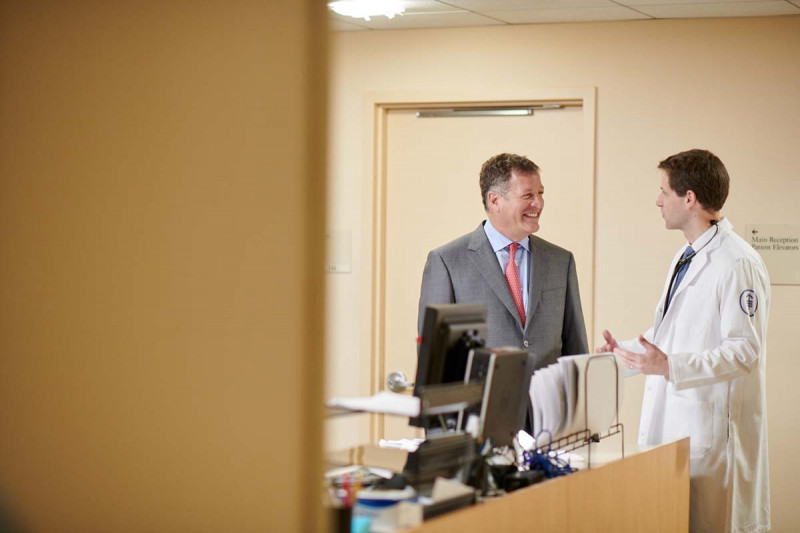
Melanoma and Sarcoma Service Chief Gary Schwartz meets with a patient. Increased understanding of tumor sensitivity and the development of new targeted agents have led to advances in treating sarcomas.
Memorial Sloan-Kettering's multidisciplinary team of specialists has surgically treated more than 8,000 patients with soft tissue sarcoma in the past two decades, and has seen almost twice that number in consultation.
As the understanding of soft tissue sarcoma has improved, doctors have learned that different sarcoma subtypes have varying growth patterns, as well as differing risks for spread. While surgery continues to be the primary form of treatment for this disease, pathologists now are better able to classify which tumors will be more sensitive to chemotherapy and radiation therapy. In addition, for some patients, we use a computerized nomogram, a prognostic tool that gives physicians the ability to decide which treatment approach will yield the most beneficial results.
Surgery remains the primary form of treatment for soft tissue sarcoma. The goal of surgery is to remove the tumor and at least one to 2 centimeters of the surrounding tissue. While amputation of an arm or leg was once a standard treatment for soft tissue sarcomas found in the limbs, today amputations are performed in only about 5 percent of cases nationwide.
In addition, new reconstructive techniques that permit the repair of nerves and blood vessels and the transfer of muscle and soft tissue have allowed extensive operations to be performed with the knowledge that function can be preserved. These techniques, which have developed over the last three decades, include the use of nerve grafts to restore function and avoid amputation.
Treatment approaches pioneered at Memorial Sloan-Kettering place an emphasis on more conservative operations, combined with radiation therapy or chemotherapy (and sometimes both), which offer patients a high rate of tumor control without the need for amputation.
For retroperitoneal sarcomas, such as liposarcoma and leiomyosarcoma, where the location of the tumor (the abdominal cavity) accommodates significant growth without causing specific symptoms, detection usually occurs at a late stage, when the sarcoma is usually large and has grown near major abdominal structures and organs. These tumors are treated with surgery. It is important that the surgeon remove the entire tumor and any surrounding organs or tissues that have been affected in order to reduce the risk of recurrence.
Although small sarcomas can be treated with surgery alone, the majority of sarcomas are greater than five centimeters in size and, thus, are managed by a combination of surgery and radiation therapy. Radiation therapy may be used before, during, or after surgery.
When used in combination with surgery, radiation therapy may reduce the chance of recurrence. Alternately, radiation may be used before surgery to shrink the tumor and thereby increase the space between the tumor and vital structures and organs, helping to improve the chance that the surgeon will remove all of the tumor cells. Radiation sterilizes tumor cells, damaging their DNA so they are no longer able to divide and multiply. This treatment can neutralize tumor cells beyond the reach of surgery.
In comparison to other tumors, soft tissue sarcoma requires that a larger margin of normal tissue be subjected to radiation. This is because sarcoma can spread along and between muscles in ways that sometimes cannot be detected. Microscopically, sarcoma cells are discrete, but they can trickle out deceptively and be left behind after surgery. The further away from the tumor site, however, the less likely there are to be sarcoma cells. Radiation oncologists typically deliver radiation to tissue five centimeters (approximately two inches) beyond where the tumor was located.
In external-beam radiation therapy, doses of radiation are delivered to the tumor area from outside the body. This approach is most useful when it is not feasible to leave catheters in place, as for tumors located in the retroperitoneum (the tissue that lines the abdominal wall and covers most of the organs in the abdomen) and the chest. Therapy with external-beam radiation therapy typically takes place over the course of seven to eight weeks, with the patient coming in five days a week for treatments that are several minutes long.
Intensity-modulated radiation therapy (IMRT) is a sophisticated computer-guided technique that allows for safe delivery of much higher doses of radiation to the tumor than traditional radiation therapy while sparing the normal surrounding tissues. IMRT has become the standard radiation therapy used to treat soft tissue sarcoma because it reduces the risk of exposing bones to radiation, thereby reducing the risk of fracture after treatment.
IMRT can be used to treat most soft tissue sarcomas in the body, but it is best reserved for cases in which protection of important organs from radiation exposure is particularly important. Another added benefit of IMRT is its improved distribution of radiation throughout a large treatment area, which can be effective for treating tumors located in the thigh or retroperitoneal sarcomas.
A recent publication demonstrated the efficacy of IMRT in terms of local tumor control of soft tissue sarcomas in the extremities with a low risk of complications. The study, conducted by Memorial Sloan-Kettering investigators, found that using IMRT for the treatment of soft tissue sarcomas located in the arms or legs provides excellent tumor control. This suggests that the precision with which IMRT distributes the radiation dose has a beneficiary effect in sparing normal tissue and improving tumor response.
Today, using a form of IMRT known as image-guided radiation therapy (IGRT), radiation oncologists are able to verify the exact location of a soft tissue sarcoma tumor prior to the delivery of radiotherapy or even during a treatment. This technique can help reduce the margin of healthy tissue exposed to radiation to five millimeters and, in certain cases, to as little as one or two millimeters. Because some soft tissue sarcoma tumors are located very close to the spine or major blood vessels, targeted therapy can provide substantial benefit in these cases.
Pioneered by Memorial Sloan-Kettering doctors for the treatment of sarcoma, brachytherapy involves delivering radiation therapy locally. It can be administered in one of two different ways to treat soft tissue sarcoma.
In one approach, which takes place during surgery, after the surgeon has removed the tumor, special tubes called catheters are inserted into the tumor bed. Once the surgical wound has healed (usually five to six days), the radiation oncologist inserts radioactive seeds into each of the catheters, which deliver a high dose of radiotherapy to the site.
When the treatment is complete (usually about five days after the radioactive seeds have been inserted), both the seeds and the catheters are removed. The entire course of treatment lasts from ten to 14 days. In certain situations, this form of brachytherapy may be administered for two to three days, combined with external radiation for five weeks.
A second form of brachytherapy, called high-dose-rate intraoperative radiation therapy, is delivered entirely during surgery. After the surgeon removes the tumor, applicators are placed against the tumor bed. The applicators are attached to a radiotherapy machine that is programmed to send a high dose of radiotherapy directly to the site.
For some types of sarcoma, such as rhabdomyosarcoma, patients will first receive chemotherapy to shrink the tumor, followed by surgery to remove the tumor and adjuvant (postsurgical) chemotherapy to kill any remaining cancer cells. This multimodality approach to treatment has improved the five-year survival rate significantly for certain types of sarcoma.
Unlike surgery and radiation therapy, which are directed toward specific areas of the body, chemotherapy travels through the bloodstream to all areas and systems of the body. For that reason, chemotherapy is called systemic treatment.
Today, doctors often give chemotherapy before surgery to patients with large, fast-growing sarcomas, a form of treatment which is called “neoadjuvant chemotherapy” or “preoperative chemotherapy.” In addition to destroying microscopic areas of metastasis (if they exist), this approach often reduces the size of the primary sarcoma. This may permit the surgeon to perform a less radical operation, and may save some patients from an amputation. Preoperative chemotherapy may also contribute to better chances of survival. The involvement of a coordinated team of doctors and nurses is critical to the success of this strategy.
Doxorubicin and ifosfamide are the chemotherapy drugs most commonly used in the treatment of sarcoma patients. For certain patients, chemotherapy that includes both doxorubicin and ifosfamide almost doubles the likelihood of shrinking a sarcoma, compared with older treatments. The nausea that has accompanied treatment with doxorubicin can now be managed for 90 percent of patients through the use of one or more antinausea drugs. These recently developed drugs have proven so effective in controlling nausea that patients often can receive chemotherapy for soft tissue sarcoma in an outpatient setting.
The location in the body in which a sarcoma arises is called the primary site. Surgical removal of a primary sarcoma, sometimes followed by radiation therapy, will cure many patients. In some cases, however, sarcoma spreads through the bloodstream to distant sites such as the lungs or liver. The process of spread is called metastasis, and the tumors that result from the spread of the cancer are called metastases. Today, more than 80 percent of all soft tissue sarcomas are diagnosed before they have metastasized.
When a patient is at risk for metastatic disease due to his or her tumor type, chemotherapy may be given either before (neoadjuvant) or after (adjuvant) surgery.
Some sarcoma patients may have microscopic metastases (micrometastases) that cannot be detected, even with modern imaging techniques. However, doctors are able to estimate the chance that a tumor has spread based on the size of a sarcoma and on its appearance under the microscope. Chemotherapy given after surgical removal of the primary tumor may be able to eradicate micrometastases, but the evidence for this is controversial and usually needs to be examined on a case-by-case basis.
At Memorial Sloan-Kettering, treatment for local recurrence of soft tissue sarcoma is individualized based on several factors. First, a physician performs an “extent of disease workup” to determine the precise stage of the recurring sarcoma. The workup may include x-rays of the area of local recurrence and chest x-rays, as well as CT and MRI scans.
Patients with an isolated local recurrence typically have a second operation (called re-resection). The majority of these patients who undergo re-resection demonstrate long-term survival. Many patients with local recurrence also receive adjuvant (additional) radiation therapy with surgery. The approach to radiotherapy will depend on the type of treatments administered previously and may include brachytherapy or external-beam radiation.
Even after a local recurrence, amputation is usually not necessary to treat sarcoma of the extremities. Although local recurrence can be a frightening event, most are treatable.
Doctors hope to develop vaccines and immunotherapies (treatments that use the body's own defenses to combat cancer), as well as strategies that block specific proteins (drugs that block the development of blood vessels, thus starving the tumor) to treat soft tissue sarcomas. Early-stage clinical trials testing these concepts are in progress.
Therapies investigating the use of high-dose radiation therapy, such as IMRT, are being studied for the treatment of some recurrent retroperitoneal sarcomas, such as liposarcoma and leiomyosarcoma.
For patients with leiomyosarcoma, our doctors are assessing a combination of drugs — gemcitabine, docetaxel, and doxorubicin — given after surgery, to see if such treatment reduces the chance of the cancer coming back.
Our investigators are evaluating a treatment that includes seven chemotherapy drugs plus radiation therapy and/or surgery for rhabdomyosarcoma. Five of the drugs have been helpful in many patients with rhabdomyosarcoma. Three drugs are given at higher doses than those used at most other hospitals. The study also uses two new drugs — irinotecan plus carboplatin — given in combination. Both of these drugs have been used in children and adults with different cancer types.
We are investigating a number of new agents, and combinations of standard agents and new drugs, to try and find more effective treatments once sarcomas have recurred.