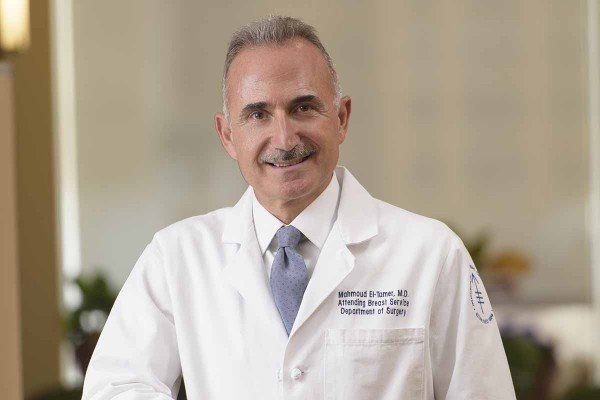
Mahmoud B. El-Tamer, MD
We post reviews for MSK healthcare providers who have at least 30 patient experience surveys completed. If you do not see reviews for a provider, it may be because they do not yet have enough survey responses, or the provider may not be part of the group of healthcare providers included in the survey.
Only outpatient providers are included in the survey. Healthcare providers who only work in the hospital or in urgent care are not included in the survey. Pathologists or researchers who do not provide direct care to patients do not have reviews.
Areas of Expertise
Conditions I Treat
- Breast cancers and conditions
- Male breast cancer
My Specialties
- Oncoplastic surgery
- Breast-conserving surgery (BCS)
- Breast reconstruction
Get to Know Me
I am a surgeon who has been caring for people with breast cancer for more than 30 years. I have expertise performing oncoplastic procedures (surgeries in which I remove the cancerous tissue and reconstruct the breast). My goal is to offer patients the most-effective procedures while maintaining and even enhancing their physical appearance. I care for more than 350 people with breast cancer each year.
When people with cancer first come to see me, they often have many concerns about their options, recovery, and the final result of their procedure: Will I survive? What shall I do? How will I look? Will I be able to get back to my normal daily life? I explain each surgery in detail and help guide them in choosing the option that is best for them. At the end of each appointment, my goal is that the people I care for feel reassured that they will receive the best care possible.
I study different aspects of breast cancer and ways to improve the quality of surgical care. I am currently working with several other cancer centers around the country on a clinical trial (the IDEA Trial). This study is exploring the possibility of no longer using radiation therapy for people with breast cancer that is at low risk of spreading to other parts of the body and who have had breast preservation surgery (lumpectomy). If we can treat them without the possible side effects of radiation, they can have a better quality of life after breast cancer surgery.
I am also looking at using smaller, less-invasive procedures for people whose breast cancer responds very well to chemotherapy.
I have been the principal or co-principal investigator on studies funded by the Avon Foundation for Women, the US Department of Veterans Affairs, and the American College of Surgeons.
I have written or co-authored more than 120 book chapters, manuscripts, and editorials on breast cancer. I have also published two textbooks to help other breast surgeons improve the cosmetic outcome of breast cancer surgeries. I organize, run, and contribute to national and international workshops to teach surgeons how to achieve the best cosmetic results following breast cancer surgery. In addition, I serve on the editorial boards of several leading medical journals.
I am also an active member of many leading professional societies, including the American College of Surgeons, the Society of Surgical Oncology, the American Society of Breast Surgeons, and the American Society of Clinical Oncology.
I'm a breast surgeon, which is a doctor with special training in breast surgery.
- Attending Surgeon
Conditions I Treat
- Breast cancers and conditions
- Male breast cancer
My Specialties
- Oncoplastic surgery
- Breast-conserving surgery (BCS)
- Breast reconstruction
- Clinical trials
Education
- MD, American University of Beirut
Residencies
- General Surgery - American University of Beirut Medical Center
- Surgery - SUNY Health Sciences Center at Brooklyn
Fellowships
- Surgical Oncology and Reconstruction - Memorial Sloan Kettering Cancer Center
Board Certifications
- Surgery
Awards and Honors
- Castle Connolly: America’s Top Doctor (2026)
- Castle Connolly: America’s Top Doctor (2025)
- Castle Connolly: America’s Top Doctor (2024)
- Top Doctors New York Metro Area, Castle Connolly (2023)
- Castle Connolly: America's Top Doctors (2023)
Insurance Information
Understanding your insurance options is an important part of managing your cancer care. We have relationships with many common healthcare providers and plans.
In Network Coverage Type
HMO, EPO PPO, POS, Transplant
In Network Coverage Type
PPO
In Network Coverage Type
PPO, POS, EPO, HMO
In Network Coverage Type
HMO
This plan is in-network at our New York sites only.
In Network Coverage Type
HMO, PPO
In Network Coverage Type
HMO, EPO PPO, POS
In Network Coverage Type
Supplemental
In Network Coverage Type
PPO, POS, HMO
In Network Coverage Type
POS, HMO
In Network Coverage Type
PPO, POS, EPO, HMO
Offers a qualified health plan from the Health Insurance Marketplace. Call Emblem to learn more.
In Network Coverage Type
HMO
This plan is in-network at our New York sites only.
In Network Coverage Type
PPO, HMO
In Network Coverage Type
HMO
This plan is in-network at our New York sites only.
In Network Coverage Type
PPO
This is a dual payer plan, which means 2 health insurance companies share this plan. MSK providers are out-of-network with UnitedHealthcare.
In Network Coverage Type
HMO, EPO
Offers a qualified health plan from the Health Insurance Marketplace. Call Fidelis to learn more.
In Network Coverage Type
HMO
This plan is in-network at our New York sites only.
In Network Coverage Type
HMO
In Network Coverage Type
PPO
In Network Coverage Type
EPO, HMO, PPO, POS
Offers a qualified health plan from the Health Insurance Marketplace. Call Healthfirst to learn more.
In Network Coverage Type
HMO
This plan is in-network at our New York sites only.
In Network Coverage Type
HMO, PPO
In Network Coverage Type
PPO EPO
In Network Coverage Type
HMO
Your plan may not cover visits to our New York sites. Please call the number on the back of your insurance card to see what your health plan covers.
In Network Coverage Type
PPO
Your plan may not cover visits to our New York sites. Please call the number on the back of your insurance card to see what your health plan covers.
In Network Coverage Type
EPO
Your plan may not cover visits to our New York sites. Please call the number on the back of your insurance card to see what your health plan covers.
In Network Coverage Type
EPO
Your plan may not cover visits to our New York sites. Please call the number on the back of your insurance card to see what your health plan covers.
In Network Coverage Type
PPO, HMO
Your plan may not cover visits to our New York sites. Please call the number on the back of your insurance card to see what your health plan covers.
In Network Coverage Type
State Government
This plan is in-network at our New York sites only.
In Network Coverage Type
PPO, POS, EPO
In Network Coverage Type
Federal Government
In Network Coverage Type
HMO (City Employee Health Plans Gold and Gold Care Only)
In Network Coverage Type
Supplemental
In Network Coverage Type
PPO/OAP
In Network Coverage Type
PPO, POS, EPO, HMO
In Network Coverage Type
TBD
In Network Coverage Type
PPO, EPO
In Network Coverage Type
PPO, POS, HMO
In Network Coverage Type
State Government
This plan is in-network at our New York sites only.
In Network Coverage Type
PPO, HMO
In Network Coverage Type
PPO, POS
In Network Coverage Type
PPO, POS, HMO
In Network Coverage Type
State Government
Don't see your carrier or plan? We can help you understand your coverage.
If you don't have health insurance or are worried that your care may not be fully covered, our financial assistance programs may be able to help.
If you have questions about insurance, call us at 646-497-9176.
Make an Appointment

Contact and Location
Looking to see a doctor at a different location? See all MSK locations.
Colleagues
Doctors at Memorial Sloan Kettering work as teams, with specialists from all different areas. I work closely with nurse practitioner Jessica Moloney. We combine our expertise to provide comprehensive care to our patients at every step of their cancer journey.
Clinical Trials

Memorial Sloan Kettering's doctors and scientists are constantly developing new treatments for cancer. MSK is typically running hundreds of clinical trials at a given time.
You may be able to participate in a clinical trial even if you are new to MSK. Search our online directory to find trial information and see more about who can participate.
Search clinical trialsResearch and Publications
Books
Principles and Techniques in Oncoplastic Breast Cancer Surgery. El-Tamer M, ed. Singapore: World Scientific Press; 2013.
Oncoplastic and Reconstructive Breast Surgery. CICERO URBAN, MARIO RIETJENS MAHMOUD EL-TAMER
VIRGILIO SACCHINI editors Springer International Publishing AG, part of Springer Nature; 2019
Book Chapters
- El-Tamer, M. Resection of the tumor. In: Principles and Techniques in Oncoplastic Breast Cancer Surgery. El-Tamer M, ed. Singapore: World Scientific Press, 2013
- Weber W, El-Tamer, M. Skin-sparing mastectomy. In: Principles and Techniques in Oncoplastic Breast Cancer Surgery. El-Tamer M, ed. Singapore: World Scientific Press, 2013
- El-Tamer, M. Mastopexy. In: Principles and Techniques in Oncoplastic Breast Cancer Surgery. El-Tamer M, ed. Singapore: World Scientific Press, 2013
- Huston TL, Rohde CH, El-Tamer M, Ascherman J. Oncoplastic breast reduction. In: Principles and Techniques in Oncoplastic Breast Cancer Surgery. El-Tamer M, ed. Singapore: World Scientific Press, 2013
- El-Tamer M. Repair of breast defects. In: Principles and Techniques in Oncoplastic Breast Cancer Surgery. El-Tamer M, ed. Singapore: World Scientific Press, 2013
- El-Tamer, M. Resection of the tumor. In: Principles and Techniques in Oncoplastic Breast Cancer Surgery. El-Tamer M, ed. Singapore: World Scientific Press, 2013
- El-Tamer M. Skin incisions. In: Principles and Techniques in Oncoplastic Breast Cancer Surgery. El-Tamer M, ed. Singapore: World Scientific Press, 2013
- Kirstein L, Boolbol SK, El-Tamer M. Neoadjuvant therapy. In: Principles and Techniques in Oncoplastic Breast Cancer Surgery. El-Tamer M, ed. Singapore: World Scientific Press, 2013
- El-Tamer M, Mitchell S. Surgical anatomy of the breast. In: Principles and Techniques in Oncoplastic Breast Cancer Surgery. El-Tamer M, ed. Singapore: World Scientific Press, 2013
- Ponamgi S, El-Tamer M. Surgical landmarks and measurements. In: Principles and Techniques in Oncoplastic Breast Cancer Surgery. El-Tamer M, ed. Singapore: World Scientific Press, 2013
- El-Tamer M, ed. Principles and Techniques in Oncoplastic Breast Cancer Surgery. Singapore: World Scientific Press, 2013
- Oncologic Safety of Oncoplastic Surgery. Urban C, Rietjens M, El-Tamer M, Sacchini V, eds. New York: Springer. 2019
- El-Tamer M, Urban C, Rietjens M, Kuroda F, Hurley J. Oncoplastic and Reconstructive Anatomy of the Breast. In: Urban C, Rietjens M, El-Tamer M, Sacchini V, eds. Oncologic Safety of Oncoplastic Surgery. New York: Springer. 2019
- Walsh, SM, El-Tamer M. Glandular Displacement Techniques. In: Urban C, Rietjens M, El-Tamer M, Sacchini V, eds. Oncologic Safety of Oncoplastic Surgery. New York: Springer. 2019
- El-Tamer M. Dome Mastopexy. In: Urban C, Rietjens M, El-Tamer M, Sacchini V, eds. Oncologic Safety of Oncoplastic Surgery. New York: Springer. 2019
- Moo TA, Ho A, El-Tamer M. Postmastectomy Radiation. In: Urban C, Rietjens M, El-Tamer M, Sacchini V, eds. Oncologic Safety of Oncoplastic Surgery. New York: Springer. 2019
- Walsh, SM, El-Tamer M. Oncologic Safety of Oncoplastic Surgery. In: Urban C, Rietjens M, El-Tamer M, Sacchini V, eds. Oncologic Safety of Oncoplastic Surgery. New York: Springer. 2019
Visit PubMed for a full listing of Dr. El-Tamer’s journal articles. Pubmed is an online index of research papers and other articles from the US National Library of Medicine and the National Institutes of Health.
See all on PubMedPatient Reviews
Your trust is our main concern
We strive to keep reviews trustworthy, honest and fair. Learn more about our patient experience reviews.
Disclosures
Members of the MSK Community often work with pharmaceutical, device, biotechnology, and life sciences companies, and other organizations outside of MSK, to find safe and effective cancer treatments, to improve patient care, and to educate the health care community. These activities outside of MSK further our mission, provide productive collaborations, and promote the practical application of scientific discoveries.
MSK requires doctors, faculty members, and leaders to report (“disclose”) the relationships and financial interests they have with external entities. As a commitment to transparency with our community, we make that information available to the public. Not all disclosed interests and relationships present conflicts of interest. MSK reviews all disclosed interests and relationships to assess whether a conflict of interest exists and whether formal COI management is needed.
Mahmoud B. El-Tamer discloses the following relationships and financial interests:
No disclosures meeting criteria for time period
If you’re a patient at MSK and would like more information about your doctor’s external relationships, please talk with your doctor.
The information published here is a complement to other publicly reported data and is for a specific annual disclosure period. There may be differences between information on this and other public sites as a result of different reporting periods and/or the various ways relationships and financial interests are categorized by organizations that publish such data.
This page and data include information for a specific MSK annual disclosure period (January 1, 2024 through disclosure submission in spring 2025). This data reflects interests that may or may not still exist. This data is updated annually.
Learn more about MSK’s COI policies here. For questions regarding MSK’s COI-related policies and procedures, email MSK’s Compliance Office at [email protected].


