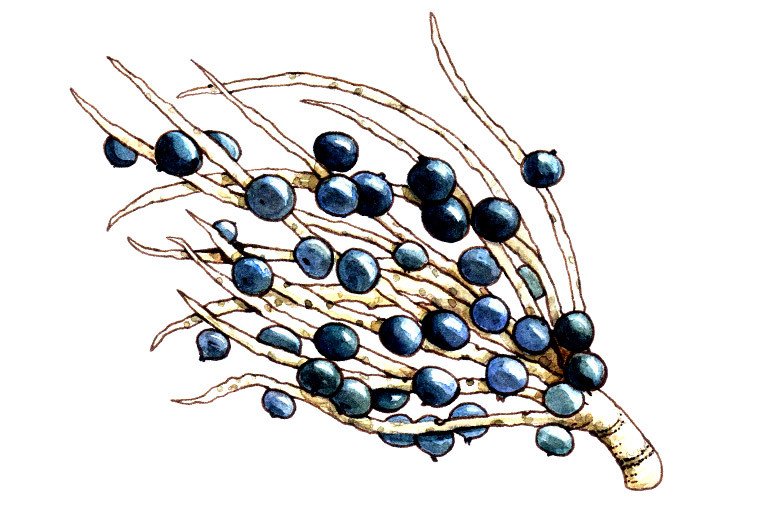
Common Names
- Acai berry
- Acai palm
- Cabbage palm
- Palm berry
For Patients & Caregivers
Tell your healthcare providers about any dietary supplements you’re taking, such as herbs, vitamins, minerals, and natural or home remedies. This will help them manage your care and keep you safe.
Acai has antioxidant effects, but it has not been shown to treat or prevent cancer.
Acai is the fruit of a palm mainly found in South America. The berries and seeds contain compounds called flavonoids that have antioxidant effects. Some laboratory studies suggest acai may reduce cholesterol, prevent diseases of the heart and blood vessels, and cause programmed cell death in leukemia cells. However, human studies are needed to confirm these effects.
Consumption of contaminated acai fruit with insects carrying Trypanosoma cruzii, a protozoan that causes Chagas disease, resulted in 178 cases of acute disease.
-
To prevent cancer
Preclinical studies suggest that flavonoids present in acai fruit have antioxidant properties. However, there are no human studies to suggest that acai can help prevent cancer. -
To prevent heart disease and stroke
In vitro studies show that acai fruit may be useful, but human data are lacking.
Patient Warnings:
Drinking unprocessed acai juice should be avoided, as it has been linked to an illness called Chagas disease.
Special Point:
Theoretically, acai may interfere with the actions of certain chemotherapy drugs due to its antioxidant effects.
For Healthcare Professionals
Acai is the fruit of a palm tree native to South America. It is consumed as food and used in traditional medicine. The pulp and skin of acai fruit are rich in anthocyanins, proanthocyanidins, and fatty acids (1). It is marketed as a dietary supplement to lower cholesterol, support heart health, and for its antioxidant properties.
Preclinical experiments suggest acai has anti-inflammatory (11), antioxidant (10), proapoptotic (2) (17), antitumorigenic (18), atheroprotective (13), and anticancer (21) effects. An acai extract inhibited beta-amyloid aggregation, which suggests it may also have neuroprotective activity (19). In a murine model, nasal administration of acai polysaccharides potentiated innate immunity against pulmonary infections (16). Other animal studies suggest oral acai extract may help prevent exercise intolerance, cardiac hypertrophy, and dysfunction in rats with myocardial infarction (20).
Limited clinical studies suggest improvements in biomarkers of inflammation and oxidative stress in individuals with metabolic syndrome (22), tinnitus (26) and vascular function in overweight adults (23) (27). Other preliminary data suggest an acai juice product may lengthen prostate specific antigen PSA doubling time in patients with recurrent prostate cancer (24). However, these observations need confirmation in larger well-designed studies (28).
Acai protected against chemo-induced cardiotoxicity in murine models (29). But because of its antioxidant effects, acai may interfere with the actions of certain chemotherapy drugs. Consumption of contaminated acai fruit with insects carrying Trypanosoma cruzii, a protozoan that causes Chagas disease, resulted in 178 cases of acute disease (12).
- Cancer
- Heart disease
- Stroke
Antioxidant properties of acai (5) (6) have been related to scavenging reactive oxygen species (7). It also protected human vascular endothelial cells against oxidative stress and inflammation, downregulated IL-6 and -8 expression at mRNA and protein levels, and inhibited gene expression of adhesion molecules and NF-κB activation (14). Anti-inflammatory effects may occur via NO or COX inhibition (5) (8). In a diabetic murine model, an acai seed extract protected against hepatic steatosis by reducing hepatic lipogenesis and increasing antioxidant defense and cholesterol excretion (25).
Apoptosis in HL-60 leukemia cells with acai may occur through caspase 3 activation (2). Cytotoxic effects on various malignant cell lines were attributed to increased expression of LC3BII, a protein marker of auto-phagosome formation (18).
Drinking unprocessed acai juice should be avoided, as it has been linked to outbreaks of Chagas disease (12).
- Theoretically, acai may interfere with the actions of certain chemotherapy drugs due to its antioxidant effects.
- Atorvastatin: Concurrent use of acai decreased the Cmax of Atorvastatin in a murine model. Clinical relevance is not known (30).
- Alogliptin: Simultaneous use of acai elevated the Cmax of Alogliptin in a murine model. Clinical relevance has yet to be determined (30).
- Empagliflozin: Concurrent use of acai increased the Cmax in a murine model. Clinical relevance is not known (30).