Health Care Professional Information
Common Name
False banana, pawpaw apple, custard banana, poor man’s banana, Hoosier banana.
Clinical Summary
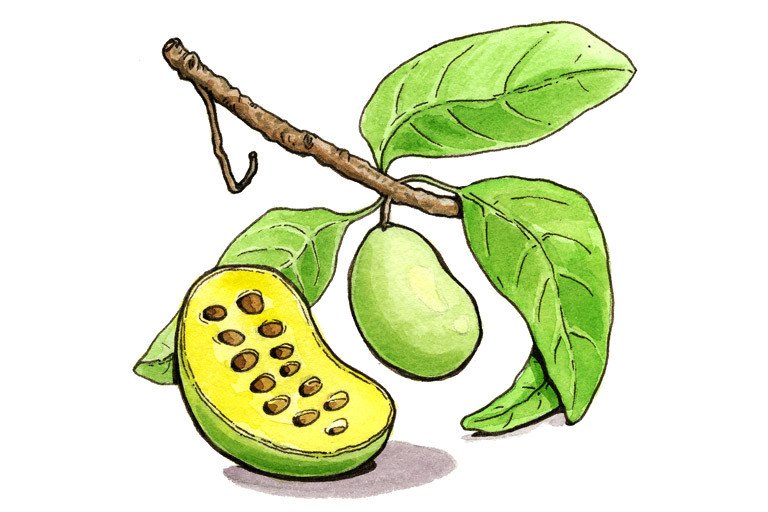
Asimina triloba, commonly known as Pawpaw, is native to North America and has edible bean shaped fruits. In vitro studies showed that Pawpaw extract has cytotoxic properties against cancer cell lines including those resistant to Adriamycin (1)and antiangiogenic properties (9). Compounds known as acetogenins are thought to be the active constituents (2). However, clinical studies are lacking.
Extracts of twigs and leaves have been used in anti-lice shampoos (3) and as pesticides (4).
Annonacin, a major constituent of Pawpaw, and the crude fruit extract have been shown to cause neurotoxicity in vitro (10).
Asimina triloba should not be confused with graviola, also known as Brazilian Paw paw, or with papaya, another fruit with a similar texture and appearance.
Purported Uses
- Lice removal
- Pesticides
- Cancer treatment
Constituents
- Acetogenins: cis- and trans-annonacin-A-one, cis- and trans-gigantetrocinone and cis-isoannonacin, trans-isoannonacin, squamolone, asimicin, bullatacin, and bullatalicin, Asitrilobins C and D
- Lipids
(2) (11) (12) (13)
Mechanism of Action
Acetogenins inhibit Complex I of the electron transport chain and NADH oxidase, a protein in the plasma membrane (1). With the decrease in regenerable NAD, the ATP levels drop, leading to subsequent cell death by apoptosis. In vivo experiments have demonstrated Pawpaw's cytotoxicity in mice (5). Pawpaw extract is also cytotoxic to Multi-Drug Resistant cells in vitro (1). This is thought to occur via acetogenin's inhibition of the 170 kDa plasma membrane glycoprotein (the P-170 glycoprotein), an efflux pump used by cells resistant to drugs like Adriamycin (1). Annonacin, a major ingredient of Pawpaw fruit, and the crude fruit extract were shown to be toxic to cortical neurons (10).
Warnings
Pawpaw is not regulated by the Federal Drug Administration (FDA) and may not be adequately tested for safety.
Literature Summary and Critique
Unpublished case studies indicate reports of improvement by cancer patients after consuming pawpaw extract (8). These studies were conducted without proper experimental controls and statistical analyses.
There are several Web sites that promote pawpaw as an effective treatment for cancer. However, there is very little scientific evidence to support such claims.
Dosage (Inside MSKCC Only)
This field is only visible to only Inside MSKCC users.
References
- Oberlies NH, Croy VL, Harrison ML, McLaughlin JL. The Annonaceous acetogenin bullatacin is cytotoxic against multidrug-resistant human mammary adenocarcinoma cells.Cancer Lett. May 1 1997;115(1):73-79.
- Zhao GX, Rieser MJ, Hui YH, et al. Biologically active acetogenins from stem bark of Asimina triloba. Phytochemistry. Jul 1993;33(5):1065-1073.
- McCage CM, Ward SM, Paling CA, et al. Development of a paw paw herbal shampoo for the removal of head lice. Phytomedicine. Dec 2002;9(8):743-748.
- Ratnayake S, Rupprecht JK, Potter WM, McLaughlin JL. Evaluation of various parts of the paw paw tree, Asimina triloba (Annonaceae), as commercial sources of the pesticidal annonaceous acetogenins.J Econ Entomol. Dec 1992;85(6):2353-2356.
- Ahammadsahib KI, Hollingworth RM, McGovren JP, Hui YH, McLaughlin JL.Mode of action of bullatacin: a potent antitumor and pesticidal annonaceous acetogenin. Life Sci. 1993;53(14):1113-1120.
- Layne DR. Pawpaw. http://www.hort.purdue.edu/newcrop/cropfactsheets/pawpaw.html. Accessed June 19, 2012.
- Avalos J, Rupprecht JK, McLaughlin JL, Rodriguez E. Guinea pig maximization test of the bark extract from pawpaw, Asimina triloba (Annonaceae). Contact Dermatitis. Jul 1993;29(1):33-35.
- McLaughlin J L, Benson GB, Forsythe JW. A novel mechanism for the control of clinical cancer: Inhibition of the production of adenosine triphosphate (ATO) with a standardized extract of paw paw (Asiminoz triloba, Annonaceae). http://www.pawpawresearch.com/pawpaw-trials1.pdf. Accessed June 19, 2012.
- Coothankandaswamy V, Liu Y, Mao SC, et al. The alternative medicine pawpaw and its acetogenin constituents suppress tumor angiogenesis via the HIF-1/VEGF pathway. J Nat Prod. 2010 May 28;73(5):956-61.
- Potts LF, Luzzio FA, Smith SC, et al. Annonacin in Asimina triloba fruit: implication for neurotoxicity. Neurotoxicology. 2012 Jan;33(1):53-8.
- Pomper KW, Lowe JD, Crabtree SB, Keller W. Identification of annonaceous acetogenins in the ripe fruit of the North American pawpaw ( Asimina triloba ). J Agric Food Chem. 2009 Sep 23;57(18):8339-43.
- Wood R, Peterson S. Lipids of the pawpaw fruit: Asimina triloba. Lipids.1999 Oct;34(10):1099-106.
- Woo MH, Kim DH, McLaughlin JL. Asitrilobins A and B: cytotoxic mono-THF annonaceous acetogenins from the seeds of Asimina triloba. Phytochemistry. 1999 Mar;50(6):1033-40.
Consumer Information
How It Works
Bottom Line: Pawpaw is toxic to some cancer cells, but such effects have not been shown in humans.
The major components of Pawpaw are compounds known as acetogenins. They prevent the cell from making ATP, an important energy source. In lab studies, the extract was shown to kill cancer cells that were resistant to commonly used chemotherapy drugs such as Adriamycin, and appear to be more toxic to cancer cells than to normal cells. However, this has not been shown in humans. The plant extract is used in anti-lice shampoo and in pesticides.
Purported Uses
- Anti-lice treatment
Pawpaw extract has been shown to be effective as an anti-lice shampoo.
- Anti-parasitic treatment
Studies have not evaluated Pawpaw's ability to kill parasites. There is laboratory-based evidence that attribute this ability to other closely related plants.
- Cancer treatment
Pawpaw has been shown to be effective against cancer cells in test tubes, but experiments in mice produced conflicting results. There are no published clinical studies in humans to determine the safety of Pawpaw for cancer treatment.
Research Evidence
Pawpaw has not been studied in well designed clinical trials.
Patient Warnings
Pawpaw is toxic to cells in test tubes and lab mice. Since there are no clear guidelines for dosage in human trials, this extract is not recommended. Pawpaw pills are not regulated by the Federal Drug Administration (FDA). They may contain too little or too much of the active substance and may not have been adequately tested for safety.
Side Effects
- Allergic reactions
- Nerve toxicity
- Reported: Emesis
Special Point
There are several Web sites that promote pawpaw as an effective treatment for cancer. However, there is very little scientific evidence to support such claims.
Last updated: June 19, 2012
administration (ad-MIH-nih-STRAY-shun)
In medicine, the act of giving a treatment, such as a drug, to a patient. It can also refer to the way it is given, the dose, or how often it is given.
Source: The National Cancer Institute's Dictionary of Cancer Terms
(http://www.cancer.gov/dictionary)
Adriamycin
An anticancer drug that belongs to the family of drugs called antitumor antibiotics. It is an anthracycline. Also called doxorubicin.
Source: The National Cancer Institute's Dictionary of Cancer Terms
(http://www.cancer.gov/dictionary)
antiangiogenic (AN-tee-AN-jee-oh-JEH-nik)
Having to do with reducing the growth of new blood vessels.
Source: The National Cancer Institute's Dictionary of Cancer Terms
(http://www.cancer.gov/dictionary)
apoptosis (A-pop-TOH-sis)
A type of cell death in which a series of molecular steps in a cell leads to its death. This is the body’s normal way of getting rid of unneeded or abnormal cells. The process of apoptosis may be blocked in cancer cells. Also called programmed cell death.
Source: The National Cancer Institute's Dictionary of Cancer Terms
(http://www.cancer.gov/dictionary)
ATP
A substance present in all living cells that provides energy for many metabolic processes and is involved in making RNA. ATP made in the laboratory is being studied in patients with advanced solid tumors to see if it can decrease weight loss and improve muscle strength. Also called adenosine triphosphate.
Source: The National Cancer Institute's Dictionary of Cancer Terms
(http://www.cancer.gov/dictionary)
cancer (KAN-ser)
A term for diseases in which abnormal cells divide without control and can invade nearby tissues. Cancer cells can also spread to other parts of the body through the blood and lymph systems. There are several main types of cancer. Carcinoma is a cancer that begins in the skin or in tissues that line or cover internal organs. Sarcoma is a cancer that begins in bone, cartilage, fat, muscle, blood vessels, or other connective or supportive tissue. Leukemia is a cancer that starts in blood-forming tissue such as the bone marrow, and causes large numbers of abnormal blood cells to be produced and enter the blood. Lymphoma and multiple myeloma are cancers that begin in the cells of the immune system. Central nervous system cancers are cancers that begin in the tissues of the brain and spinal cord. Also called malignancy.
Source: The National Cancer Institute's Dictionary of Cancer Terms
(http://www.cancer.gov/dictionary)
cell (sel)
The individual unit that makes up the tissues of the body. All living things are made up of one or more cells.
Source: The National Cancer Institute's Dictionary of Cancer Terms
(http://www.cancer.gov/dictionary)
chemotherapy (KEE-moh-THAYR-uh-pee)
Treatment with drugs that kill cancer cells.
Source: The National Cancer Institute's Dictionary of Cancer Terms
(http://www.cancer.gov/dictionary)
clinical (KLIH-nih-kul)
Having to do with the examination and treatment of patients.
Source: The National Cancer Institute's Dictionary of Cancer Terms
(http://www.cancer.gov/dictionary)
cytotoxic (SY-toh-TOK-sik)
Cell-killing.
Source: The National Cancer Institute's Dictionary of Cancer Terms
(http://www.cancer.gov/dictionary)
drug (drug)
Any substance, other than food, that is used to prevent, diagnose, treat or relieve symptoms of a disease or abnormal condition. Also refers to a substance that alters mood or body function, or that can be habit-forming or addictive, especially a narcotic.
Source: The National Cancer Institute's Dictionary of Cancer Terms
(http://www.cancer.gov/dictionary)
emesis (EH-meh-sis)
Vomiting.
Source: The National Cancer Institute's Dictionary of Cancer Terms
(http://www.cancer.gov/dictionary)
experimental (ek-SPAYR-ih-men-tul)
In clinical trials, refers to a drug (including a new drug, dose, combination, or route of administration) or procedure that has undergone basic laboratory testing and received approval from the U.S. Food and Drug Administration (FDA) to be tested in human subjects. A drug or procedure may be approved by the FDA for use in one disease or condition, but be considered experimental in other diseases or conditions. Also called investigational.
Source: The National Cancer Institute's Dictionary of Cancer Terms
(http://www.cancer.gov/dictionary)
extract (EK-strakt)
In medicine, a preparation of a substance obtained from plants, animals, or bacteria and used as a drug or in drugs.
Source: The National Cancer Institute's Dictionary of Cancer Terms
(http://www.cancer.gov/dictionary)
glycoprotein (gly-koh-PROH-teen)
A protein that has sugar molecules attached to it.
Source: The National Cancer Institute's Dictionary of Cancer Terms
(http://www.cancer.gov/dictionary)
in vitro (in VEE-troh)
In the laboratory (outside the body). The opposite of in vivo (in the body).
Source: The National Cancer Institute's Dictionary of Cancer Terms
(http://www.cancer.gov/dictionary)
in vivo (in VEE-voh)
In the body. The opposite of in vitro (outside the body or in the laboratory).
Source: The National Cancer Institute's Dictionary of Cancer Terms
(http://www.cancer.gov/dictionary)
membrane (MEM-brayn)
A very thin layer of tissue that covers a surface.
Source: The National Cancer Institute's Dictionary of Cancer Terms
(http://www.cancer.gov/dictionary)
nerve (nerv)
A bundle of fibers that receives and sends messages between the body and the brain. The messages are sent by chemical and electrical changes in the cells that make up the nerves.
Source: The National Cancer Institute's Dictionary of Cancer Terms
(http://www.cancer.gov/dictionary)
neurotoxicity (NOOR-oh-tok-SIH-sih-tee)
The tendency of some treatments to cause damage to the nervous system.
Source: The National Cancer Institute's Dictionary of Cancer Terms
(http://www.cancer.gov/dictionary)
plasma (PLAZ-muh)
The clear, yellowish, fluid part of the blood that carries the blood cells. The proteins that form blood clots are in plasma.
Source: The National Cancer Institute's Dictionary of Cancer Terms
(http://www.cancer.gov/dictionary)
pump (pump)
A device that is used to give a controlled amount of a liquid at a specific rate. For example, pumps are used to give drugs (such as chemotherapy or pain medicine) or nutrients.
Source: The National Cancer Institute's Dictionary of Cancer Terms
(http://www.cancer.gov/dictionary)
toxic (TOK-sik)
Having to do with poison or something harmful to the body. Toxic substances usually cause unwanted side effects.
Source: The National Cancer Institute's Dictionary of Cancer Terms
(http://www.cancer.gov/dictionary)