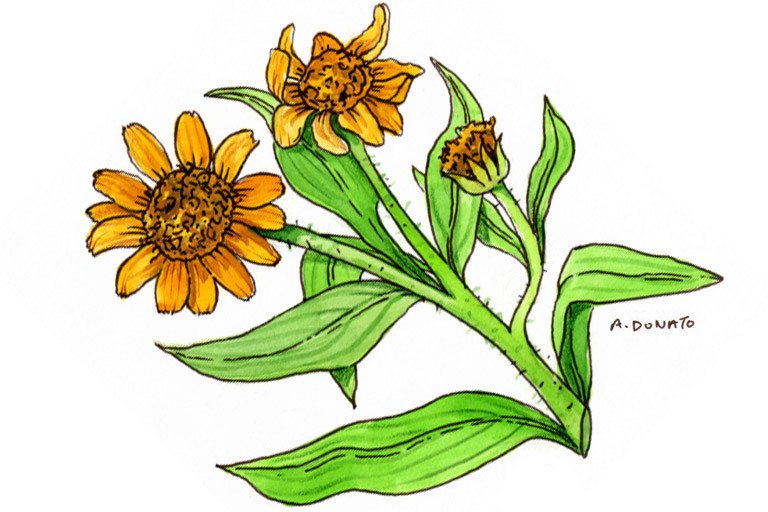
Common Names
- Mountain tobacco
- Leopard's bane
- Wolf's bane
- Mountain arnica
For Patients & Caregivers
Tell your healthcare providers about any dietary supplements you’re taking, such as herbs, vitamins, minerals, and natural or home remedies. This will help them manage your care and keep you safe.
Arnica is a plant in the sunflower family. Its flowers and roots are used to treat many health issues. Arnica comes as tablets, gels, ointments, and creams.
Arnica is used to:
- Reduce swelling
- Treat bruises (discoloration of skin due to injury)
- Treat sprains (torn or stretched ligament). Ligaments connect bone to bone and hold your joints in place.
- Reduce muscle pain
- Treat osteoarthritis. Osteoarthritis is a disease in which the cartilage (protective tissue at the ends of bones) of your joint wears down. This can lead to pain and swelling.
Arnica also has other uses that haven’t been studied by doctors to see if they work.
Talk with your healthcare provider before taking arnica supplements. They may affect how your other medications work. For more information, read the “What else do I need to know?” section below.
- Using arnica on your skin can cause irritation and swelling.
- Talk with your healthcare provider if you’re taking blood thinners such as warfarin (Coumadin®, Jantoven®). Arnica may increase your risk of bleeding.
- Do not take arnica or use it on your skin if you’re allergic to sunflowers, marigolds, ragweed, or other plants from the sunflower family.
For Healthcare Professionals
Arnica is a perennial herb found in East Asia, Europe, the northern United States, and Canada. Its medicinal history dates back several centuries and arnica continues to be popular today. Its flowers and roots have been used to treat bruises, sprains, arthritic pain, and muscle aches. A highly diluted form of arnica is also used in homeopathic remedies.
In vitro studies show that arnica has antimicrobial (1) and anti-inflammatory (2) properties. A few clinical trials suggest that topical arnica is helpful for osteoarthritis (3) (4) (5), and significantly reduces bruising compared with placebo or low-concentration vitamin K ointments (6). However, a small study reported that topical arnica actually increased pain 24 hours after calf exercises (7).
Studies on postoperative benefits from use of arnica are mixed. It reduced swelling in patients following knee surgery (9), reduced pain following tonsillectomy (10), and may reduce bruising from rhinoplasty (20) (21), but was not helpful after blepharoplasty (22). A recent meta-analysis of homeopathic arnica for postoperative recovery suggests a small effect size for preventing excess bruising and related sequelae (24).
Rigorous research is needed to determine the clinical benefits of homeopathic arnica.
- Inflammation
- Bruises
- Sprains
- Muscle pain
- Osteoarthritis
Sesquiterpene lactones, the active constituents in arnica, have anti-inflammatory properties and inhibit binding of transcription factors AP-1 and NF-κB to DNA (14). A tincture prepared from arnica flowers suppressed collagenase-1 (MMP1) and interstitial collagenase-13 (MMP13) mRNA levels in human articular chondrocytes in vitro (14). MMP13 and MMP1 enzymes are thought to play a significant role in cartilage and joint destruction and inflammation seen in osteoarthritis and rheumatoid arthritis. Both arnica tinctures and sesquiterpene lactones were found to suppress NF-κB activation and IL-12 production in dendritic cells at high concentrations, but can also have immunostimulatory effects when diluted (2). Another study found that sesquiterpene lactones inhibit platelet function by interacting with platelet sulfhydryl groups, probably associated with reduced phospholipase A2 activity (12). In addition to sesquiterpene lactones, the allergenic potential of arnica may be partly due to other allergens such as polyacetylenes (15).
Pregnant and nursing women: Ingestion of arnica tea by a nursing mother caused serious side effects in a newborn (17).
Allergies to sunflowers, marigolds, or ragweed: Individuals with allergies to members of the Asteracea family may likely be allergic to arnica.
Case reports
Oral, raw herb: Gastrointestinal distress, internal bleeding, tachycardia, dyspnea, and coma (11).
Oral, homeopathic overdose: Severe vomiting followed by acute, bilateral vision loss after accidental overdose (18).
Oral, infant exposure through breast-milk: Hemolytic anemia in a 9-day-old breastfed infant 48 hours after his mother began drinking an arnica flower tea (17).
Topical: Contact dermatitis (8) (23).