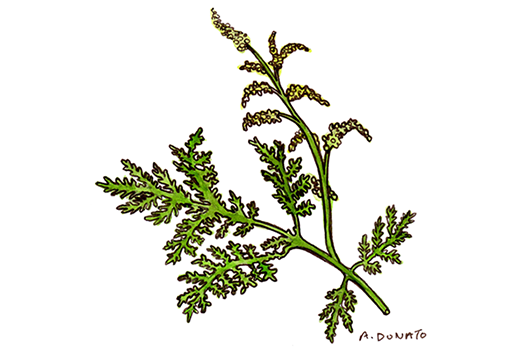
Common Names
- Qing Hao
- Sweet sagewort
- Sweet wormwood
- Annual wormwood
For Patients & Caregivers
Tell your healthcare providers about any dietary supplements you’re taking, such as herbs, vitamins, minerals, and natural or home remedies. This will help them manage your care and keep you safe.
Artemisia annua is an herb used in traditional Chinese medicine. It also comes as capsules, teas, powders, and extracts.
Artemisia is used to:
- Treat malaria
- Reduce fever
- Reduce swelling
Artemisia has other uses, but doctors haven’t studied them to see if they work.
It’s generally safe to use artemisia in tea. Talk with your healthcare providers before taking artemisia supplements. Herbal supplements are stronger than the herbs you’d use in cooking. They can also interact with some medications and affect how they work. For more information, read the “What else do I need to know?” section below.
Side effects of artemisia supplements may include:
- Dizziness
- Hearing problems
- Don’t take artemisia if you have ulcers or stomach disorders. It may not be safe for you.
For Healthcare Professionals
Commonly known as wormwood or sweet sagewort, Artemisia annua has been used in traditional Chinese medicine for fevers, inflammation, headaches, bleeding, and malaria. In vitro studies indicate that artemisinin, the active principle of A. annua, may be effective for protozoal infections including leishmaniasis (8), Chagas’ disease, and African sleeping sickness (9). Cytotoxic effects of A. annua compounds have also been evaluated in tumor cell lines (1) (18) (19) (20) (25) (26).
Artemisinin-based combination therapies are part of the standard treatment arsenal for malaria. Systematic reviews suggest it is as effective as quinine (4) (5), but increased risk of relapse may limit its uses (6) (7). It is also unclear whether it is effective against quinine-resistant malaria strains. Other reports of artemisinin-based therapy resistance are also emerging, prompting additional drug development (28).
Studies of artemisia for other conditions are limited. In one RCT, a low-dose artemisia formulation produced clinically relevant pain reductions in patients with hip or knee osteoarthritis (3). A subsesquent open-label continuation study demonstrated long-term safety with improvements maintained at 6 months (10). Artemisia improved symptoms in patients with seasonal allergic rhinitis (34) and seasonal allergic rhinoconjunctivitis (36) (37) but did not produce any clinical benefits in patients receiving highly active antiretroviral therapy (35). A few safety studies in advanced cancer patients suggest oral add-on artesunate, a semisynthetic artemisinin derivative, is well tolerated, although monitoring for ototoxicity is needed (13) (21) (38). In other studies, oral or intravenous artesunate did not produce a response (29) (30), although modest clinical activity was observed with intravenous administration (30). More studies are needed to determine the conditions under which compounds derived from artemisia may be safe and effective.
- Malaria
- Fever
- Inflammation
Artemisinin, the active constituent of A. annua, exerts antimalarial effects by free radicals formed via cleavage of the endoperoxide bond in its structure, which are responsible for eradicating the Plasmodium species (23).
Artemisinin induces apoptosis and cell cycle arrest of Leishmani donovani promastigotes (8). It has antiproliferative effects on medullary thyroid carcinoma cells (2), and induces apoptosis in a lung cancer cell line by modulating p38 and calcium signaling (14). In another study, it significantly inhibited cell growth and proliferation, and caused G1 cell-cycle arrest in neuroblastoma cell lines (25). Dihydroartemisinin, a semi-synthetic derivative of artemisinin, demonstrates anti-inflammatory activity by attenuating COX-2 production via downregulation of serine/threonine kinase and MAPK pathways (24). Recent findings suggest that dihydroartemisinin-triggered apoptosis in colorectal cells occurs through the ROS-mediated mitochondria-dependent pathway (26).
Patients with ulcers or GI disorders should not take artemisia (11).
Case reports
- Hepatitis: In a 52-year-old man following consumption of an herbal supplement containing artemisinin (17).
- Acute cholestatic hepatitis: In a patient due to ingestion of artemisia tea as prophylaxis against malaria (31).
- Delayed hemolytic anemia: Two cases after either oral or intravenous therapy with artemisinin-based treatment for malaria (32) (33). It is thought this reaction may be related to higher parasite loads (32).
- Ototoxicity and vertigo: Possibly related to oral artesunate, an active artemisia compound, among several advanced breast cancer patients in a safety trial (13) (21). The study drug was otherwise largely well tolerated among patients.
- Dermatitis: With topical use of artemisia (11).
- CYP450 substrates: In laboratory studies, artemisia extracts induced CYP2B6 and CYP3A4 (27) and may affect the serum concentration of drugs metabolized by these enzymes. Clinical relevance has yet to be determined.