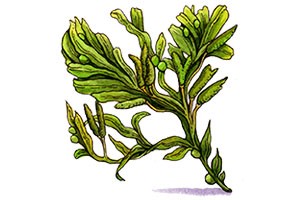
Common Names
- Sea kelp
- Brown kelp seaweed
- Sea wrack
- Marine oak
For Patients & Caregivers
Tell your healthcare providers about any dietary supplements you’re taking, such as herbs, vitamins, minerals, and natural or home remedies. This will help them manage your care and keep you safe.
Claims of benefit with use of bladder wrack have not been confirmed in clinical studies.
Bladder wrack extract is rich in iodine. Although it is claimed to stimulate thyroid activity to treat obesity, there is no evidence to support this, and data in humans are quite limited.
In one small study, women who took bladder wrack showed improvement in their menstrual symptoms. Other small studies showed only marginal impacts on metabolic and inflammatory responses and that it was no more effective than placebo for osteoarthritis. Topical application of a bladder wrack extract suggest benefits for skin, but further studies are needed to confirm any of these effects.
Bladder wrack is often referred to as brown kelp but it should not be confused with "kelp," which is another species of seaweed.
- Weight loss
Evidence is lacking to support this claim. - Skin care
A small study suggest topical bladder wrack extract may improve skin elasticity. - Underactive thyroid
Bladder wrack is rich in iodine and has been used as a supplement for patients with hypothyroidism caused by iodine deficiency. However, this has not been studied in clinical trials and the dosage used is unclear. - Fatigue
Evidence is lacking to support this claim. - Menstrual abnormalities
In a small study, women who took bladder wrack reported improvement in menstrual symptoms.
Case report
- Consumption of a slimming product containing 20 different herbs including bladder wrack resulted in bladder inflammation in a 33-year-old woman.
Patient Warnings:
Consumption of bladder wrack harvested from polluted waters may cause kidney toxicity due to the presence of heavy metals such as arsenic, cadmium, and mercury.
Do Not Take if:
- If you are taking CYP450 substrates: Bladder wrack may affect cellular concentrations of drugs metabolized by these enzymes. Clinical relevance is not known.
- If you are taking amiodarone: In an animal study, bladder wrack decreased bioavailability of this drug, which is used to treat irregular heartbeat. Clinical relevance is not known.
For Healthcare Professionals
Bladder wrack is a seaweed prevalent on the Atlantic and Pacific coasts from Europe to Asia. It is often referred to as brown kelp but it should not be confused with “kelp,” another species of seaweed. Bladder wrack is consumed as food and medicine, and is a rich source of iodine. It is used in traditional medicine to treat hypothyroidism due to iodine deficiency. It is also promoted as a dietary supplement for weight loss.
In preclinical studies, bladder wrack extracts demonstrated anticollagenase, antioxidant, and chemopreventive properties (6) (7).
Data in humans are limited and suggest only marginal impacts on metabolic and inflammatory responses (14) and no more effectiveness than placebo for osteoarthritic symptoms (12). It may prolong the menstrual cycle and exert antiestrogenic effects in premenopausal women (1). Topical applications helped reduce skin thickness and improve elasticity (2). However, additional studies are needed to determine safety and effectiveness of this product for any condition.
Atlantic sea kelp, seaweed
- Weight loss
- Skin care
- Hypothyroidism
- Fatigue
- Menstrual abnormalities
Bladder wrack extract is rich in iodine. It may lower plasma cholesterol levels by competitive inhibition via fucosterols. As cholesterol is a precursor for biosynthesis of steroid hormones, a reduction in cholesterol bioavailability may lower circulating estradiol levels, thereby altering menstrual cycling patterns (1). An extract of bladder wrack reduced 17,beta-estradiol levels and also acted as a competitive inhibitor of estradiol binding to alpha- and beta- estrogen receptors in vitro (3). In rats, bladder wrack lengthened overall estrous cycles and reduced circulating 17,beta-estradiol levels (4).
Bladder wrack and related seaweed species exhibit antihypertensive effects via angiotensin-I-converting enzyme inhibition. Antibacterial and antioxidant properties may be due to polyphenols (1). Topical bladder wrack reduced skin thickness and improved the mechanical/elastic properties (2).
Bladder wrack extract inhibited pancreatic cancer cells via upregulation of cell cycle inhibitors, independent of caspases. It showed low cytotoxic activity against nonmalignant resting T cells and erythrocytes (11).
Consumption of bladder wrack harvested from polluted waters may cause nephrotoxicity due to the presence of heavy metals such as arsenic, cadmium, and mercury (5).
Case report
- Consumption of a slimming product containing 20 different herbs including bladder wrack resulted in hemorrhagic cystitis in a 33-year-old woman (8).
- CYP450 substrates: Bladder wrack may affect the cellular concentration of drugs metabolized by these enzymes (7) (13). Clinical relevance is not known.
- Amiodarone: In a murine model, bladder wrack decreased bioavailability of this drug which is used to treat arrhythmias (10). Clinical relevance is not known.