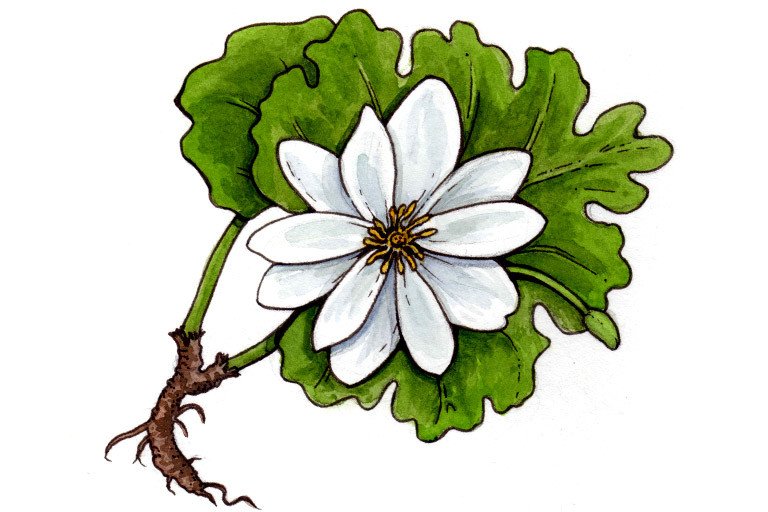
Common Names
- Bloodroot; Red root
- Indian paint
- Snakebite
- Coonroot; Puccoon
For Patients & Caregivers
Tell your healthcare providers about any dietary supplements you’re taking, such as herbs, vitamins, minerals, and natural or home remedies. This will help them manage your care and keep you safe.
Bloodroot has not been shown to treat cancer in humans.
Bloodroot is a perennial flowering herb native to eastern North America. It has been used for inflammation, cough, infections, as an antiplaque agent, and for cancer treatment. Sanguinarine, a compound present in bloodroot, was shown to have antimicrobial activity and to inhibit growth of new blood vessels. Use of bloodroot for skin lesions may result in serious harm. Other side effects of bloodroot include dizziness, vertigo, nausea, and vomiting.
- Cancer
Extracts of bloodroot have been studied in the laboratory and in animals for their anticancer effects. Traditional use of bloodroot for cancer is associated with serious adverse effects. - Cough
There is not enough scientific evidence to support this use. - Inflammation
This use is not backed by any studies. - Infection
This use is not backed by any studies.
Topical: Skin irritation, burning and lesions in the mouth and throat.
Case Reports
Disfigurement, worsening lesions: With topical use of bloodroot salves to treat skin lesions, with some cases requiring hospitalization.
Patient Warnings:
- Inappropriate use of bloodroot for cancer treatment can have severe adverse effects.
- Bloodroot should not be used in individuals with glaucoma.
Special Point:
Unapproved use of bloodroot paste externally as cancer treatment has been linked to disfigurement.
For Healthcare Professionals
Bloodroot is a perennial flowering plant native to eastern North America. It is thought to have antiseptic, diuretic, and emetic properties and is used to reduce inflammation, cough, infections, and as an anti-plaque agent. Bloodroot is also an ingredient in black salve, which is promoted as an alternative cancer treatment.
The major constituent of bloodroot is sanguinarine, an alkaloid that exhibits antimicrobial (8), tumoricidal (22) (23), anticancer (25) (27), antiangiogenic (4) (5) (9) and antimicrotubule (21) properties. However, its efficacy has not been tested in humans.
Topical use of bloodroot for skin cancer can lead to severe adverse effects including disfigurement (15) (24) (26) (28) (29) (30). The use of sanguinarine as an oral antiplaque agent has been linked to leukoplakia (10) (14).
- Cancer
- Infection
- Inflammation
- Cough
Laboratory studies suggest sanguinarine, a benzophenanthrine alkaloid, has potential antineoplastic properties, as it intercalates with DNA at guanine-cytosine-rich sequences (17). Sanguinarine also inhibits transcription factor NFkB (6) and tubulin protein formation (21), activates pro-apoptotic Bcl-2 family proteins (2), and induces apoptosis (3) perhaps via increased activation of caspases 3 and 9 (27).
Sanguinarine exhibits antiplatelet effects, reduces platelet thromboxane production, and suppresses cyclooxygenase-1 (13). Bloodroot can inhibit the action of sodium-potassium ATPase and also prolong ventricular refractory period (18) (19).
Antiplaque effects may be caused by conversion of sanguinarine to an iminium ion that binds to plaque. However when used in oral preparations, bloodroot has been linked with leukoplakia (10) (14).
Avoid use in patients with glaucoma (12).
Case Reports
- Disfigurement, worsening lesions: With topical use of bloodroot salves to treat skin lesions, with some cases requiring hospitalization (15) (24) (26) (28) (29) (30).
- Permanent scarring and disfigurement: Following use of products containing bloodroot for removing skin moles/tags (31).
- Persistent periorbital inflammation, persistence of malignancy, and significant tissue destruction: In a 65-year-old woman diagnosed with a medial canthal basal cell carcinoma and self treated with a bloodroot salve (32).