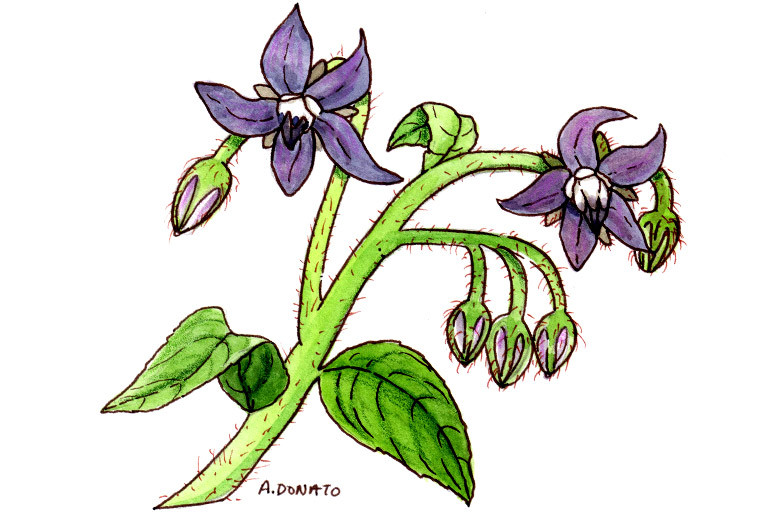
Health Care Professional Information
Common Name
Bee plant, bee bread, borage seed oil, ox’s tongue, starflower oil
Clinical Summary
Oil derived from the plant. Recent studies have shown gamma-linoleic acid (GLA) from borage seed oil has some benefits in treating rheumatoid arthritis (7) (9). Studies on borage oil's effect on skin conditions, such as atopic eczema (11) (12) and infantile seborrheic dermatitis (5), yielded mixed results. Borage oil contains a pyrrolizidine alkaloid, amabiline, which is hepatotoxic. Risk of hepatic damage increases with length of exposure and cumulative dose consumed. Patients should use borage oil certified free of unsaturated pyrrolizidine alkaloids. Borage oil may be unsafe during pregnancy.
Purported Uses
- Arthritis
- Chest congestion
- Cough
- Depression
- Infantile seborrheic dermatitis
- Menopausal symptoms
Constituents
- Alkaloids: Contains small amounts of many pyrrolizidine types, especially amabiline (hepatotoxin).
- Fatty acids: Linoleic acid gamolenic acid (GLA), oleic and saturated fatty acids
- Mucilages: Glucose, galactose and arabinose
- Acids: Acetic, lactic, malic and silicic
- Tannins
- Saponins
(1)
Mechanism of Action
The GLA from the borage seeds may have anti-inflammatory properties. GLA can be converted to the prostaglandin precursor dihomo-gama-linolenic acid (DGLA). DGLA can block the transformation of arachidonic acid to leukotrienes and other prostaglandins (10). GLA can increase cAMP level which suppresses the synthesis of tumor necrosis factor-alpha - an inflammatory mediator linked to rheumatoid arthritis (9). The mucilage constituent has an expectorant-like action and malic acid has a mild diuretic effect. The tannin constituent may have mild astringent and constipating actions.
(3)
Warnings
Borage contains small amounts of the alkaloid amabiline, which is hepatotoxic. Consumption of 1-2 g of borage seed oil daily can result in an intake of toxic unsaturated pyrrolizidine alkaloids (UPAs) approaching 10 ug. The German Federal Health Agency now specifies consumption of such products should be limited to no more than 1 ug of UPA daily. Borage oil products should be certified free of UPAs (meet criterion of no more than 0.5-1 ug/g).
(2)
Contraindications
Pregnancy: Preliminary studies suggest borage oil has a teratogenic effect and that its prostaglandin E agonist action may cause premature labor.
(9)
Herb-Drug Interactions
Phenothiazines: Theoretically borage oil may lower the seizure threshold due to its gamma linoleic acid content. Seizures have been documented with evening primrose oil, but not borage oil.
Tricyclic antidepressants: Theoretically, may lower seizure threshold due to gamma linoleic acid content. Seizures have been documented with evening primrose oil, but not borage oil.
NSAIDS: Theoretically concomitant use with borage oil would decrease the effects of borage oil, as NSAIDS interfere with the synthesis of prostaglandin E.
(6) (9)
Literature Summary and Critique
Henz BM, et al. Double-blind, multicentre analysis of the efficacy of borage oil in patients with atopic eczema. Br J Dermatol 1999;140:685-8.
A double-blind, multicenter study of borage oil (23% GLA) in 167 adults with stable atopic eczema of moderate severity. Patients were randomized to take daily either 500 mg of borage oil-containing capsules or the bland lipid miglyol as a placebo over a 24-week period. Primary endpoint was amount of rescue medication (topical diflucortolone-21-valerate cream) used until response; secondary endpoint was clinical improvement. Patients taking borage oil experienced small but insignificant clinical improvements compared to placebo; a subgroup excluding noncompliant patients and those who failed to show increased erythrocyte dihomo-gamma-linolenic acid levels showed a significant benefit.
Leventhal LJ, et al. Treatment of rheumatoid arthritis with gammalinoleic acid. Ann Intern Med 1993;119:867-73.
A randomized, double-blind, placebo-controlled, 24-week trial of 37 patients with rheumatoid arthritis and active synovitis. The treatment group receiving gammalinoleic acid (GLA) 1.4 g experienced a 36% reduction in the number of tender joints and a 28% reduction in swollen joints. The placebo group did not show significant improvement in any measure. No significant adverse effects were reported.
Pullman-Mooar S, et al. Alteration of the cellular fatty acid profile and the production of eicosanoids in human monocytes by gamma-linolenic acid. Arthritis Rheum 1990;33:1526-33.
In an uncontrolled trial, borage seed oil 1.1 g was given to 7 healthy patients and seven patients with rheumatoid arthritis for 12 weeks. Eighty-five percent of the arthritic group experienced relief, possibly due to the GLA in the borage oil.
Dosage (Inside MSKCC Only)
This field is only visible to only Inside MSKCC users.
References
- Newell CA, et al. Herbal Medicine: A Guide for Healthcare Professionals. London: Pharmaceutical Press; 1996.
- Tyler V. Herbs of Choice, the Therapeutical Use of Phytomedicinals. Binghamton: Pharmaceutical Press; 1994.
- Peirce A. The American Pharmaceutical Association Practical Guide to Natural Medicines. New York: The Stonesong Press Inc; 1999. 270.
- Hoffman D. The Herb Users Guide: The Basic Skills of Medical Herbalism. Wellingborough: Thorsons, 1987.
- Tollesson A, Frithz A. Borage oil, an effective new treatment for infantile seborrhoeic dermatitis. Br J Derm 1993;129:95.
- Brinker F. Herb Contraindications and Drug Interactions, 3rd ed. Sandy (OR): Eclectic Medical Publications; 2001.
- Leventhal LJ, et al. Treatment of rheumatoid arthritis with gamma-linolenic acid. Ann Intern Med 1993;119:867-73.
- Pullman-Mooar S, et al. Alteration of the cellular fatty acid profile and the production of eicosanoids in human monocytes by gamma-linolenic acid. Arthritis Rheum 1990;22:1526-33.
- Kast RE. Borage oil reduction of rheumatoid arthritis activity may be medicated by increased cAMP that suppresses tumor necrosis factor-alpha. International Immunopharmacol 2001;2197-99.
- Belch JJ, Hill A. Evening primrose oil and borage oil in rheumatologic conditions. Am J Clin Nutr 2000;71(suppl):352S-6S.
- Henz BM, et al. Double-blind, multicentre analysis of the efficacy of borage oil in patients with atopic eczema. Br J Dermatology 1999;140:685-8.
- Takwale A, Tan E, Agarwal S, Barclay G, Ahmed I, Hotchkiss K, Thompson JR, Chapman T, Berth-Jones J. Efficacy and tolerability of borage oil in adults and children with atopic eczema: randomised, double blind, placebo controlled, parallel group trial. BMJ. 2003 Dec 13;327(7428):1385.
Consumer Information
How It Works
Bottom Line: Borage may be helpful in treating rheumatoid arthritis, but there is no evidence that it can treat menopausal symptoms, depression, dermatitis or other serious medical conditions.
Borage seeds contain oils that are probably responsible for its medicinal actions. These oils are known to contain the omega-6 fatty acid gamma-linolenic acid (GLA), which is also produced naturally in the body. Scientists have not figured out how exactly borage exerts its effects, but theorize that GLA has anti-inflammatory activity. Chronic inflammation is mediated in part by substances known as prostaglandins and leukotrienes, both by-products of metabolism of arachidonic acid, a fatty acid in cell membranes. GLA is able to reduce the formation of prostaglandins and leukotrienes by replacing arachidonic acid in cell membranes.
Borage also contains mucilage, a sticky mixture of plant sugars, which can act as an expectorant to produce phlegm in patients with coughs.
Purported Uses
- To reduce inflammation and pain associated with arthritis
A handful of small clinical trials support this use.
- As an expectorant and to treat coughs
Laboratory studies support this use, but there is no proof from clinical trials that borage can treat coughs.
- To treat depression
No scientific evidence supports this use.
- To treat infantile seborrheic dermatitis
Laboratory studies do not support this use.
- To treat atopic dermatitis (eczema)
One large clinical trial (described below) does not support this use.
- To ease menopausal symptoms such as hot flashes, vaginal dryness, sleep disturbances, and mood swings
No scientific evidence supports this use.
Research Evidence
Thus far, not many clinical trials have been performed with borage oil, and all have focused on small groups of patients.
Rheumatoid arthritis:
A randomized controlled trial studied the use of borage oil in 37 patients with rheumatoid arthritis and active synovitis. After 24 weeks, the group that received 1.4 g of gammalinoleic acid (GLA) daily had a significant reduction in the number of tender joints and swollen joints. The group that took a placebo pill every day did not show improvement, and some patients worsened. No side effects were reported. This small study supports the safety and efficacy of short-term use of GLA in treating rheumatoid arthritis, but patients should be aware that the safety of its long-term use is still not known.
In an uncontrolled trial, 1.1 g of borage seed oil was given to seven healthy patients and seven patients with rheumatoid arthritis for twelve weeks. Six of the seven patients with rheumatoid arthritis reported relief of their symptoms. Because this study is very small and lacks a placebo group (a group of patients with rheumatoid arthritis taking a placebo pill) to which the borage oil group's improvements can be compared, its results are not very reliable. Larger, controlled clinical trials should be conducted.
Atopic eczema:
A randomized, controlled trial examined the effectiveness of borage oil with a high concentration of GLA (23%) in 160 adults with atopic eczema. Patients were randomly assigned to take either 500 mg of borage oil capsules or placebo capsules for 24 weeks. Those taking borage oil showed a slight improvement in symptoms, but the change was not considered “significant” by scientific standards. This well-designed trial does not support the use of borage oil for adult atopic eczema.
Patient Warnings
- This product is regulated by the F.D.A. as a dietary supplement. Unlike approved drugs, supplements are not required to be manufactured under specific standardized conditions. This product may not contain the labeled amount or may be contaminated. In addition, it may not have been tested for safety or effectiveness.
- Borage oil products should be certified free of toxic compounds called unsaturated pyrrolizidine alkaloids (UPAs), at least no more than 0.5-1 microgram of UPAs per gram of borage oil. The German Federal Health Agency recommends that consumption of UPAs should be limited to no more than 1 microgram daily.
Do Not Take If
- You are pregnant (Borage oil may cause birth defects and premature labor).
- You are taking phenothiazines (In theory, the GLA in borage oil may lower patients' seizure threshold. Seizures have been reported in patients that have combined phenothiazines with evening primrose oil, which also contains GLA.)
- You are taking tricyclic antidepressants (In theory, the GLA in borage oil may lower patients' seizure threshold. Seizures have been reported in patients that have combined tricyclic antidepressants with evening primrose oil, which also contains GLA.)
- You are regularly taking NSAIDs (such as aspirin, AdvilTM, or cox-2 inhibitors) (In theory, NSAIDs can reduce the effects of borage oil).
Side Effects
- Constipation
- Liver damage has occurred in a few patients who took borage oil for prolonged periods of time.
Special Point
Borage oil products should not be used unless they are certified free of unsaturated pyrrolizidine alkaloids (UPAs) such as amabiline, which can damage the liver. Risk of liver damage increases with length of exposure and cumulative dose.
Last updated: February 9, 2011
acid (A-sid)
A chemical that gives off hydrogen ions in water and forms salts by combining with certain metals. Acids have a sour taste and turn certain dyes red. Some acids made by the body, such as gastric acid, can help organs work the way they should. An example of an acid is hydrochloric acid. Acidity is measured on a scale called the pH scale. On this scale, a value of 7 is neutral, and a pH value of less than 7 to 0 shows increasing acidity.
Source: The National Cancer Institute's Dictionary of Cancer Terms
(http://www.cancer.gov/dictionary)
administration (ad-MIH-nih-STRAY-shun)
In medicine, the act of giving a treatment, such as a drug, to a patient. It can also refer to the way it is given, the dose, or how often it is given.
Source: The National Cancer Institute's Dictionary of Cancer Terms
(http://www.cancer.gov/dictionary)
agonist (A-guh-nist)
A drug or substance that binds to a receptor inside a cell or on its surface and causes the same action as the substance that normally binds to the receptor.
Source: The National Cancer Institute's Dictionary of Cancer Terms
(http://www.cancer.gov/dictionary)
alkaloid (AL-kuh-loyd)
A member of a large group of substances found in plants and in some fungi. Alkaloids contain nitrogen and can be made in the laboratory. Nicotine, caffeine, codeine, and vincristine are alkaloids. Some alkaloids, such as vincristine, are used to treat cancer.
Source: The National Cancer Institute's Dictionary of Cancer Terms
(http://www.cancer.gov/dictionary)
anti-inflammatory (AN-tee-in-FLA-muh-TOR-ee)
Having to do with reducing inflammation.
Source: The National Cancer Institute's Dictionary of Cancer Terms
(http://www.cancer.gov/dictionary)
arthritis (ar-THRY-tis)
A disease that causes inflammation and pain in the joints.
Source: The National Cancer Institute's Dictionary of Cancer Terms
(http://www.cancer.gov/dictionary)
cell (sel)
The individual unit that makes up the tissues of the body. All living things are made up of one or more cells.
Source: The National Cancer Institute's Dictionary of Cancer Terms
(http://www.cancer.gov/dictionary)
chronic (KRAH-nik)
A disease or condition that persists or progresses over a long period of time.
Source: The National Cancer Institute's Dictionary of Cancer Terms
(http://www.cancer.gov/dictionary)
clinical (KLIH-nih-kul)
Having to do with the examination and treatment of patients.
Source: The National Cancer Institute's Dictionary of Cancer Terms
(http://www.cancer.gov/dictionary)
clinical trial (KLIH-nih-kul TRY-ul)
A type of research study that tests how well new medical approaches work in people. These studies test new methods of screening, prevention, diagnosis, or treatment of a disease. Also called clinical study.
Source: The National Cancer Institute's Dictionary of Cancer Terms
(http://www.cancer.gov/dictionary)
concentration (KON-sen-TRAY-shun)
In science, the amount of a substance, such as a salt, that is in a certain amount of tissue or liquid, such as blood. A substance becomes more concentrated when less water is present. For example, the salt in urine may become more concentrated when a person doesn’t drink enough water.
Source: The National Cancer Institute's Dictionary of Cancer Terms
(http://www.cancer.gov/dictionary)
constipation (KON-stih-PAY-shun)
A condition in which stool becomes hard, dry, and difficult to pass, and bowel movements don’t happen very often. Other symptoms may include painful bowel movements, and feeling bloated, uncomfortable, and sluggish.
Source: The National Cancer Institute's Dictionary of Cancer Terms
(http://www.cancer.gov/dictionary)
cumulative dose (KYOO-myuh-luh-tiv dose)
In medicine, the total amount of a drug or radiation given to a patient over time; for example, the total dose of radiation given in a series of radiation treatments.
Source: The National Cancer Institute's Dictionary of Cancer Terms
(http://www.cancer.gov/dictionary)
dermatitis (DER-muh-TY-tis)
Inflammation of the skin.
Source: The National Cancer Institute's Dictionary of Cancer Terms
(http://www.cancer.gov/dictionary)
dietary supplement (DY-uh-TAYR-ee SUH-pleh-ment)
A product that is added to the diet. A dietary supplement is taken by mouth, and usually contains one or more dietary ingredient (such as vitamin, mineral, herb, amino acid, and enzyme). Also called nutritional supplement.
Source: The National Cancer Institute's Dictionary of Cancer Terms
(http://www.cancer.gov/dictionary)
diuretic (DY-yoo-REH-tik)
A drug that increases the production of urine.
Source: The National Cancer Institute's Dictionary of Cancer Terms
(http://www.cancer.gov/dictionary)
dose (dose)
The amount of medicine taken, or radiation given, at one time.
Source: The National Cancer Institute's Dictionary of Cancer Terms
(http://www.cancer.gov/dictionary)
eczema (EK-zeh-muh)
A group of conditions in which the skin becomes inflamed, forms blisters, and becomes crusty, thick, and scaly. Eczema causes burning and itching, and may occur over a long period of time. Atopic dermatitis is the most common type of eczema.
Source: The National Cancer Institute's Dictionary of Cancer Terms
(http://www.cancer.gov/dictionary)
efficacy (EH-fih-kuh-see)
Effectiveness. In medicine, the ability of an intervention (for example, a drug or surgery) to produce the desired beneficial effect.
Source: The National Cancer Institute's Dictionary of Cancer Terms
(http://www.cancer.gov/dictionary)
endpoint (end-point)
In clinical trials, an event or outcome that can be measured objectively to determine whether the intervention being studied is beneficial. The endpoints of a clinical trial are usually included in the study objectives. Some examples of endpoints are survival, improvements in quality of life, relief of symptoms, and disappearance of the tumor.
Source: The National Cancer Institute's Dictionary of Cancer Terms
(http://www.cancer.gov/dictionary)
erythrocyte (eh-RITH-roh-site)
A cell that carries oxygen to all parts of the body. Also called RBC and red blood cell.
Source: The National Cancer Institute's Dictionary of Cancer Terms
(http://www.cancer.gov/dictionary)
fatty acid (FA-tee A-sid)
A major component of fats that is used by the body for energy and tissue development.
Source: The National Cancer Institute's Dictionary of Cancer Terms
(http://www.cancer.gov/dictionary)
gram (gram)
A unit of weight in the metric system. One gram is equal to one thousandth of a kilogram and is approximately 30-times less than an ounce.
Source: The National Cancer Institute's Dictionary of Cancer Terms
(http://www.cancer.gov/dictionary)
hepatic (heh-PA-tik)
Refers to the liver.
Source: The National Cancer Institute's Dictionary of Cancer Terms
(http://www.cancer.gov/dictionary)
herbal (ER-bul)
Having to do with plants.
Source: The National Cancer Institute's Dictionary of Cancer Terms
(http://www.cancer.gov/dictionary)
inflammation (IN-fluh-MAY-shun)
Redness, swelling, pain, and/or a feeling of heat in an area of the body. This is a protective reaction to injury, disease, or irritation of the tissues.
Source: The National Cancer Institute's Dictionary of Cancer Terms
(http://www.cancer.gov/dictionary)
inflammatory (in-FLA-muh-TOR-ee)
Having to do with inflammation (redness, swelling, pain, and a feeling of heat that helps protect tissues affected by injury or disease).
Source: The National Cancer Institute's Dictionary of Cancer Terms
(http://www.cancer.gov/dictionary)
lipid (LIH-pid)
Fat.
Source: The National Cancer Institute's Dictionary of Cancer Terms
(http://www.cancer.gov/dictionary)
liver (LIH-ver)
A large organ located in the upper abdomen. The liver cleanses the blood and aids in digestion by secreting bile.
Source: The National Cancer Institute's Dictionary of Cancer Terms
(http://www.cancer.gov/dictionary)
medication (MEH-dih-KAY-shun)
A legal drug that is used to prevent, treat, or relieve symptoms of a disease or abnormal condition.
Source: The National Cancer Institute's Dictionary of Cancer Terms
(http://www.cancer.gov/dictionary)
metabolism (meh-TA-buh-lih-zum)
The chemical changes that take place in a cell or an organism. These changes make energy and the materials cells and organisms need to grow, reproduce, and stay healthy. Metabolism also helps get rid of toxic substances.
Source: The National Cancer Institute's Dictionary of Cancer Terms
(http://www.cancer.gov/dictionary)
microgram (MY-kroh-gram)
One millionth of a gram.
Source: The National Cancer Institute's Dictionary of Cancer Terms
(http://www.cancer.gov/dictionary)
multicenter study (MUL-tee-SEN-ter STUH-dee)
A clinical trial that is carried out at more than one medical institution.
Source: The National Cancer Institute's Dictionary of Cancer Terms
(http://www.cancer.gov/dictionary)
necrosis (neh-KROH-sis)
Refers to the death of living tissues.
Source: The National Cancer Institute's Dictionary of Cancer Terms
(http://www.cancer.gov/dictionary)
phlegm (flem)
A more than normal amount of thick mucus made by the cells lining the upper airways and lungs. A buildup of phlegm may be caused by infection, irritation, or chronic lung disease, and can cause discomfort in the chest and coughing.
Source: The National Cancer Institute's Dictionary of Cancer Terms
(http://www.cancer.gov/dictionary)
placebo (pluh-SEE-boh)
An inactive substance or treatment that looks the same as, and is given the same way as, an active drug or treatment being tested. The effects of the active drug or treatment are compared to the effects of the placebo.
Source: The National Cancer Institute's Dictionary of Cancer Terms
(http://www.cancer.gov/dictionary)
placebo-controlled (pluh-SEE-boh-kun-TROLD)
Refers to a clinical study in which the control patients receive a placebo.
Source: The National Cancer Institute's Dictionary of Cancer Terms
(http://www.cancer.gov/dictionary)
pregnancy (PREG-nun-see)
The condition between conception (fertilization of an egg by a sperm) and birth, during which the fertilized egg develops in the uterus. In humans, pregnancy lasts about 288 days.
Source: The National Cancer Institute's Dictionary of Cancer Terms
(http://www.cancer.gov/dictionary)
prostaglandin (PROS-tuh-GLAN-din)
One of several hormone-like substances made by the body. Different prostaglandins control blood pressure, contraction of smooth muscles, and other processes within tissues where they are made. Certain prostaglandins are being studied as cancer biomarkers. Also called PG.
Source: The National Cancer Institute's Dictionary of Cancer Terms
(http://www.cancer.gov/dictionary)
randomized
Describes an experiment or clinical trial in which animal or human subjects are assigned by chance to separate groups that compare different treatments.
Source: The National Cancer Institute's Dictionary of Cancer Terms
(http://www.cancer.gov/dictionary)
reduction (ree-DUK-shun)
A chemical reaction that takes place when a substance comes into contact with hydrogen or another reducing substance.
Source: The National Cancer Institute's Dictionary of Cancer Terms
(http://www.cancer.gov/dictionary)
rheumatoid arthritis (ROO-muh-TOYD ar-THRY-tis)
An autoimmune disease that causes pain, swelling, and stiffness in the joints, and may cause severe joint damage, loss of function, and disability. The disease may last from months to a lifetime, and symptoms may improve and worsen over time.
Source: The National Cancer Institute's Dictionary of Cancer Terms
(http://www.cancer.gov/dictionary)
seizure (SEE-zher)
Sudden, uncontrolled body movements and changes in behavior that occur because of abnormal electrical activity in the brain. Symptoms include loss of awareness, changes in emotion, loss of muscle control, and shaking. Seizures may be caused by drugs, high fevers, head injuries, and certain diseases, such as epilepsy.
Source: The National Cancer Institute's Dictionary of Cancer Terms
(http://www.cancer.gov/dictionary)
significant (sig-NIH-fih-kunt)
In statistics, describes a mathematical measure of difference between groups. The difference is said to be significant if it is greater than what might be expected to happen by chance alone. Also called statistically significant.
Source: The National Cancer Institute's Dictionary of Cancer Terms
(http://www.cancer.gov/dictionary)
synovitis (SIH-noh-VY-tis)
Inflammation (swelling, pain, and warmth) of a synovial membrane, which is a layer of connective tissue that lines a joint, such as the hip, knee, ankle, or shoulder. Synovitis is caused by some types of arthritis and other diseases.
Source: The National Cancer Institute's Dictionary of Cancer Terms
(http://www.cancer.gov/dictionary)
tannin (TA-nin)
A type of chemical found in plants and in certain foods, such as fruits, vegetables, nuts, wine, and tea. Tannins have antioxidant properties and may promote good health. They are being studied in the prevention of cancer, heart disease, and other diseases. They are also used in certain medicines, fabrics, leather, and ink. A tannin is a type of polyphenol. Also called tannic acid.
Source: The National Cancer Institute's Dictionary of Cancer Terms
(http://www.cancer.gov/dictionary)
toxic (TOK-sik)
Having to do with poison or something harmful to the body. Toxic substances usually cause unwanted side effects.
Source: The National Cancer Institute's Dictionary of Cancer Terms
(http://www.cancer.gov/dictionary)
tumor (TOO-mer)
An abnormal mass of tissue that results when cells divide more than they should or do not die when they should. Tumors may be benign (not cancer), or malignant (cancer). Also called neoplasm.
Source: The National Cancer Institute's Dictionary of Cancer Terms
(http://www.cancer.gov/dictionary)