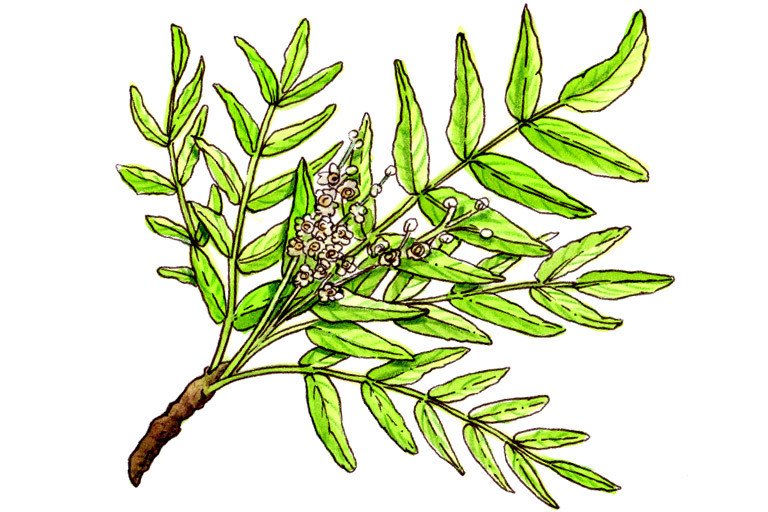
Common Names
- Indian frankincense
For Patients & Caregivers
Tell your healthcare providers about any dietary supplements you’re taking, such as herbs, vitamins, minerals, and natural or home remedies. This will help them manage your care and keep you safe.
Boswellia is an herbal extract made from the bark of the boswellia tree. It is also known as frankincense. The resin (sticky substance found in trees and plants) is used to make an extract.
Boswellia resin is used in Ayurvedic (traditional Indian) medicine. You can take boswellia in different ways, including taking it orally (by mouth) in a capsule, pill, or tablet, or using it as an oil that you can put on your body.
Boswellia is used to:
- Treat arthritis
- Help with asthma
- Treat colitis (inflammation of your colon)
- Help with inflammation (swelling and redness)
- Help reduce fluid cerebral edema (brain swelling) after radiotherapy, in patients with brain tumors
- Help reduce skin damage due to radiotherapy, in breast cancer patients
It’s generally safe to use boswellia. However, talk with your healthcare providers before taking supplements. Herbal supplements can have higher amounts of boswellia compared to Ayurvedic formulas.
Supplements can also interact with some medications and affect how they work. For more information, read the “What else do I need to know?” section below.
Side effects of using boswellia may include:
- Allergic skin reactions
- Talk to your doctor if you’re taking blood thinners such as warfarin (Coumadin®). Boswellia may increase your risk of bleeding if you take it with blood thinners.
For Healthcare Professionals
Boswellia serrata is a tree prevalent in India, the Middle East and North Africa. The gummy exudate or resin obtained by peeling away the bark is commonly known as frankincense or olibanum. Boswellia is used widely in Ayurveda for treating arthritis, ulcerative colitis, coughs, sores, wound healing, and asthma. It is also available in supplemental forms to support joint health.
The bioactive compound in boswellia is boswellic acid (1), a 5-lipoxygenase inhibitor. It showed anti-inflammatory, anti-arthritic (1) (2) (3), cytotoxic (4) (5) (6) (7) and radio-enhancing effects (21), and prevented intestinal tumorigenesis in a murine model (26). Other animal models suggest boswellia may improve cognitive impairment and insulin resistance (42); and essential oil of boswellia showed antimicrobial property (24).
In clinical studies, boswellia extracts (11) (44) (52) (53) (55) (58) (59) (60); a formulation containing boswellia, Terminalia chebula and turmeric (39); as well as boswellic acid combined with curcumin (40) were reported useful in patients with osteoarthritis although data are conflicting (48). Supplements containing boswellia also improved bone fracture healing rate (61), alleviated symptoms of tendinopathy (45), were comparable to acetaminophen in reducing musculoskeletal pain (46), and reduced aromatase inhibitor-induced joint pain (54). Additional studies suggest benefits in patients with oral aphthous lesions (49), bronchial asthma (8), ulcerative colitis (9), mild irritable bowel syndrome (38) (50), knee pain (56) , low back pain (62) (63) and osteo-muscular pain (36). Larger trials are needed to confirm these effects. As well, evidence is unclear, or negative, surrounding boswellia’s effectiveness against collagenous colitis (12) (13) (14), with no significant benefit in maintaining remission in patients with Crohn’s disease (15).
Preliminary findings suggest boswellia may be effective in reducing cerebral edema in patients with brain tumors following radio- and radiochemotherapy (23) (43), and topical use prevented radiation-induced skin damage in breast cancer patients (32). Also, boswellia formulations helped reduce mammary density, a risk factor for breast cancer (33), inhibited breast cancer proliferation (57), and decreased genitourinary pain in men with prostatitis-like symptoms (47).
Although similar in many functions, boswellia should not be confused with guggul or myrrh.
- Arthritis
- Asthma
- Colitis
- Inflammation
- Radiation therapy side effects
Boswellic acid, the major constituent of boswellia, is thought to contribute to many of the herb’s pharmacological activities. Preclinical studies show that anti-inflammatory activity occurs via inhibition of 5-lipoxygenase (2) (3) and cyclooxygenase-1 (35). Boswellic acid also inhibits nuclear transcription factor KappaB (NF-KappaB) signaling, markedly decreasing production of the key proinflammatory cytokine tumor necrosis factor (TNF-alpha) (17). Unlike other non-steroidal anti-inflammatory drugs, however, it failed to show analgesic or antipyretic effects (16).
Research on cytotoxic effects of boswellic acid indicates that it induces p21 expression through a p53-independent pathway and causes apoptosis in glioma (4) (6) and leukemia (5) cell lines. A boswellia extract induced apoptosis in a cervical cancer cells by inducing endoplasmic reticulum (ER) stress (18). Other apoptotic mechanisms include early generation of nitric oxide and reactive oxygen species that upregulated time-dependent expression of p53/p21/PUMA (19), inhibition of microsomal prostaglandin E synthase-1 (mPGES-1), and decreased prostaglandin (PGE2) levels and its downstream targets (37).
A semisynthetic analog of boswellic acid, 3-alpha-Butyryloxy-beta-boswellic acid, demonstrated significant growth inhibition in Ehrlich Ascitic Tumour (EAT), Ehrlich Ascitic Carcinoma (EAC) and Sarcoma-180 tumor models, via NF-KappaB downregulation and induction of poly (ADP-ribose) polymerase (PARP) cleavage (27). Acetyl-boswellic acids inhibited topoisomerases by competing with DNA for binding sites (20). Acetyl-11-keto-beta-boswellic acid (AKBA) inhibited human prostate tumor growth via inhibition of VEGFR2-induced angiogenesis (22). The antiplatelet effects of boswellia gum resin extracts are attributed to inhibition of clotting factors Xa and XIa. (34).
Generally well tolerated (15).
Case reports
- Allergic contact dermatitis: After using boswellia oil (51) and a topical cream containing a boswellia extract (28)
- Gastric bezoar (accumulation of vegetable fiber, hair or other substances, in the stomach or small intestine): In a 17-year-old girl with celiac disease after excessive intake of frankincense. Her symptoms, which included epigastric pain and vomiting, resolved after surgical excision of the bezoar (29).
- Mild stypsis: In IBS patients supplemented with Casperome®, a lecithin-based formulation of boswellia extract (38).
- OATP1B3 (an anion transporter): Both 11-keto-beta-boswellic acid (KBA) and 3-acetyl-11-keto-beta-boswellic acid (AKBA) modulated the activity of OATP1B3, in vitro (30). Clinical relevance is not known.
- MRP2 (a multidrug resistant protein): Both 11-keto-beta-boswellic acid (KBA) and 3-acetyl-11-keto-beta-boswellic acid (AKBA) modulated the activity of MRP2, in vitro (30). Clinical relevance is not known.
- P-Glycoprotein (P-Gp): A Boswellia extract and keto-boswellic acids inhibit the activity of P-Glycoprotein in vitro, and may affect the transport of drugs mediated by this protein (31). Clinical significance has yet to be determined.
- Anticoagulant and/or antiplatelet drugs: Boswellia extracts can inhibit platelet aggregation and may increase risk of bleeding when used with these drugs (34). Clinical significance has yet to be determined.