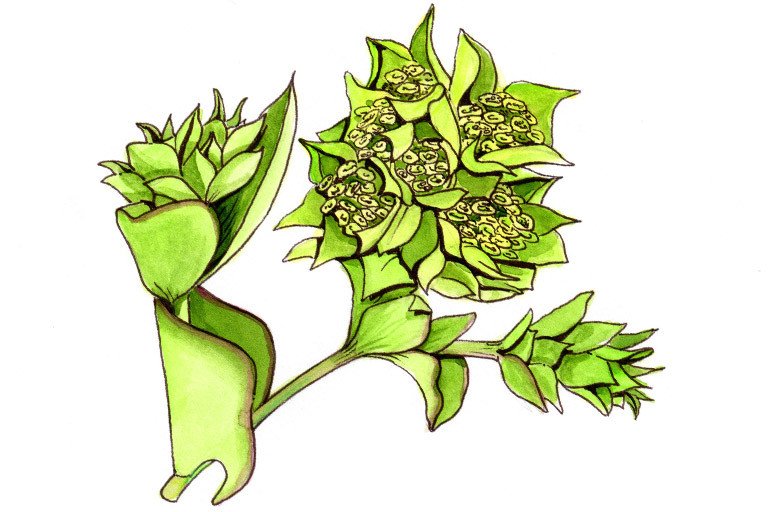
Common Names
- Chai Hu
- Hare's ear root
- Thorowax root
- Saiko
For Patients & Caregivers
Tell your healthcare providers about any dietary supplements you’re taking, such as herbs, vitamins, minerals, and natural or home remedies. This will help them manage your care and keep you safe.
Although bupleurum is used along with other herbs in traditional formulas to treat many conditions, studies in humans are lacking.
Bupleurum is an important herb used in traditional Chinese and Japanese medicine. It is frequently prescribed in combination with other herbs to treat colds, fever, digestive disorders, chronic liver diseases, and depression symptoms. Herbal formulas such as Xiao Chai Hu Tang (Sho-saiko-to) and Xiao Yao San contain bupleurum as a major ingredient.
Compounds called saikosaponins in bupleurum have been identified as responsible for the plant's medicinal activities. However, most studies on bupleurum have only been performed in the lab and human data are lacking. In addition, excess doses have been linked to a few cases of adverse effects.
NOTE: The following uses and descriptions of effectiveness apply to bupleurum only. Please see our monograph on Sho-saiko-to for information regarding the effectiveness of bupleurum in combination with other herbs.
- To treat liver diseases, including hepatitis and cirrhosis of the liver
Although bupleurum is used in traditional Chinese medicine to treat liver diseases, human data are lacking. - To treat the common cold
Bupleurum may have antiviral activity, but clinical trials have not been conducted. - As a fever reducer
Although bupleurum is used in traditional Chinese medicine to reduce fever, there are no clinical data to back this claim. - To treat infections
Bupleurum may have antibacterial and antiviral activity, but human studies are lacking. - To reduce inflammation
Laboratory studies show that components of bupleurum interfere with the processes that cause inflammation. Human studies are needed. - To reduce depression symptoms
The evidence on Bupleurum chinense for depression is considered low quality.
There have been a few case reports of liver damage with excess doses of bupleurum.
Do Not Take if:
- You are taking drugs that are substrates of CYP2C9: Lab studies suggest bupleurum extracts may increase the risk of side effects of these drugs. Clinical relevance has yet to be determined. Patients should check with their treating physician.
- You are taking drugs that are substrates of CYP2E1, 2D6, and 3A4: Animal studies suggest that bupleurum can induce CYP2E1, CYP2D6 and CYP3A4 enzymes, but that herb-drug interactions are more likely at higher doses. Patients should check with their treating physician.
For Healthcare Professionals
Bupleurum is an important herb used in traditional Chinese and Japanese medicine. It is frequently prescribed in combination with other herbs to treat colds, fever, malaria, digestive disorders, chronic liver diseases, and depression. Herbal formulas such as Xiao Chai Hu Tang (Sho-saiko-to) and Xiao Yao San contain bupleurum as a major ingredient.
Preclinical studies suggest that bupleurum has antiviral (4) (7), hepatoprotective (16), anti-inflammatory (1) (17), immune-modulating (3) (14), antiproliferative (11), and chemopreventive (12) (13) properties. Experiments suggest bupleurum might exert some influence over multidrug resistance in drug-resistant cells (2). Saikosaponins, a major constituent, enhanced cisplatin cytotoxicity against solid tumors (15).
In animal studies, bupleurum demonstrated inhibitory effects against allergic asthma (10). Experiments in both chronic mildly stressed and healthy rats describe differential effective and toxic responses (21). Saikosaponins were identified as the compound which may be responsible for bupleurum-induced liver injury (22).
Studies of bupleurum in humans are lacking. Although a meta-analysis suggests Bupleurum chinense herbal formulas may help reduce depression severity, the evidence was considered to be of low quality (28). Poor quality control is also a concern with commercial herbal products. A sample of bupleurum was found contaminated with a nephrotoxic drug, aristolactone (18). In addition, the extent to which bupleurum is screened for levels of toxic compounds such as polyacetylenes in general is unclear (23).
- Cold, fever
- Infections
- Inflammation
- Liver disease
- Depression
Saikosaponins in bupleurum are the main constituent to which medicinal activities are attributed. In vitro studies indicate they exert anti-inflammatory effects by inhibiting arachidonic acid metabolism (4). Bupleurum polysaccharides also have anti-inflammatory properties, attributed to their inhibitory effect on LPS-mediated Toll like receptor 4 (TLR4) signaling (17). Immunoregulatory activity of saikosaponin-d has been related to the promotion of interleukin-2 production and receptor expression as well as modulating T-lymphocyte function (3) (14). However, saikosaponins were also identified as the compound which may be responsible for dose-dependent bupleurum-induced liver injury (22).
Apoptotic effects of bupleurum may be partly mediated by increased c-myc and p53 mRNA levels along with decreased bcl-2 mRNA levels (6), and by inhibition of telomerase activity (9). In some solid tumor cells, bupleurum demonstrated antiadhesive and hemolytic effects (5) (8).
Case reports
- Increased risk of liver injury: In hepatitis B patients using Chinese herbal products containing >19 g of bupleurum (24) .
- Liver injuries and hepatitis: With use of the traditional medicine formula Sho-saiko-to, which contains bupleurum (25) (26).
CYP2C9 substrates: In vitro, bupleurum extracts inhibit CYPC29 and might affect the intracellular concentration of drugs metabolized by this enzyme (20). Clinical relevance has yet to be determined.
CYP2E1, 2D6, and 3A4 substrates: Animal studies suggest that bupleurum can induce CYP2E1, CYP2D6, and CYP3A4 enzymes, but that herb-drug interactions are more likely at higher doses (27). Clinical relevance has yet to be determined.