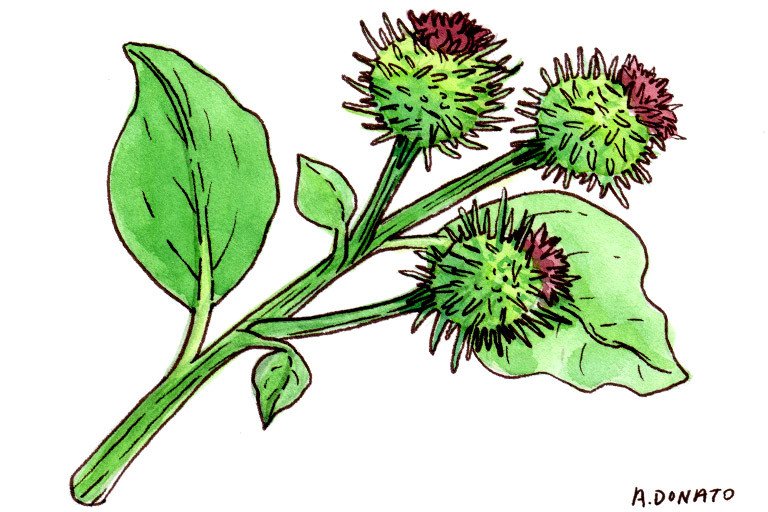
Common Names
- Lappa
- Wild gobo
- Happy major
- Niubang
For Patients & Caregivers
Tell your healthcare providers about any dietary supplements you’re taking, such as herbs, vitamins, minerals, and natural or home remedies. This will help them manage your care and keep you safe.
There is no evidence to support use of burdock to treat cancer, infections, diabetes, or other medical conditions.
Certain components of burdock were shown to stop the growth of bacteria and fungi in lab studies. In animal experiments, the root extract lowered blood sugar, stimulated uterine contractions, induced an immune response, and protected against DNA mutations. A clinical study found that application of a cream containing burdock extract improved the appearance of wrinkled skin.
Some burdock teas are contaminated with alkaloids such as atropine from the belladonna plant, which can cause undesirable effects on the nervous system. Burdock is also one of the ingredients in the herbal tea Essiac, which is promoted as an alternative cancer treatment.
- To treat cancer
Evidence is lacking to support this claim. - To lower blood sugar in diabetes
A small study found that burdock reduced proteinuria and improved post-meal blood glucose levels and lipid metabolism in patients with diabetic nephropathy. - To treat eczema and psoriasis
Evidence is lacking to support this claim. - To treat AIDS
Evidence is lacking to support this claim. - To treat microbial infections
Although certain compounds in burdock can stop the growth of bacteria and fungi in lab studies, human data are lacking. - To promote urination
Evidence is lacking to support this claim. - To reduce wrinkles
One clinical study found that application of a cream containing burdock extract improved the appearance of wrinkled skin. More studies are needed to confirm this effect.
- Allergic Contact Dermatitis
- Anaphylaxis characterized by redness over the entire body and dyspnea: In a 53-year-old man after one hour of consuming boiled burdock. His symptoms resolved following treatment.
- Acute liver injury: In a 36-year-old woman following intake of an herbal liver detox tea containing burdock. Symptoms abated after discontinuing the tea.
Do Not Take if:
- You are allergic to chrysanthemums: You may exhibit cross-sensitivity to burdock.
- You are pregnant: Burdock may stimulate the uterus and increase the risk of premature delivery.
For Healthcare Professionals
Burdock, a perennial plant native to Europe and Northern Asia, is now found worldwide. The root has been consumed as food in Asia for many centuries. Burdock fruit is valued in traditional Chinese medicine as a blood purifier, a cure for sore throat and colds, and as a topical remedy for skin disorders including acne, eczema and psoriasis. It is also used to treat anorexia, gout, cancer and AIDS. Burdock showed anti-inflammatory (1), antibacterial (11), antiulcerogenic (12), hepatoprotective (6), antidiabetic (13) and anticancer (14) effects in preclinical studies.
In small studies, topical use of a formula containing burdock improved dermal extracellular matrix metabolism and visibly reduced wrinkles (4). Oral intake of burdock tea improved inflammatory markers in patients with knee osteoarthritis (18) and formulations containing burdock improved lipid metabolism and postprandial blood glucose in patients with diabetic nephropathy (5), may be useful against Helicobacter pylori infection (19) (20) and reduce the frequency and intensity of night sweats in postmenopausal women (21). Confirmatory studies are needed.
A burdock tea was found contaminated with atropine, an alkaloid (7). Patients should be aware that poor quality control is a major concern with commercial herbal products.
Burdock is also one of the ingredients in the herbal tea Essiac , which is promoted as an alternative cancer treatment.
- Cancer treatment
- Diabetes
- Eczema
- AIDS
- Microbial infections
- Promote urination
- Psoriasis
- Wrinkle reduction
Arctiin and arctigenin, the lignans present in burdock, exert anti-inflammatory effects by inhibit the pro-inflammatory factors, nitric oxide (NO), tumor necrosis factor-alpha (TNF-a), and interleukin-6 (IL-6) (3) (4). The polyacetylenes and chlorogenic acid have antibacterial properties and are thought responsible for burdock’s beneficial effects against infections and skin disorders (11).
Arctigenin and arctiin, along with lignans matairesinol, (iso)lappaol A, lappaol C, and lappaol F were shown to up-regulate the expression of Jun-N-terminal kinase-1 (jnk-1), and promote longetivty and stress resistance in the round worm Caenorhabditis elegans via the JNK-1-DAF-16 cascade (15).
Animal studies indicate that burdock extract induces hypoglycemia and increases carbohydrate tolerance, stimulates uterine smooth muscle, and has antimutagenic activity. The tannin extract induces macrophage response (8). Burdock also exhibits hepatoprotective effects in rats due to its antioxidative activity (6).
Further, Lappaol F was shown to induce G(1) and G(2) cell-cycle arrest, induce cell death in several cancer cell lines, and to activate caspases (16). In other studies, arctigenin inhibited the proliferation, and induced caspase-3-dependent apoptosis of ovarian cancer cells via suppression of inducible nitric oxide synthase (iNOS)/nitric oxide (NO)/signal transducer and activator of transcription-3 (STAT3)/survivin signalling pathway (17).
- Patients allergic to chrysanthemums may exhibit cross-sensitivity to burdock.
- Burdock may cause uterine stimulation and should be avoided by pregnant women.
- Allergic Contact Dermatitis (9)
- Anaphylaxis characterized by redness over the entire body and dyspnea: In a 53-year-old man after one hour of consuming boiled burdock. His symptoms resolved following treatment (10).
- Acute liver injury: In a 36-year-old woman following intake of an herbal liver detox tea containing burdock. Symptoms abated after discontinuing the tea (22).