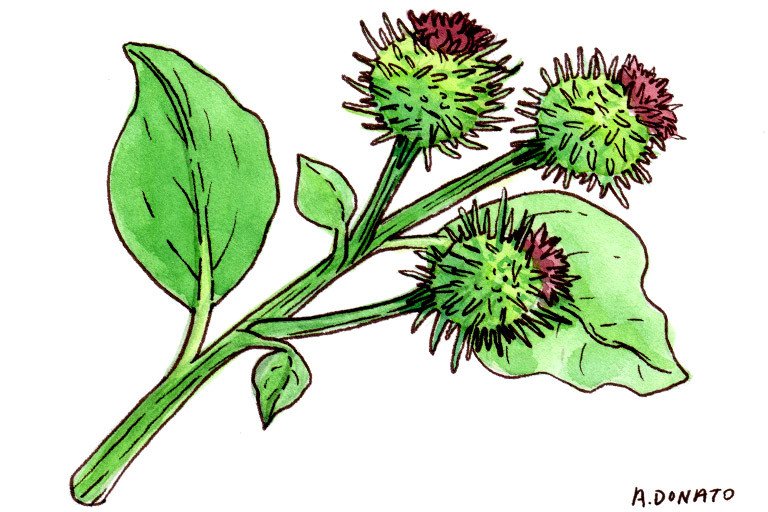
Health Care Professional Information
Scientific Name
Arctium majus, Arctium lappa
Common Name
Lappa, edible burdock, gobo, wild gobo, happy major
Clinical Summary
Derived from the root or seeds of the plant. Historically, burdock has been used as a diuretic and to lower blood sugar. It is also used to treat anorexia, psoriasis, acne, gout, cancer and HIV, although no published clinical studies have evaluated these claims (1) (2). The active components in this supplement are arctiin and arctigenin, lignans that reduced pro-inflammatory factors in vitro (3) (4). Animal studies indicate hepatoprotective (6) and hypoglycemic effects.
A clinical study found that topical application of a formulation containing burdock extract significantly improved dermal extracellular matrix metabolism and visibly reduced wrinkles (4). A mixture of burdock fruit and astragalus root (Fructus Arctii) reduced urinary protein and albumin, and improved lipid metabolism and post-prandial blood glucose in patients with diabetic nephropathy (5).
Cases of burdock tea contaminated with belladonna alkaloids have been reported in the United States (7).
Purported Uses
- Anorexia
- Arthritis
- Cancer treatment
- Diabetes
- Eczema
- HIV and AIDS
- Microbial infection
- Promote urination
- Psoriasis
- Wrinkle reduction
Constituents
- Acids: Acetic, butyric, caffeic, chlorogenic, trans-2-hexenoic, isovaleric, lauric, linoleic, propionic, stearic acid
- Aldehydes: Acetaldehyde, benzaldehyde, butyraldehyde, isovaleraldehyde, and valeraldehyde
- Carbohydrates: Inulin, mucilage, pectin
- Flavonols: Kaempferol, quercetin
- Polyacetylenes
- Other constituents: Volatile oils, sesquiterpene lactone (arctiopicrin), bitters (lappatin), arctiin, arctigenin (3) (4), phytosterols (sitosterol and stigmasterol), tannins
(1)
Mechanism of Action
In vitro studies have shown that the polyacetylene component has antibacterial and fungistatic properties. Both arctiin and arctigenin inhibit the pro-inflammatory factors, nitric oxide (NO), tumor necrosis factor-alpha (TNF-a), and interleukin-6 (IL-6) (3) (4). Animal studies indicate that the root extract induces hypoglycemia and increases carbohydrate tolerance, stimulates uterine smooth muscle, and has antimutagenic activity; the tannin extract induces macrophage response (2) (8). Burdock also exhibits hepatoprotective effects in rats due to its antioxidative activity (6).
Warnings
Some commercial preparations of Burdock tea were found contaminated with belladonna alkaloids (atropine).
Contraindications
Patients allergic to chrysanthemums may exhibit cross-sensitivity to burdock.
Burdock may cause uterine stimulation and should be avoided by pregnant women.
(7)
Adverse Reactions
- Allergic Contact Dermatitis (9)
- Case Report: A 53-year-old man developed anaphylaxis (redness over his entire body and dyspnea) one hour after consuming boiled burdock. His symptoms resolved following treatment (10).
Herb-Drug Interactions
Hypoglycemics: Theoretically, large doses of burdock may have an additive effect.
Literature Summary and Critique
Knott A, et al. Natural Arctium lappa fruit extract improves the clinical signs of aging skin. J Cosmet Dermatol. 2008 Dec;7(4):281-9.
The goal of this study was to identify an active ingredient with anti-inflammatory and dermal matrix stimulating activity for use in a clinical trial studying its effect on the clinical signs of aging skin. In vitro assays with human dermal fibroblasts and monocyte-derived dendritic cells treated with pure arctiin displayed a stimulation in collagen synthesis and decrease in the proinflammatory factors IL-6 and TNF-a, compared to control cells. Topical in vivo application of a formulation containing A. lappa extract for 12 weeks (n=6), found that it significantly increased procollagen synthesis (p=0.01), and hyaluron synthase-2 expression (p<0.05), and improved hyaluron levels, compared to vehicle-treated areas. Treatment with an A. lappa containing formulation for 4 weeks was also found to significantly reduced “crow's feet” wrinkle volume around the eyes (p=0.05; n=38), as compared to treatment with the vehicle.
Wang HY, et al. Clinical observation on treatment of diabetic nephropathy with compound Fructus arctii mixture. Zhongguo Zhong Xi Yi Jie He Za Zhi. 2004 Jul;24(7):589-92.
This controlled clinical trial investigated the effect of a fructus arctii mixture (FAM) (Fructus arctii and astragalus root) in treating patients with diabetic neuropathy. In this study, 31 patients were given FAM and a group of 23 patients receiving Losartan served as the control group. Both groups of patients received FAM for 3 months. During the study, clinical symptoms, blood glucose, lipid metabolism, and urinary albumin were monitored. Study results indicated that patients who received FAM had significantly improved clinical symptoms, urinary protein and albumin, and lipid metabolism (p<0.05), whereas patients in the control group only experienced a significant improvement in urinary albumin level (p<0.05). The authors concluded that FAM was effective in reducing urinary albumin and 24 hour urinary protein, and it also improved post-prandial blood glucose and lipid metabolism.
Dosage (Inside MSKCC Only)
This field is only visible to only Inside MSKCC users.
References
- Newall CA, et al. Herbal Medicines: A Guide for Health-Care Professionals. London: Pharmaceutical Press; 1996.
- Foster S, et al. Tyler's Honest Herbal: A Sensible Guide to the Use of Herbs and Related Remedies. New York: Hawthorn Herbal Press; 1999.
- Zhao F, Wang L, Liu K. In vitro anti-inflammatory effects of arctigenin, a lignan from Arctium lappa L., through inhibition on iNOS pathway. J Ethnopharmacol. 2009 Apr 21;122(3):457-62.
- Knott A, Reuschlein K, Mielke H, et al. Natural Arctium lappa fruit extract improves the clinical signs of aging skin. J Cosmet Dermatol. 2008 Dec;7(4):281-9.
- Wang HY, Chen YP. Clinical observation on treatment of diabetic nephropathy with compound fructus arctii mixture. Zhongguo Zhong Xi Yi Jie He Za Zhi. 2004 Jul;24(7):589-92.
- Lin SC, et al. Hepatoprotective effects of Arctium lappa Linne on liver injuries induced by chronic ethanol consumption and potentiated by carbon tetrachloride. J Biomed Sci 2002 Sep-Oct;9(5):401-9.
- Bryson PD. Burdock root tea poisoning. Case report involving a commercial preparation. JAMA 1978;239:2157.
- Tamayo C, et al. The chemistry and biological acitivity of herbs used in Flor-essence herbal tonic and Essiac. Phytother Res 2000;14:1-14.
- Rodriguez P, Blanco J, Juste S, et al. Allergic contact dermatitis due to burdock (Arctium lappa). Contact Dermatitis 1995 Aug;33(2):134-5.
- Sasaki Y, Kimura Y, Tsunoda T, Tagami H. Anaphylaxis due to burdock. Int J Dermatol. 2003 Jun;42(6):472-3.
Consumer Information
How It Works
Bottom Line: There is no evidence to support use of burdock to treat cancer, infections, diabetes, or other medical conditions.
Burdock extract is derived from the root or seeds of the plant. Certain components of burdock were shown to stop the growth of bacteria and fungi in lab studies. In animal experiments, the root extract lowered blood sugar, stimulated uterine contractions, induced an immune response, and protected against DNA mutations. However, none of these effects have been shown to occur in the human body.
Purported Uses
- To treat cancer
There is no scientific evidence to support this use.
- To lower blood sugar in diabetes
Although studies in animals show this effect. Studies in animals have shown this effect. One small study found that burdock reduced proteinuria and improved post-meal blood glucose levels and lipid metabolism in patients with diabetic nephropathy.
- To treat eczema and psoriasis
No scientific evidence supports this use.
- To treat HIV and AIDS
This claim is not backed by scientific data.
- To treat microbial infections
Although certain compounds in burdock can stop the growth of bacteria and fungi in lab studies, human data are lacking.
- To promote urination
No scientific evidence supports this use.
- To reduce wrinkle
One clinical study found that application of a cream containing burdock extract improved the appearance of wrinkled skin. However, more studies are needed to confirm this effect.
Research Evidence
Aging
The goal of this study was to identify an active ingredient with anti-inflammatory and dermal matrix stimulating activity to treat clinical signs of aging skin. Treatment with a burdock containing formulation for 4 weeks was found to significantly reduce “crow's feet” wrinkle volume around the eyes in the 6 patients of the study.
Diabetic nephropathy
In this study, 31 patients with diabetic nephropathy were given FAM (a mixture of Fructus arctii and astragalus root) for three months, and 23 patients receiving Losartan served as the control group. During the study, clinical symptoms, blood glucose, lipid metabolism, and urinary albumin were monitored. Study results indicated that patients who received FAM had significantly improved clinical symptoms, urinary protein and albumin, and lipid metabolism, whereas patients in the control group only experienced improvement in urinary albumin level. The authors concluded that FAM was effective in reducing urinary albumin and 24 hour urinary protein; it also improved post-prandial blood glucose and lipid metabolism.
Patient Warnings
- Some burdock teas are contaminated with alkaloids such as atropine from the belladonna plant, which can cause undesirable effects on the nervous system.
Do Not Take If
- You are pregnant (Burdock may stimulate the uterus and increase the risk of premature delivery).
- You are taking hypoglycemic medication for diabetes (Based on animal studies, large doses of burdock may lower blood sugar even further.)
Side Effects
- Allergic Contact Dermatitis
- Case Report: A 53-year-old man developed anaphylaxis (redness over his entire body and dyspnea) one hour after taking boiled burdock. His symptoms resolved following treatment.
Special Point
Burdock is one of the ingredients in the herbal tea Essiac.
Last updated: June 28, 2012
albumin
A protein manufactured by the liver.
Source: The National Cancer Institute's Dictionary of Cancer Terms
(http://www.cancer.gov/dictionary)
albumin (al-BYOO-min)
A type of protein found in blood, egg white, milk, and other substances.
Source: The National Cancer Institute's Dictionary of Cancer Terms
(http://www.cancer.gov/dictionary)
anti-inflammatory (AN-tee-in-FLA-muh-TOR-ee)
Having to do with reducing inflammation.
Source: The National Cancer Institute's Dictionary of Cancer Terms
(http://www.cancer.gov/dictionary)
arctigenin (ARK-tih-JEH-nin)
A substance found in certain plants, including burdock. It has shown antiviral and anticancer effects. Arctigenin belongs to a group of substances called lignans.
Source: The National Cancer Institute's Dictionary of Cancer Terms
(http://www.cancer.gov/dictionary)
arctiin (ARK-tine)
A substance found in certain plants, including burdock. It has shown anticancer effects. Arctiin belongs to a group of substances called lignans.
Source: The National Cancer Institute's Dictionary of Cancer Terms
(http://www.cancer.gov/dictionary)
bacteria (bak-TEER-ee-uh)
A large group of single-cell microorganisms. Some cause infections and disease in animals and humans. The singular of bacteria is bacterium.
Source: The National Cancer Institute's Dictionary of Cancer Terms
(http://www.cancer.gov/dictionary)
benzaldehyde (ben-ZAL-deh-hide)
A chemical used in flavorings and in some dyes, perfumes, and medicines. It is found in essential oils made from almonds and peach pits and in other foods. It can also be made in the laboratory.
Source: The National Cancer Institute's Dictionary of Cancer Terms
(http://www.cancer.gov/dictionary)
blood (blud)
A tissue with red blood cells, white blood cells, platelets, and other substances suspended in fluid called plasma. Blood takes oxygen and nutrients to the tissues, and carries away wastes.
Source: The National Cancer Institute's Dictionary of Cancer Terms
(http://www.cancer.gov/dictionary)
blood sugar (blud SHUH-ger)
Glucose (a type of sugar) found in the blood. Also called glycemia.
Source: The National Cancer Institute's Dictionary of Cancer Terms
(http://www.cancer.gov/dictionary)
burdock (BUR-dok)
A plant whose seeds and root have been used in some cultures to treat certain medical problems. It may have antioxidant effects. The scientific name is . Also called happy major and lappa.
Source: The National Cancer Institute's Dictionary of Cancer Terms
(http://www.cancer.gov/dictionary)
cancer (KAN-ser)
A term for diseases in which abnormal cells divide without control and can invade nearby tissues. Cancer cells can also spread to other parts of the body through the blood and lymph systems. There are several main types of cancer. Carcinoma is a cancer that begins in the skin or in tissues that line or cover internal organs. Sarcoma is a cancer that begins in bone, cartilage, fat, muscle, blood vessels, or other connective or supportive tissue. Leukemia is a cancer that starts in blood-forming tissue such as the bone marrow, and causes large numbers of abnormal blood cells to be produced and enter the blood. Lymphoma and multiple myeloma are cancers that begin in the cells of the immune system. Central nervous system cancers are cancers that begin in the tissues of the brain and spinal cord. Also called malignancy.
Source: The National Cancer Institute's Dictionary of Cancer Terms
(http://www.cancer.gov/dictionary)
carbohydrate (KAR-boh-HY-drayt)
A sugar molecule. Carbohydrates can be small and simple (for example, glucose) or they can be large and complex (for example, polysaccharides such as starch, chitin or cellulose).
Source: The National Cancer Institute's Dictionary of Cancer Terms
(http://www.cancer.gov/dictionary)
clinical (KLIH-nih-kul)
Having to do with the examination and treatment of patients.
Source: The National Cancer Institute's Dictionary of Cancer Terms
(http://www.cancer.gov/dictionary)
clinical study (KLIH-nih-kul STUH-dee)
A type of research study that tests how well new medical approaches work in people. These studies test new methods of screening, prevention, diagnosis, or treatment of a disease. Also called clinical trial.
Source: The National Cancer Institute's Dictionary of Cancer Terms
(http://www.cancer.gov/dictionary)
clinical trial (KLIH-nih-kul TRY-ul)
A type of research study that tests how well new medical approaches work in people. These studies test new methods of screening, prevention, diagnosis, or treatment of a disease. Also called clinical study.
Source: The National Cancer Institute's Dictionary of Cancer Terms
(http://www.cancer.gov/dictionary)
collagen (KAH-luh-jen)
A fibrous protein found in cartilage and other connective tissue.
Source: The National Cancer Institute's Dictionary of Cancer Terms
(http://www.cancer.gov/dictionary)
control group (kun-TROLE groop)
In a clinical trial, the group that does not receive the new treatment being studied. This group is compared to the group that receives the new treatment, to see if the new treatment works.
Source: The National Cancer Institute's Dictionary of Cancer Terms
(http://www.cancer.gov/dictionary)
controlled clinical trial (kun-TROLD KLIH-nih-kul TRY-ul)
A clinical study that includes a comparison (control) group. The comparison group receives a placebo, another treatment, or no treatment at all.
Source: The National Cancer Institute's Dictionary of Cancer Terms
(http://www.cancer.gov/dictionary)
DNA
The molecules inside cells that carry genetic information and pass it from one generation to the next. Also called deoxyribonucleic acid.
Source: The National Cancer Institute's Dictionary of Cancer Terms
(http://www.cancer.gov/dictionary)
extract (EK-strakt)
In medicine, a preparation of a substance obtained from plants, animals, or bacteria and used as a drug or in drugs.
Source: The National Cancer Institute's Dictionary of Cancer Terms
(http://www.cancer.gov/dictionary)
glucose (GLOO-kose)
A type of sugar; the chief source of energy for living organisms.
Source: The National Cancer Institute's Dictionary of Cancer Terms
(http://www.cancer.gov/dictionary)
herbal (ER-bul)
Having to do with plants.
Source: The National Cancer Institute's Dictionary of Cancer Terms
(http://www.cancer.gov/dictionary)
HIV
The cause of acquired immunodeficiency syndrome (AIDS). Also called human immunodeficiency virus.
Source: The National Cancer Institute's Dictionary of Cancer Terms
(http://www.cancer.gov/dictionary)
hypoglycemia (HY-poh-gly-SEE-mee-uh)
Abnormally low blood sugar.
Source: The National Cancer Institute's Dictionary of Cancer Terms
(http://www.cancer.gov/dictionary)
IL-6
One of a group of related proteins made by leukocytes (white blood cells) and other cells in the body. IL-6 is made mainly by some T lymphocytes. It causes B lymphocytes to make more antibodies and also causes fever by affecting areas of the brain that control body temperature. IL-6 made in the laboratory is used as a biological response modifier to boost the immune system in cancer therapy. IL-6 is a type of cytokine. Also called interleukin-6.
Source: The National Cancer Institute's Dictionary of Cancer Terms
(http://www.cancer.gov/dictionary)
immune response (ih-MYOON reh-SPONTS)
The activity of the immune system against foreign substances (antigens).
Source: The National Cancer Institute's Dictionary of Cancer Terms
(http://www.cancer.gov/dictionary)
in vitro (in VEE-troh)
In the laboratory (outside the body). The opposite of in vivo (in the body).
Source: The National Cancer Institute's Dictionary of Cancer Terms
(http://www.cancer.gov/dictionary)
in vivo (in VEE-voh)
In the body. The opposite of in vitro (outside the body or in the laboratory).
Source: The National Cancer Institute's Dictionary of Cancer Terms
(http://www.cancer.gov/dictionary)
interleukin-6 (in-ter-LOO-kin...)
One of a group of related proteins made by leukocytes (white blood cells) and other cells in the body. Interleukin-6 is made mainly by some T lymphocytes. It causes B lymphocytes to make more antibodies and also causes fever by affecting areas of the brain that control body temperature. Interleukin-6 made in the laboratory is used as a biological response modifier to boost the immune system in cancer therapy. Interleukin-6 is a type of cytokine. Also called IL-6.
Source: The National Cancer Institute's Dictionary of Cancer Terms
(http://www.cancer.gov/dictionary)
L
A measure of volume for a liquid, using the metric system. One L is equal to 1,000 cubic centimeters (cc), 1,000 milliliters (mm), or 1.0567 quarts (qt). Also called liter.
Source: The National Cancer Institute's Dictionary of Cancer Terms
(http://www.cancer.gov/dictionary)
lipid (LIH-pid)
Fat.
Source: The National Cancer Institute's Dictionary of Cancer Terms
(http://www.cancer.gov/dictionary)
losartan (loh-SAR-tan)
A drug used to treat high blood pressure. Losartan blocks the action of chemicals that make blood vessels constrict (get narrower). It is a type of angiotensin II receptor antagonist. Also called Cozaar and losartan potassium.
Source: The National Cancer Institute's Dictionary of Cancer Terms
(http://www.cancer.gov/dictionary)
macrophage (MA-kroh-fayj)
A type of white blood cell that surrounds and kills microorganisms, removes dead cells, and stimulates the action of other immune system cells.
Source: The National Cancer Institute's Dictionary of Cancer Terms
(http://www.cancer.gov/dictionary)
metabolism (meh-TA-buh-lih-zum)
The chemical changes that take place in a cell or an organism. These changes make energy and the materials cells and organisms need to grow, reproduce, and stay healthy. Metabolism also helps get rid of toxic substances.
Source: The National Cancer Institute's Dictionary of Cancer Terms
(http://www.cancer.gov/dictionary)
necrosis (neh-KROH-sis)
Refers to the death of living tissues.
Source: The National Cancer Institute's Dictionary of Cancer Terms
(http://www.cancer.gov/dictionary)
neuropathy (noor-AH-puh-thee)
A nerve problem that causes pain, numbness, tingling, swelling, or muscle weakness in different parts of the body. It usually begins in the hands or feet and gets worse over time. Neuropathy may be caused by physical injury, infection, toxic substances, disease (such as cancer, diabetes, kidney failure, or malnutrition), or drugs, including anticancer drugs. Also called peripheral neuropathy.
Source: The National Cancer Institute's Dictionary of Cancer Terms
(http://www.cancer.gov/dictionary)
oxide (OK-side)
A type of chemical substance that is a combination of oxygen and another substance. Oxides are found in essential oils.
Source: The National Cancer Institute's Dictionary of Cancer Terms
(http://www.cancer.gov/dictionary)
protein (PROH-teen)
A molecule made up of amino acids that are needed for the body to function properly. Proteins are the basis of body structures such as skin and hair and of substances such as enzymes, cytokines, and antibodies.
Source: The National Cancer Institute's Dictionary of Cancer Terms
(http://www.cancer.gov/dictionary)
proteinuria (PROH-teen-YOOR-ee-uh)
Higher-than-normal amount of protein in the blood.
Source: The National Cancer Institute's Dictionary of Cancer Terms
(http://www.cancer.gov/dictionary)
response (reh-SPONTS)
In medicine, an improvement related to treatment.
Source: The National Cancer Institute's Dictionary of Cancer Terms
(http://www.cancer.gov/dictionary)
sesquiterpene lactone (SES-kwih-TER-peen LAK-tone)
A substance found in some plants. Sesquiterpene lactones may have anti-inflammatory and anticancer effects. Plants containing sesquiterpene lactones have been used in some cultures to treat certain medical problems.
Source: The National Cancer Institute's Dictionary of Cancer Terms
(http://www.cancer.gov/dictionary)
significant (sig-NIH-fih-kunt)
In statistics, describes a mathematical measure of difference between groups. The difference is said to be significant if it is greater than what might be expected to happen by chance alone. Also called statistically significant.
Source: The National Cancer Institute's Dictionary of Cancer Terms
(http://www.cancer.gov/dictionary)
tannin (TA-nin)
A type of chemical found in plants and in certain foods, such as fruits, vegetables, nuts, wine, and tea. Tannins have antioxidant properties and may promote good health. They are being studied in the prevention of cancer, heart disease, and other diseases. They are also used in certain medicines, fabrics, leather, and ink. A tannin is a type of polyphenol. Also called tannic acid.
Source: The National Cancer Institute's Dictionary of Cancer Terms
(http://www.cancer.gov/dictionary)
topical (TAH-pih-kul)
On the surface of the body.
Source: The National Cancer Institute's Dictionary of Cancer Terms
(http://www.cancer.gov/dictionary)
tumor (TOO-mer)
An abnormal mass of tissue that results when cells divide more than they should or do not die when they should. Tumors may be benign (not cancer), or malignant (cancer). Also called neoplasm.
Source: The National Cancer Institute's Dictionary of Cancer Terms
(http://www.cancer.gov/dictionary)
urinary (YOOR-ih-NAYR-ee)
Having to do with urine or the organs of the body that produce and get rid of urine.
Source: The National Cancer Institute's Dictionary of Cancer Terms
(http://www.cancer.gov/dictionary)
uterus (YOO-teh-rus)
The small, hollow, pear-shaped organ in a woman's pelvis. This is the organ in which a fetus develops. Also called womb.
Source: The National Cancer Institute's Dictionary of Cancer Terms
(http://www.cancer.gov/dictionary)