Health Care Professional Information
Common Name
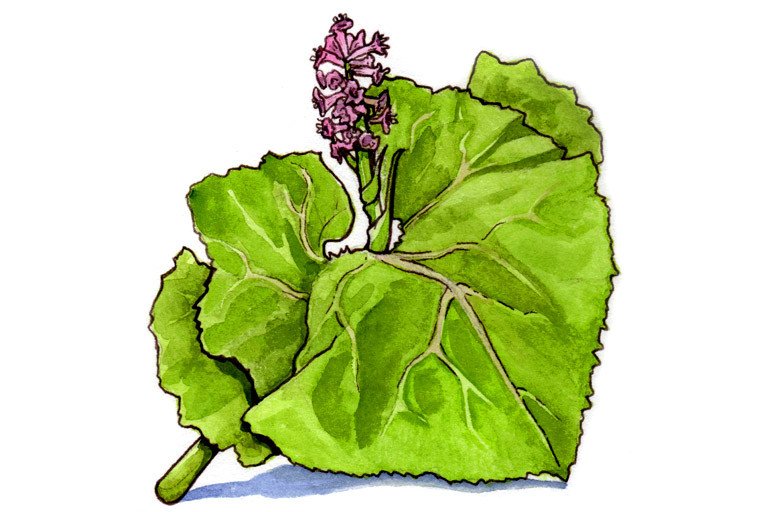
Butterbur, Butter dock, Bog rhubarb, Exwort
Brand Name
ZE 339 (a standardized carbon dioxide extract of butterbur that contains 8mg petasine, Petadolex
Clinical Summary
Butterbur is an herb native to Europe, Southwestern Asia, and North Africa, the leaf and root extracts of which have been used to treat allergies, bronchial asthma, headache, pain, and muscle and urinary tract spasms. Petasins, the sesquiterpene compounds found in Butterbur, are thought to be the active constituents (1) (2) (3).
Leaf and root extracts of Butterbur are effective in controlling migraines in adults and in children (4) (5) (6) (17) (19) and asthma (7). Butterbur extract may also be effective against somatoform disorders (20).
But results from studies on allergic diseases are mixed. Some studies suggest the efficacy of Butterbur extract is comparable to standard antihistamine drugs (8) (9) (10) for allergic rhinitis but conflicting data indicate that it is no better than placebo for intermittent rhinitis (11) or for allergic skin disease (12). A systematic review of trials suggests the need for more rigorous studies before recommending use of Butterbur (13).
Raw butterbur extract may contain excessive toxic pyrrolizidine alkaloids that can cause liver damage (14).
Purported Uses
- Allergic rhinitis
- Asthma
- Migraine
Constituents
- Pyrrolizidine alkaloids
- Sesquiterpene esters: petasin, furanopetasin
(13)
Mechanism of Action
The sesquiterpene petasin is thought to be responsible for butterbur's anti-inflammatory and antiallergic effects by blocking leukotriene and histamine activities (15). Petasins were also shown to have calcium channel blocking effects (18) making them effective for migraine prophylaxis (1). The vasorelaxation effects of petasin may be via direct Ca(2+) antagonism of L-type voltage-dependent Ca(2+) channel (VDCC) in vascular smooth muscle (21). Butterbur extract showed dose-dependent inhibition effect on cyclooxygenase (COX2) and prostaglandin E2 in vitro that is not correlated to the petasin content (16).
Contraindications
- Hypersensitivity to Butterbur
- Patients with liver disease or dysfunction should avoid raw butterbur extract with pyrrolizidine alkaloids due to potential for hepatotoxicity.
Literature Summary and Critique
Danesch UC. Petasites hybridus (Butterbur root) extract in the treatment of asthma—an open trial. Altern Med Rev 2004;9(1):54-62.
In a prospective, non-randomized open trial, 80 patients were treated for two months with butterbur extract followed by two months of optimal intake of extract. Patients had either mild or moderate asthma and were allowed to continue to receive their asthma medication. The number, duration, and severity of asthma attacks decreased, while peak flow, forced ecpiratory volume (FEV1) and all measured symptoms improved during therapy. Forty percent of patients who were receiving asthma medications reduced their intake of the medications during the course of the study. Adverse events were considered not related to the use of butterbur and did not lead to withdrawal of any subjects in the study.
Lee DK, Gray RD, Robb FM, et al. A placebo-controlled evaluation of butterbur and fexofenadine on objective and subjective outcomes in perennial allergic rhinitis. Clin Exp Allergy 2004;34(4):646-9.
In a double-blind crossover placebo-controlled trial, 16 patients were randomized to receive butterbur 50 mg twice a day, fexofenadine 180 mg, or placebo. Peak nasal inspiratory flow (PNIF) was evaluated. There was a significant PNIF fall from baseline with butterbur compared to placebo. There was also a reduction in total nasal symptoms. Authors conclude that butterbur and fexofenadine may be equally effective in improving nasal symptoms in allergic rhinitis.
Dosage (Inside MSKCC Only)
This field is only visible to only Inside MSKCC users.
References
- Thomet OA. Wiesmann UN, Schapowal A, et al. Role of petasin in the potential anti-inflammatory activity of a plant extract of petasites hybridus. Biochem Pharmacol 2001;61(8):1041-7.
- Thomet OA, Simon HU. Petasins in the treatment of allergic diseases: results of preclinical and clinical studies. Int Arch Allergy Immunol 2002;129(2):108-12.
- Saritas Y, von Reuss SH, Konig WA. Sesquiterpene constituents in Petasites hybridus. Phytochemistry 2002;59(8):795-803.
- Diener HC, Rahlfs VW, Danesch U, The first placebo-controlled trial of a special butterbur root extract for the prevention of migraine: reanalysis of efficacy criteria. Eur Neurol 2004;51(2):89-97.
- Grossman W, Schmidramsl H. An extract of Petasites hybridus is effective in the prophylaxis of migraine. Altern Med Rev 2001;6(3):303-10.
- Lipton RB, Gobel H, Einhaupl KM, et al. Petasites hybridus root (butterbur) is an effective preventive treatment for migraine. Neurology 2004;63(12):2240-4.
- Danesch UC. Petasites hybridus (Butterbur root) extract in the treatment of asthma—an open trial. Altern Med Rev 2004;9(1):54-62.
- Schapowal A: Petasites Study Group. Randomised controlled trial of butterbur and cetirizine for treating seasonal allergic rhinitis. BMJ 2002;324(7330):144-6.
- Schapowal A. Butterbur Ze339 for the treatment of intermittent allergic rhinitis: dose-dependent efficacy in a prospective, randomized, double-blind, placebo-controlled study. Arch Otolaryngol Head Neck Surg. Dec 2004;130(12):1381-1386.
- Schapowal A: A Study Group. Treating intermittent allergic rhinitis: a prospective, randomized, placebo and antihistamine-controlled study of Butterbur extract Ze 339. Phytother Res 2005;19(6):530-7.
- Gray RD, Haggart K, Lee DK, Cull S, Lipworth BJ. Effects of butterbur treatment in intermittent allergic rhinitis: a placebo-controlled evaluation. Ann Allergy Asthma Immunol. Jul 2004;93(1):56-60.
- Jackson CM, Lee DK, Lipworth BJ. The effects of butterbur on the histamine and allergen cutaneous response. Ann Allergy Asthma Immunol. Feb 2004;92(2):250-254.
- Agosti R, Duke RK, Chrubasik JE, Chrubasik S. Effectiveness of Petasites hybridus preparations in the prophylaxis of migraine: a systematic review. Phytomedicine. Nov 2006;13(9-10):743-746.
- Wildi E, Langer T, Schaffner W, Buter KB. Quantitative analysis of petasin and pyrrolizidine alkaloids in leaves and rhizomes of in situ grown Petasites hybridus plants. Planta Med. Apr 1998;64(3):264-267.
- Thomet OA, Schapowal A, Heinisch IV, Wiesmann UN, Simon HU. Anti-inflammatory activity of an extract of Petasites hybridus in allergic rhinitis. Int Immunopharmacol. Jun 2002;2(7):997-1006.
- Fiebich BL, Grozdeva M, Hess S, et al. Petasites hybridus extracts in vitro inhibit COX-2 and PGE2 release by direct interaction with the enzyme and by preventing p42/44 MAP kinase activation in rat primary microglial cells. Planta Med. Jan 2005;71(1):12-19.
- Sun-Edelstein C, Mauskop A. Foods and supplements in the management of migraine headaches. Clin J Pain. 2009 Jun;25(5):446-52. Review.
- Sheykhzade M, Smajilovic S, Issa A, et al. S-petasin and butterbur lactones dilate vessels through blockage of voltage gated calcium channels and block DNA synthesis. Eur J Pharmacol. 2008 Sep 28;593(1-3):79-86.
- Oelkers-Ax R, Leins A, Parzer P, et al. Butterbur root extract and music therapy in the prevention of childhood migraine: an explorative study. Eur J Pain. 2008 Apr;12(3):301-13.
- Melzer J, Schrader E, Brattström A, Schellenberg R, Saller R. Fixed herbal drug combination with and without butterbur (Ze 185) for the treatment of patients with somatoform disorders: randomized, placebo-controlled pharmaco-clinical trial. Phytother Res. 2009 Sep;23(9):1303-8.
- Wang GJ, Lin YL, Chen CH, et al. Cellular calcium regulatory machinery of vasorelaxation elicited by petasin. Clin Exp Pharmacol Physiol. 2010 Mar;37(3):309-15.
Consumer Information
How It Works
Bottom Line: Butterbur extracts have been shown effective in the treatment of migraines and allergies.
Butterbur is an herb native to Europe, Southwestern Asia, and North Africa. It has been used to treat allergies, asthma, headache, and muscle spasms. Butterbur was shown in clinical studies to be effective for migraines, allergic rhinitis (inflammation of the mucus membranes of nose marked by runny nose, congestion, itching, and sneezing) and asthma.
Purported Uses
- Allergic rhinitis
- Butterbur was shown to have benefits for allergic rhinitis.
- Migraine
Several clinical trials have shown that Butterbur extract is effective but more well designed studies are needed.
- Asthma
Some studies have shown that Butterbur may be beneficial.
Research Evidence
Asthma
Eighty patients were treated in a non-randomized study for two months with butterbur extract followed by two months of optimal intake of extract. Patients had either mild or moderate asthma and were allowed to continue to receive their asthma medication. The number, duration, and severity of asthma attacks decreased during therapy. Forty percent of patients reduced their intake of asthma medications during the course of the study.
Allergic rhinitis
In another study, 16 patients were randomized to receive butterbur 50 mg twice a day, fexofenadine 180 mg, or placebo. There was a reduction in total nasal symptoms in both the butterbur and fexofenadine groups. Butterbur and fexofenadine may be equally effective in improving nasal symptoms in patients with allergic rhinitis.
Do Not Take If
- You are hypersensitive to Butterbur.
- You have liver disease or dysfunction because some compounds present in Butterbur can be damaging to the liver.
Last updated: July 12, 2012
antihistamine (AN-tee-HIS-tuh-meen)
A type of drug that blocks the action of histamines, which can cause fever, itching, sneezing, a runny nose, and watery eyes. Antihistamines are used to prevent fevers in patients receiving blood transfusions and to treat allergies, coughs, and colds.
Source: The National Cancer Institute's Dictionary of Cancer Terms
(http://www.cancer.gov/dictionary)
asthma (AZ-muh)
A chronic disease in which the bronchial airways in the lungs become narrowed and swollen, making it difficult to breathe. Symptoms include wheezing, coughing, tightness in the chest, shortness of breath, and rapid breathing. An attack may be brought on by pet hair, dust, smoke, pollen, mold, exercise, cold air, or stress.
Source: The National Cancer Institute's Dictionary of Cancer Terms
(http://www.cancer.gov/dictionary)
baseline (BAYS-line)
An initial measurement that is taken at an early time point to represent a beginning condition, and is used for comparison over time to look for changes. For example, the size of a tumor will be measured before treatment (baseline) and then afterwards to see if the treatment had an effect.
Source: The National Cancer Institute's Dictionary of Cancer Terms
(http://www.cancer.gov/dictionary)
calcium (KAL-see-um)
A mineral needed for healthy teeth, bones, and other body tissues. It is the most common mineral in the body. A deposit of calcium in body tissues, such as breast tissue, may be a sign of disease.
Source: The National Cancer Institute's Dictionary of Cancer Terms
(http://www.cancer.gov/dictionary)
clinical (KLIH-nih-kul)
Having to do with the examination and treatment of patients.
Source: The National Cancer Institute's Dictionary of Cancer Terms
(http://www.cancer.gov/dictionary)
dose-dependent (dose-deh-PEN-dent)
Refers to the effects of treatment with a drug. If the effects change when the dose of the drug is changed, the effects are said to be dose-dependent.
Source: The National Cancer Institute's Dictionary of Cancer Terms
(http://www.cancer.gov/dictionary)
dysfunction (dis-FUNK-shun)
A state of not functioning normally.
Source: The National Cancer Institute's Dictionary of Cancer Terms
(http://www.cancer.gov/dictionary)
efficacy (EH-fih-kuh-see)
Effectiveness. In medicine, the ability of an intervention (for example, a drug or surgery) to produce the desired beneficial effect.
Source: The National Cancer Institute's Dictionary of Cancer Terms
(http://www.cancer.gov/dictionary)
extract (EK-strakt)
In medicine, a preparation of a substance obtained from plants, animals, or bacteria and used as a drug or in drugs.
Source: The National Cancer Institute's Dictionary of Cancer Terms
(http://www.cancer.gov/dictionary)
fexofenadine (FEK-soh-FEH-nuh-deen)
A drug used to treat certain allergy symptoms. It blocks a chemical released during an allergic response that causes itching, sneezing, runny nose, wheezing, and watery eyes. It is a type of antihistamine. Also called Allegra.
Source: The National Cancer Institute's Dictionary of Cancer Terms
(http://www.cancer.gov/dictionary)
hypersensitivity (HY-per-SEN-sih-tih-vih-tee)
An exaggerated response by the immune system to a drug or other substance.
Source: The National Cancer Institute's Dictionary of Cancer Terms
(http://www.cancer.gov/dictionary)
in vitro (in VEE-troh)
In the laboratory (outside the body). The opposite of in vivo (in the body).
Source: The National Cancer Institute's Dictionary of Cancer Terms
(http://www.cancer.gov/dictionary)
liver (LIH-ver)
A large organ located in the upper abdomen. The liver cleanses the blood and aids in digestion by secreting bile.
Source: The National Cancer Institute's Dictionary of Cancer Terms
(http://www.cancer.gov/dictionary)
medication (MEH-dih-KAY-shun)
A legal drug that is used to prevent, treat, or relieve symptoms of a disease or abnormal condition.
Source: The National Cancer Institute's Dictionary of Cancer Terms
(http://www.cancer.gov/dictionary)
mucus (MYOO-kus)
A thick, slippery fluid made by the membranes that line certain organs of the body, including the nose, mouth, throat, and vagina.
Source: The National Cancer Institute's Dictionary of Cancer Terms
(http://www.cancer.gov/dictionary)
nasal (NAY-zul)
By or having to do with the nose.
Source: The National Cancer Institute's Dictionary of Cancer Terms
(http://www.cancer.gov/dictionary)
placebo (pluh-SEE-boh)
An inactive substance or treatment that looks the same as, and is given the same way as, an active drug or treatment being tested. The effects of the active drug or treatment are compared to the effects of the placebo.
Source: The National Cancer Institute's Dictionary of Cancer Terms
(http://www.cancer.gov/dictionary)
placebo-controlled (pluh-SEE-boh-kun-TROLD)
Refers to a clinical study in which the control patients receive a placebo.
Source: The National Cancer Institute's Dictionary of Cancer Terms
(http://www.cancer.gov/dictionary)
prophylaxis (PROH-fih-LAK-sis)
An attempt to prevent disease.
Source: The National Cancer Institute's Dictionary of Cancer Terms
(http://www.cancer.gov/dictionary)
prospective (pruh-SPEK-tiv)
In medicine, a study or clinical trial in which participants are identified and then followed forward in time.
Source: The National Cancer Institute's Dictionary of Cancer Terms
(http://www.cancer.gov/dictionary)
prostaglandin (PROS-tuh-GLAN-din)
One of several hormone-like substances made by the body. Different prostaglandins control blood pressure, contraction of smooth muscles, and other processes within tissues where they are made. Certain prostaglandins are being studied as cancer biomarkers. Also called PG.
Source: The National Cancer Institute's Dictionary of Cancer Terms
(http://www.cancer.gov/dictionary)
randomized
Describes an experiment or clinical trial in which animal or human subjects are assigned by chance to separate groups that compare different treatments.
Source: The National Cancer Institute's Dictionary of Cancer Terms
(http://www.cancer.gov/dictionary)
reduction (ree-DUK-shun)
A chemical reaction that takes place when a substance comes into contact with hydrogen or another reducing substance.
Source: The National Cancer Institute's Dictionary of Cancer Terms
(http://www.cancer.gov/dictionary)
significant (sig-NIH-fih-kunt)
In statistics, describes a mathematical measure of difference between groups. The difference is said to be significant if it is greater than what might be expected to happen by chance alone. Also called statistically significant.
Source: The National Cancer Institute's Dictionary of Cancer Terms
(http://www.cancer.gov/dictionary)
therapy (THAYR-uh-pee)
Treatment.
Source: The National Cancer Institute's Dictionary of Cancer Terms
(http://www.cancer.gov/dictionary)
toxic (TOK-sik)
Having to do with poison or something harmful to the body. Toxic substances usually cause unwanted side effects.
Source: The National Cancer Institute's Dictionary of Cancer Terms
(http://www.cancer.gov/dictionary)