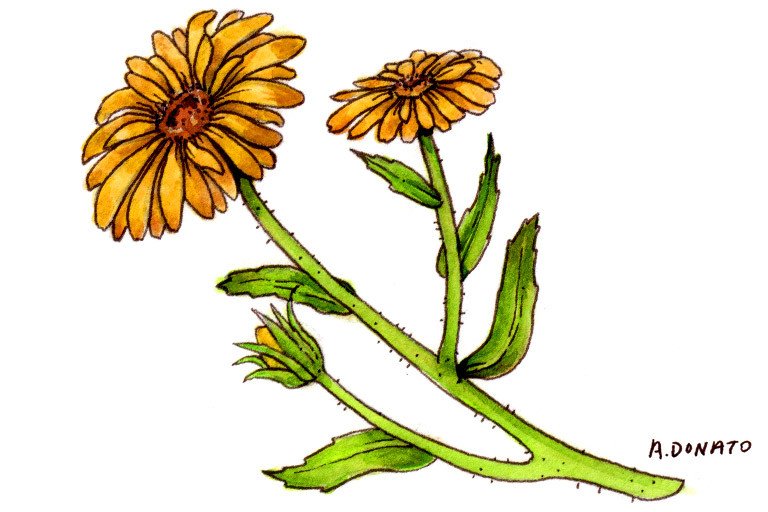
Health Care Professional Information
Common Name
Gold-bloom, Marigold, Marybud, Pot Marigold
Clinical Summary
Extracted from the flower of the marigold plant, calendula is used topically for wound healing (1). Major constituents of the leaves and stems of the plant include lutein and beta-carotene (2). Extracts from calendula demonstrated anti-inflammatory properties (3), which may improve wound healing (4), and antibacterial, antiparasitic (5), anti-HIV (6), cytotoxic and anti-tumor effects (9) (10) both in vitro and in vivo. Further, studies done in mice indicate hepato-, reno- (14), photo- (15), and cardioprotective (16) properties.
An herbal formulation containing calendula was found effective in reducing earache in children with acute otitis media (7) (8).
Topical application of a calendula cream was shown safe and effective in infants as well for treating diaper dermatitis (21).
Preliminary data support use of topical calendula for prophylaxis of acute dermatitis during radiation therapy (11) (13); and a mouthwash containing calendula against chemotherapy-induced stomatitis (17). More research is needed.
Purported Uses
- Conjunctivitis
- Eczema
- GI disorders
- Inflammation
- Menstrual cramps
- Menstrual disorder
- Radiation therapy side effects
- Spasms
- Varicose veins
Constituents
- Flavonoids
- Polysaccharides
- Triterpenoids (oleanolic acid)
- Volatile Oils
(3) (5) (14)
Mechanism of Action
The triterpenoids from calendula have been shown to have anti-inflammatory (3) and anti-HIV (6)effects, and a calendula extract suppressed cell fusion, which may inhibit early events in the HIV replication cycle (6). The most active triterpenoid is a monoester of faradiol (1). Calendula also exhibits hepato- and reno-protective effects which are likely due to its antioxidant activity (14). The photoprotective effect of topical gel formulations of calendula is thought to be associated with an improvement in collagen synthesis in the sub-epidermal connective tissue (15). Calendula also affords cardioprotection which involves modulating the antioxidant and anti-inflammatory pathways by activation of Akt (a serine/threonine protein kinase) and Bcl2 (a protein that regulates apoptosis) and down regulation of tumor necrosis factor (TNF alpha) (16). In another study, calendula was shown to inhibit human gingival fibroblast-mediated degradation of collagen and matrix metalloprotease (MMP-2) activity (18).
In a recent study, the essential oil from calendula flowers was shown to have sun protection activity (19)
Application of a cream containing essential oil of calendula prevented UV-B-induced alterations in the skin in a study of rats (20). Calendula extract also accelerated healing of experimentally-induced thermal burns in rats by increasing collagen-hydroxyproline and hexosamine, bio-indicators of wound healing(4).
Contraindications
Calendula should be avoided during pregnancy and lactation because safety data are lacking (1).
Adverse Reactions
Calendula is known to cause allergic reactions (1) (12).
Literature Summary and Critique
Dosage (Inside MSKCC Only)
This field is only visible to only Inside MSKCC users.
References
- Barnes J, Anderson LA, Phillipson JD. Herbal Medicines. London: Pharmaceutical Press; 2002.
- Bako E, Deli J, Toth G. HPLC study on the carotenoid composition of Calendula products. J Biochem Biophys Methods. Oct-Nov 2002;53(1-3):241-250.
- Akihisa T, Yasukawa K, Oinuma H, et al. Triterpene alcohols from the flowers of compositae and their anti-inflammatory effects. Phytochemistry. Dec 1996;43(6):1255-1260.
- Chandran PK, Kuttan R. Effect of Calendula officinalis Flower Extract on Acute Phase Proteins, Antioxidant Defense Mechanism and Granuloma Formation During Thermal Burns. J Clin Biochem Nutr. Sep 2008;43(2):58-64.
- Szakiel A, Ruszkowski D, Grudniak A, et al. Antibacterial and Antiparasitic Activity of Oleanolic Acid and its Glycosides isolated from Marigold (Calendula officinalis).Planta Med. Nov 2008;74(14):1709-1715.
- Kalvatchev Z, Walder R, Garzaro D. Anti-HIV activity of extracts from Calendula officinalis flowers. Biomed Pharmacother. 1997;51(4):176-180.
- Sarrell EM, Cohen HA, Kahan E. Naturopathic treatment for ear pain in children. Pediatrics. May 2003;111(5 Pt 1):e574-579.
- Sarrell EM, Mandelberg A, Cohen HA.Efficacy of naturopathic extracts in the management of ear pain associated with acute otitis media. Arch Pediatr Adolesc Med. Jul 2001;155(7):796-799.
- Boucaud-Maitre Y, Algernon O, Raynaud J. Cytotoxic and antitumoral activity of Calendula officinalis extracts. Pharmazie. Mar 1988;43(3):220-221.
- Ukiya M, Akihisa T, Yasukawa K, et al. Anti-inflammatory, anti-tumor-promoting, and cytotoxic activities of constituents of marigold (Calendula officinalis) flowers. J Nat Prod. Dec 2006;69(12):1692-1696.
- Pommier P, Gomez F, Sunyach MP, et al. Phase III randomized trial of Calendula officinalis compared with trolamine for the prevention of acute dermatitis during irradiation for breast cancer. J Clin Oncol. Apr 15 2004;22(8):1447-1453.
- Reider N, Komericki P, Hausen BM, et al. The seamy side of natural medicines: contact sensitization to arnica (Arnica montana L.) and marigold (Calendula officinalis L.). Contact Dermatitis. 2001 Nov;45(5):269-72.
- Kassab S, Cummings M, Berkovitz S, et al. Homeopathic medicines for adverse effects of cancer treatments. Cochrane Database Syst Rev. 2009 Apr 15;(2):CD004845. Review.
- Preethi KC, Kuttan R. Hepato and reno protective action of Calendula officinalis L. flower extract. Indian J Exp Biol. 2009 Mar;47(3):163-8.
- Fonseca YM, Catini CD, Vicentini FT, et al. Efficacy of marigold extract-loaded formulations against UV-induced oxidative stress. J Pharm Sci. 2011 Jun;100(6):2182-93.
- Ray D, Mukherjee S, Falchi M, Bertelli A, Das DK. Amelioration of myocardial ischemic reperfusion injury with Calendula officinalis. Curr Pharm Biotechnol. 2010 Dec;11(8):849-54.
- Oberbaum M, Yaniv I, Ben-Gal Y, et al. A randomized, controlled clinical trial of the homeopathic medication TRAUMEEL S in the treatment of chemotherapy-induced stomatitis in children undergoing stem cell transplantation. Cancer. 2001 Aug 1;92(3):684-90.
- Saini P, Al-Shibani N, Sun J, et al. Effects of Calendula officinalis on human gingival fibroblasts. Homeopathy. 2012 Apr;101(2):92-8.
- Mishra A, Mishra A, Chattopadhyay P. Assessment of In vitro Sun Protection Factor of Calendula Officinalis L. (Asteraceae) Essential Oil Formulation. J Young Pharm. 2012 Jan;4(1):17-21.
- Mishra AK, Mishra A, Verma A, Chattopadhyay P. Effects of Calendula Essential Oil-Based Cream on Biochemical Parameters of Skin of Albino Rats against Ultraviolet B Radiation. Sci Pharm. 2012 Sep;80(3):669-83.
- Panahi Y, Sharif MR, Sharif A, et al. A randomized comparative trial on the therapeutic efficacy of topical aloe vera and Calendula officinalis on diaper dermatitis in children. Scientific World Journal. 2012;2012:810234.
Consumer Information
How It Works
Bottom Line: Topical application of calendula may reduce painful swelling and irritation associated with radiation therapy. It has not been shown to treat cancer.
Naturally occurring chemicals derived from the marigold plant have been shown to reduce inflammation in laboratory studies. These chemicals, which are called triterpenoids, also inhibit HIV virus and some tumors. When applied to the skin, extracts of calendula help to heal wounds and inflammation after radiation therapy. More research is needed.
Purported Uses
- To heal burns and scalds
Laboratory and animal studies show that calendula, when applied to the skin, has anti-inflammatory properties, and reduces burn tissue injury in animals. However, studies have not been undertaken to determine if this corresponds to faster healing of burns and scalds. Also, clinical studies in humans have not been performed.
- To treat painful menstruation
No scientific evidence supports this use.
- To prevent skin inflammation
Calendula ointment applied to the skin reduced painful swelling and irritation associated with radiation therapy in breast cancer patients.
- To treat spasms
No scientific evidence supports this use.
- To treat varicose veins
This claim is not backed by scientific data.
Research Evidence
Radiation Therapy Associated Dermatitis
Two hundred fifty-four breast cancer patients undergoing radiation therapy participated in a trial of Calendula to see if it would reduce skin inflammation due to radiation therapy. The patients were randomly assigned to receive a topical ointment containing either Calendula or trolamine. Trolamine is a standard treatment for skin inflammation. Subjects who used calendula had fewer cases of severe skin inflammation. Because the texture, color, and smell of the two ointments were quite different, patients knew which treatment they were receiving but researchers did not know which treatment they had received. This study suggests that calendula ointment may be used as a preventive treatment for skin inflammation due to radiation therapy.
Do Not Take If
- You are allergic to plants in the Asteraceae/Compositae family.
- You are pregnant or lactating because safety data are lacking.
Side Effects
- Calendula can cause allergic reactions.
Last updated: January 23, 2013
acute (uh-KYOOT)
Symptoms or signs that begin and worsen quickly; not chronic.
Source: The National Cancer Institute's Dictionary of Cancer Terms
(http://www.cancer.gov/dictionary)
Akt
A group of enzymes involved in several processes related to cell growth and survival. Akt enzymes help to transfer signals inside cells. An Akt enzyme is a type of serine/threonine protein kinase. Also called protein kinase B.
Source: The National Cancer Institute's Dictionary of Cancer Terms
(http://www.cancer.gov/dictionary)
anti-inflammatory (AN-tee-in-FLA-muh-TOR-ee)
Having to do with reducing inflammation.
Source: The National Cancer Institute's Dictionary of Cancer Terms
(http://www.cancer.gov/dictionary)
antibacterial (AN-tee-bak-TEER-ee-ul)
A substance that kills bacteria or stops them from growing and causing disease.
Source: The National Cancer Institute's Dictionary of Cancer Terms
(http://www.cancer.gov/dictionary)
antioxidant (AN-tee-OK-sih-dent)
A substance that protects cells from the damage caused by free radicals (unstable molecules made by the process of oxidation during normal metabolism). Free radicals may play a part in cancer, heart disease, stroke, and other diseases of aging. Antioxidants include beta-carotene, lycopene, vitamins A, C, and E, and other natural and manufactured substances.
Source: The National Cancer Institute's Dictionary of Cancer Terms
(http://www.cancer.gov/dictionary)
antiparasitic (AN-tee-PAYR-uh-SIH-tik)
A drug used to treat infections caused by bacteria and parasites. It is also used in the treatment of some cancers.
Source: The National Cancer Institute's Dictionary of Cancer Terms
(http://www.cancer.gov/dictionary)
BCL2
A protein that helps control whether a cell lives or dies by blocking a type of cell death called apoptosis. The gene for BCL2 is found on chromosome 18, and transfer of the BCL2 gene to a different chromosome is seen in many B-cell leukemias and lymphomas. This causes the BCL2 protein to be made in larger amounts, which may keep cancer cells from dying. Also called B-cell leukemia/lymphoma 2 protein.
Source: The National Cancer Institute's Dictionary of Cancer Terms
(http://www.cancer.gov/dictionary)
breast (brest)
Glandular organ located on the chest. The breast is made up of connective tissue, fat, and breast tissue that contains the glands that can make milk. Also called mammary gland.
Source: The National Cancer Institute's Dictionary of Cancer Terms
(http://www.cancer.gov/dictionary)
breast cancer (brest KAN-ser)
Cancer that forms in tissues of the breast, usually the ducts (tubes that carry milk to the nipple) and lobules (glands that make milk). It occurs in both men and women, although male breast cancer is rare.
Source: The National Cancer Institute's Dictionary of Cancer Terms
(http://www.cancer.gov/dictionary)
calendula ointment (kuh-LEN-juh-luh OYNT-ment)
A substance made from the flower of the marigold plant . Calendula-based skin products have been used to treat minor cuts, burns, and skin irritation. The products that are available in the United States may not contain the same amount or mixture of ingredients and may not be effective. Another product, Calendula ointment, is being studied in France in the prevention of dermatitis in patients having radiation therapy for breast cancer. The ointment being studied is not available in the United States.
Source: The National Cancer Institute's Dictionary of Cancer Terms
(http://www.cancer.gov/dictionary)
cancer (KAN-ser)
A term for diseases in which abnormal cells divide without control and can invade nearby tissues. Cancer cells can also spread to other parts of the body through the blood and lymph systems. There are several main types of cancer. Carcinoma is a cancer that begins in the skin or in tissues that line or cover internal organs. Sarcoma is a cancer that begins in bone, cartilage, fat, muscle, blood vessels, or other connective or supportive tissue. Leukemia is a cancer that starts in blood-forming tissue such as the bone marrow, and causes large numbers of abnormal blood cells to be produced and enter the blood. Lymphoma and multiple myeloma are cancers that begin in the cells of the immune system. Central nervous system cancers are cancers that begin in the tissues of the brain and spinal cord. Also called malignancy.
Source: The National Cancer Institute's Dictionary of Cancer Terms
(http://www.cancer.gov/dictionary)
cell (sel)
The individual unit that makes up the tissues of the body. All living things are made up of one or more cells.
Source: The National Cancer Institute's Dictionary of Cancer Terms
(http://www.cancer.gov/dictionary)
clinical (KLIH-nih-kul)
Having to do with the examination and treatment of patients.
Source: The National Cancer Institute's Dictionary of Cancer Terms
(http://www.cancer.gov/dictionary)
collagen (KAH-luh-jen)
A fibrous protein found in cartilage and other connective tissue.
Source: The National Cancer Institute's Dictionary of Cancer Terms
(http://www.cancer.gov/dictionary)
connective tissue (kuh-NEK-tiv TIH-shoo)
Supporting tissue that surrounds other tissues and organs. Specialized connective tissue includes bone, cartilage, blood, and fat.
Source: The National Cancer Institute's Dictionary of Cancer Terms
(http://www.cancer.gov/dictionary)
cytotoxic (SY-toh-TOK-sik)
Cell-killing.
Source: The National Cancer Institute's Dictionary of Cancer Terms
(http://www.cancer.gov/dictionary)
dermatitis (DER-muh-TY-tis)
Inflammation of the skin.
Source: The National Cancer Institute's Dictionary of Cancer Terms
(http://www.cancer.gov/dictionary)
essential oil (eh-SENT-shul oyl)
The scented liquid taken from certain plants using steam or pressure. Essential oils contain the natural chemicals that give the plant its “essence” (specific odor and flavor). Essential oils are used in perfumes, food flavorings, medicine, and aromatherapy.
Source: The National Cancer Institute's Dictionary of Cancer Terms
(http://www.cancer.gov/dictionary)
extract (EK-strakt)
In medicine, a preparation of a substance obtained from plants, animals, or bacteria and used as a drug or in drugs.
Source: The National Cancer Institute's Dictionary of Cancer Terms
(http://www.cancer.gov/dictionary)
GI
Refers to the stomach and intestines. Also called gastrointestinal.
Source: The National Cancer Institute's Dictionary of Cancer Terms
(http://www.cancer.gov/dictionary)
grade (grayd)
A description of a tumor based on how abnormal the cancer cells look under a microscope and how quickly the tumor is likely to grow and spread. Grading systems are different for each type of cancer.
Source: The National Cancer Institute's Dictionary of Cancer Terms
(http://www.cancer.gov/dictionary)
herbal (ER-bul)
Having to do with plants.
Source: The National Cancer Institute's Dictionary of Cancer Terms
(http://www.cancer.gov/dictionary)
HIV
The cause of acquired immunodeficiency syndrome (AIDS). Also called human immunodeficiency virus.
Source: The National Cancer Institute's Dictionary of Cancer Terms
(http://www.cancer.gov/dictionary)
in vitro (in VEE-troh)
In the laboratory (outside the body). The opposite of in vivo (in the body).
Source: The National Cancer Institute's Dictionary of Cancer Terms
(http://www.cancer.gov/dictionary)
in vivo (in VEE-voh)
In the body. The opposite of in vitro (outside the body or in the laboratory).
Source: The National Cancer Institute's Dictionary of Cancer Terms
(http://www.cancer.gov/dictionary)
inflammation (IN-fluh-MAY-shun)
Redness, swelling, pain, and/or a feeling of heat in an area of the body. This is a protective reaction to injury, disease, or irritation of the tissues.
Source: The National Cancer Institute's Dictionary of Cancer Terms
(http://www.cancer.gov/dictionary)
necrosis (neh-KROH-sis)
Refers to the death of living tissues.
Source: The National Cancer Institute's Dictionary of Cancer Terms
(http://www.cancer.gov/dictionary)
ointment (OYNT-ment)
A substance used on the skin to soothe or heal wounds, burns, rashes, scrapes, or other skin problems. Also called unguent.
Source: The National Cancer Institute's Dictionary of Cancer Terms
(http://www.cancer.gov/dictionary)
postoperative (post-AH-pruh-tiv)
After surgery.
Source: The National Cancer Institute's Dictionary of Cancer Terms
(http://www.cancer.gov/dictionary)
pregnancy (PREG-nun-see)
The condition between conception (fertilization of an egg by a sperm) and birth, during which the fertilized egg develops in the uterus. In humans, pregnancy lasts about 288 days.
Source: The National Cancer Institute's Dictionary of Cancer Terms
(http://www.cancer.gov/dictionary)
preventive (pree-VEN-tiv)
Used to prevent disease.
Source: The National Cancer Institute's Dictionary of Cancer Terms
(http://www.cancer.gov/dictionary)
prophylaxis (PROH-fih-LAK-sis)
An attempt to prevent disease.
Source: The National Cancer Institute's Dictionary of Cancer Terms
(http://www.cancer.gov/dictionary)
protein (PROH-teen)
A molecule made up of amino acids that are needed for the body to function properly. Proteins are the basis of body structures such as skin and hair and of substances such as enzymes, cytokines, and antibodies.
Source: The National Cancer Institute's Dictionary of Cancer Terms
(http://www.cancer.gov/dictionary)
radiation (RAY-dee-AY-shun)
Energy released in the form of particle or electromagnetic waves. Common sources of radiation include radon gas, cosmic rays from outer space, medical x-rays, and energy given off by a radioisotope (unstable form of a chemical element that releases radiation as it breaks down and becomes more stable).
Source: The National Cancer Institute's Dictionary of Cancer Terms
(http://www.cancer.gov/dictionary)
radiation therapy (RAY-dee-AY-shun THAYR-uh-pee)
The use of high-energy radiation from x-rays, gamma rays, neutrons, protons, and other sources to kill cancer cells and shrink tumors. Radiation may come from a machine outside the body (external-beam radiation therapy), or it may come from radioactive material placed in the body near cancer cells (internal radiation therapy). Systemic radiation therapy uses a radioactive substance, such as a radiolabeled monoclonal antibody, that travels in the blood to tissues throughout the body. Also called irradiation and radiotherapy.
Source: The National Cancer Institute's Dictionary of Cancer Terms
(http://www.cancer.gov/dictionary)
randomized
Describes an experiment or clinical trial in which animal or human subjects are assigned by chance to separate groups that compare different treatments.
Source: The National Cancer Institute's Dictionary of Cancer Terms
(http://www.cancer.gov/dictionary)
replication cycle (reh-plih-KAY-shun...)
In biology, refers to the reproduction cycle of viruses. A repliction cycle begins with the infection of a host cell and ends with the release of mature progeny virus particles.
Source: The National Cancer Institute's Dictionary of Cancer Terms
(http://www.cancer.gov/dictionary)
stomatitis (STOH-muh-TY-tis)
Inflammation or irritation of the mucous membranes in the mouth.
Source: The National Cancer Institute's Dictionary of Cancer Terms
(http://www.cancer.gov/dictionary)
surgery (SER-juh-ree)
A procedure to remove or repair a part of the body or to find out whether disease is present. An operation.
Source: The National Cancer Institute's Dictionary of Cancer Terms
(http://www.cancer.gov/dictionary)
therapy (THAYR-uh-pee)
Treatment.
Source: The National Cancer Institute's Dictionary of Cancer Terms
(http://www.cancer.gov/dictionary)
tissue (TIH-shoo)
A group or layer of cells that work together to perform a specific function.
Source: The National Cancer Institute's Dictionary of Cancer Terms
(http://www.cancer.gov/dictionary)
topical (TAH-pih-kul)
On the surface of the body.
Source: The National Cancer Institute's Dictionary of Cancer Terms
(http://www.cancer.gov/dictionary)
tumor (TOO-mer)
An abnormal mass of tissue that results when cells divide more than they should or do not die when they should. Tumors may be benign (not cancer), or malignant (cancer). Also called neoplasm.
Source: The National Cancer Institute's Dictionary of Cancer Terms
(http://www.cancer.gov/dictionary)
virus (VY-rus)
In medicine, a very simple microorganism that infects cells and may cause disease. Because viruses can multiply only inside infected cells, they are not considered to be alive.
Source: The National Cancer Institute's Dictionary of Cancer Terms
(http://www.cancer.gov/dictionary)
wound (woond)
A break in the skin or other body tissues caused by injury or surgical incision (cut).
Source: The National Cancer Institute's Dictionary of Cancer Terms
(http://www.cancer.gov/dictionary)