Common Names
- Entelev®
- Cantron®; Sheridan's formula; JS-114; JS-101
- 126-F; Jim's Juice; Quantrol; Protocel®
For Patients & Caregivers
Tell your healthcare providers about any dietary supplements you’re taking, such as herbs, vitamins, minerals, and natural or home remedies. This will help them manage your care and keep you safe.
Cancell® has not been shown to treat or prevent cancer.
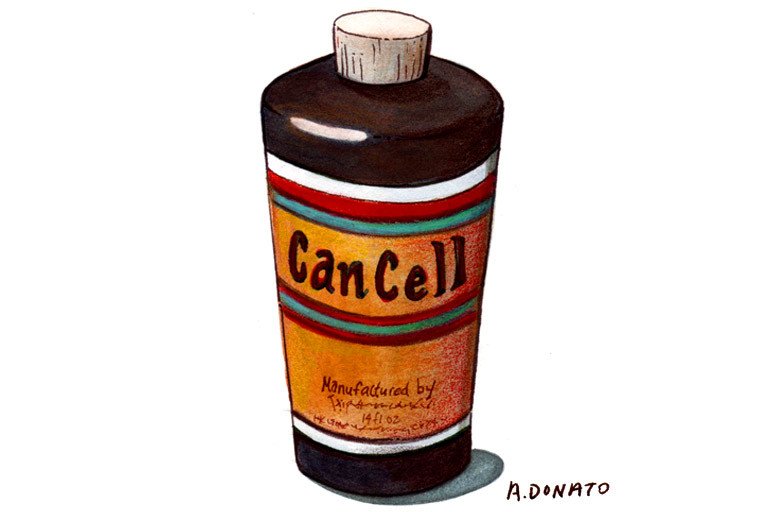
CanCell® (also called Entelev® or Cantron®) was developed by a chemist in the 1930s. Its exact ingredients are unknown, but it is thought to contain catechol (stabilizes collagen and is used in tanning and dyeing), nitric acid (an intermediate used in the manufacturing of fertilizers and explosives), sodium sulfite, potassium hydroxide (a caustic material), sulfuric acid (a corrosive liquid), crocinic acid, and various minerals and vitamins. This mixture of chemicals, the manufacturers claim, normalizes cellular metabolism and balances the vibrational frequency of cancer cells, causing them to die or return to a healthy state. Scientists from the National Cancer Institute reviewed these theories, tested CanCell® in laboratory studies on cancer cells, and concluded that CanCell® has no anticancer activity.
None of the following claims is supported by scientific evidence.
- To treat Alzheimer's disease
- To treat cancer
- To treat cystic fibrosis
- To treat Diabetes
- To treat emphysema
- To treat epilepsy
- To treat Epstein-Barr virus
- To treat hemophilia
- To treat herpes
- To treat HIV and AIDS
- To lower high blood pressure
- To raise low blood pressure
- To treat multiple sclerosis
- To treat scleroderma
- To treat systemic lupus erythematosus (SLE)
For Healthcare Professionals
Cancell is an unproven alternative treatment which contains a variety of ingredients depending on manufacturer (e.g catechol, nitric acid, sodium sulfite, potassium hydroxide, sulfuric acid, crocinic acid, and various minerals and vitamins). Patients use this product to prevent and treat cancer, HIV/AIDS, epilepsy, Alzheimer’s, and other immunologic and degenerative diseases.
Proposed by James Sheridan in the 1930s, CanCell® is believed to balance the vibrational frequency of cancer cells, thereby returning them to their healthy state. This theory is not supported by scientific evidence (1) (2). Manufacturers of CanCell® discourage combining CanCell® with conventional oncology treatments (1). Patients should avoid this product.
- Alzheimer’s disease
- Cancer treatment
- Cystic fibrosis
- Diabetes
- Emphysema
- Epilepsy
- Hemophilia
- Herpes
- HIV and AIDS
- Hypertension
- Hypotension
- Multiple sclerosis
- Scleroderma
- Systemic lupus erythematosus (SLE)
- Viral infections
Manufacturers of CanCell® and Cantron® offer different theories to explain the anticancer activities of these products: Cancer cells function at a “critical point” of cellular respiration, above which normal cells function aerobically, and below which abnormal anaerobic cells are destroyed as foreign matter. The catechol component is claimed to inhibit cellular respiration in cancer cells so that they might fall from the “critical point” to a primitive state and self-destruct. In addition, CanCell® is thought to balance the vibrational frequency of cancer cells, returning them to a normal state.
The manufacturers of Cantron® claim that imbalance in cellular respiration results in cellular damage. Cantron® is believed to help maintain balance through the electrolyte and antioxidant properties of its hydroxyquinone and catechol components. Neither set of claims is supported by scientific data.
(1) (2)