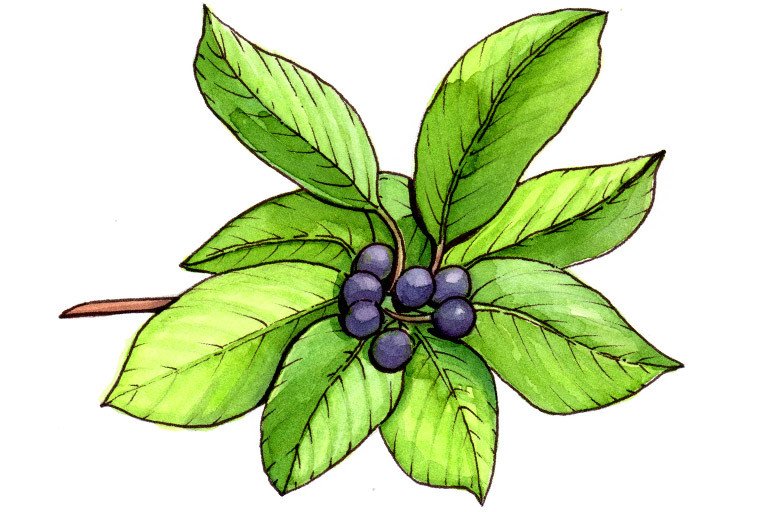
Common Names
- Cascara sagrada
- Sacred bark
For Patients & Caregivers
Tell your healthcare providers about any dietary supplements you’re taking, such as herbs, vitamins, minerals, and natural or home remedies. This will help them manage your care and keep you safe.
Cascara is a strong laxative. It has not been shown to treat or prevent cancer.
Cascara is made out of the bark of the Cascara sagrada plant. It is known to stimulate the large intestine and produces a well-documented laxative effect. Cascara also causes water and electrolytes such as sodium and potassium to be expelled with the feces. This eases bowel passage but can also lead to dangerously low potassium and sodium levels if cascara is used for prolonged periods of time.
Scientists have isolated a compound called aloe-emodin from cascara. In laboratory studies, this compound inhibited the growth of tumor cells, but it is unknown if this effect would take place in the human body. Scientists have also studied whether cascara might be a carcinogen, with inconsistent results.
Cascara is one of the ingredients in the Hoxsey herbal therapy, which is promoted to treat cancer. However, there is no evidence that Hoxsey herbal therapy is effective in treating cancer.
- To relieve constipation
Scientific evidence supports this use, but prolonged use is not recommended because it can lead to dangerous blood electrolyte imbalances and potential liver toxicity. - To treat cancer
Lab studies show that aloe-emodin from cascara has anticancer activity. However, lab results often do not translate to effectiveness in humans, and clinical trials have not yet been conducted.
Abdominal cramps, electrolyte imbalance, diarrhea and weight loss with excess use.
Case Reports
Liver disease such as severe or acute hepatitis have been reported.
Patient Warnings:
- Long-term use or overdose of cascara can cause electrolyte imbalances like very low blood levels of potassium, sodium, and chloride. It may also lead to liver injury.
- Whether cascara may be a cancer-causing substance is uncertain, as studies have produced conflicting results.
Do Not Take if:
- You are taking drugs that are substrates of P-Glycoprotein (P-Gp): Emodin, a compound present in cascara inhibits P-Gp, and may affect how these drugs are absorbed or metabolized. Clinical relevance has yet to be determined.
For Healthcare Professionals
Cascara sagrada is a species of buckthorn plant native to North America. The bark of the plant has been used to relieve constipation and is marketed as a dietary supplement. It is also used as an ingredient in the Hoxsey herbal formula, an ineffective alternative cancer treatment.
The major constituents are cascarosides that stimulate the large intestine and produce a laxative effect. In vitro studies suggest that emodin, one of the constituents, has hepatoprotective (17), neuroprotective (18), anti-osteoporotic (21), and chemopreventive effects (10) (12) (13). Emodin also enhances the cytotoxic effects of some chemotherapeutic agents (14) (15) (19) (20). However, human studies have not been conducted to confirm these effects.
Prolonged use or overdose of cascara can cause diarrhea, electrolyte imbalance, and hepatitis (7) (11).
Food flavoring agent
- Cancer treatment
- Constipation
Cascarosides stimulate the large intestine, increasing intestinal motility and contractions to produce a well-documented laxative effect. Increased water and electrolyte content in the lumen also results, which further facilitates bowel passage. The constituent emodin has direct excitatory effect on circular smooth muscle cells in the large intestine (9).
Emodin may play a protective role against osteoporosis. It was shown to suppress the receptor activator of nuclear factor-κB (NF-κB) ligand (RANKL)-induced osteoclast differentiation of bone marrow macrophages (BMMs), and the bone resorption of mature osteoclasts via inhibiting expression of RANKL-induced NF-κB, c-Fos, and NFATc1 (21).
In vitro studies suggest anticancer properties, as aloe-emodin induces p53 and p21 expression that results in G1-phase cell cycle arrest (8). However, more studies are needed to confirm such effects. Studies on the carcinogenic effects of cascara have produced conflicting results (4) (5) (6) (10).
Chronic use may cause electrolyte imbalance (11), especially hypokalemia.
P-Glycoprotein (P-Gp): Emodin inhibits the activity of P-Glycoprotein in vitro and in vivo, and may affect the transport of drugs mediated by this protein (22). Clinical relevance has yet to be determined.