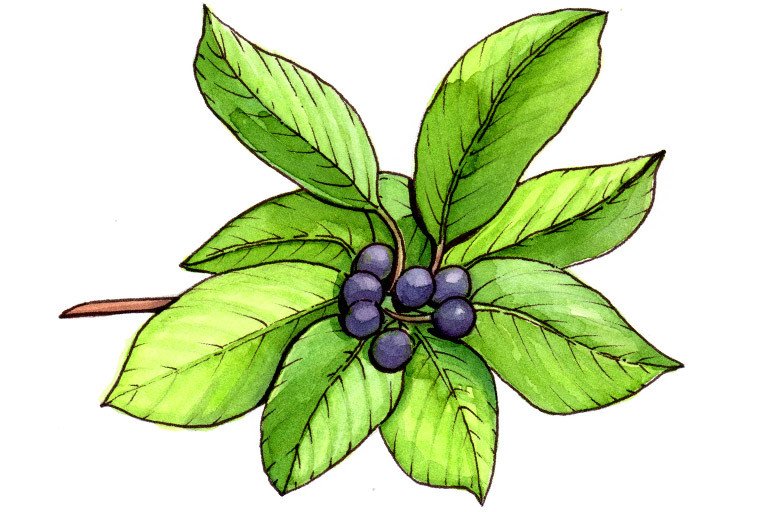
Health Care Professional Information
Common Name
Cascara Sagrada, Sacred Bark
Clinical Summary
Derived from the bark of the plant, cascara is mainly used to relieve constipation. The major constituents are cascarosides that stimulate the large intestine and produce a laxative effect. Cascara is one of the herbs incorporated in the Hoxsey herbal therapy.
In vitro studies indicate that emodin, one of the constituents of cascara, has hepatoprotective (17), neuroprotective (18), and chemopreventive effects (10) (12) (13). Emodin also enhances the cytotoxic effects of some chemotherapeutic agents (14) (15) (19) (20). Human studies have not been conducted to confirm these effects.
Prolonged use or overdose of cascara may cause diarrhea, electrolyte imbalance and hepatitis (7).
Constituents
Anthracene glycosides:Cascarosides, aloins, chrysaloins, aloe-emodin, chrysophanol, emodin and physcion
Others: Linoleic acid, myristic acid, syringic acid, lipids, resin and tannin
(1)
Mechanism of Action
The major constituents cascarosides stimulate the large intestine and produce a well-documented laxative effect (1) (3). Cascarosides increase intestinal motility and lead to propulsive contractions. This results in an increased water and electrolyte content in the lumen, which further facilitates bowel passage. The other constituent emodin has direct excitatory effect on circular smooth muscle cells in the large intestine (9). Cascara's anticancer activities may arise from its emodin and aloe-emodin content. In vitro studies show that aloe-emodin induces p53 and p21 expression resulting in cell cycle arrest in the G1 phase (8). However, more studies are needed to confirm this effect. Studies on the carcinogenic effects of cascara have produced conflicting results (4) (5) (6) (10).
Pharmacokinetics
After ingestion, cascara glycosides pass through the small intestine unchanged. Upon reaching the large intestine, glycosides are hydrolysed and activated by local bacteria. Studies show that the dimeric aglycones are well absorbed through the intestinal wall and strongly bind to plasma proteins. Aglycones are excreted through the bile.
(9)
Contraindications
Cascara should not be used by patients with intestinal obstruction or undiagnosed abdominal symptoms. Patients with inflammatory bowel disease should use caution with this supplement.
Anthraquinone-containing laxatives like cascara should not be used by pregnant or nursing mothers.
Adverse Reactions
Reported: Fresh cascara contains anthrones, which may cause vomiting and intestinal cramps.
Toxicity: Excessive use can cause diarrhea and weakness.
(2) (3)
Rare: Cascara has been associated with cholestatic hepatitis (7).
Case Report: Toxic hepatitis has been been reported with use of cascara (16).
Herb-Drug Interactions
Diuretics: Cascara can cause excessive loss of potassium.
Digoxin: Cascara may potentiate cardiac effects.
(1)
Herb Lab Interactions
Decreased serum potassium.
Anthraquinones in cascara may discolor the urine and interfere with diagnostic tests.
(3)
Literature Summary and Critique
Clinical trials have not been conducted to evaluate cascara.
Dosage (Inside MSKCC Only)
This field is only visible to only Inside MSKCC users.
References
- Barnes J, et al. Herbal Medicines. Second Ed. London: Pharmaceutical Press; 2002.
- DerMarderosian A, editor. The Review of Natural Products. St. Louis: Facts and Comparisons; 1999.
- Gruenwald J, et al. PDR for Herbal medicines, Montvale (NJ): Medical Economics Company; 1998.
- Borrelli F, et al. Effect of bisacodyl and cascara on growth of aberrant crypt foci and malignant tumors in the rat colon. Life Sci 2001;69:1871-7.
- Wang H, et al. Induction of cytochromes P450 1A1 and 1B1 by emodin in human lung adenocarcinoma cell line CL5. Drug Metab Dispos 2001;29:1229-35.
- Mereto E, et al. Evaluation of the potential carcinogenic activity of Senna and Cascara glycosides for the rat colon. Cancer Lett 1996;101:79-83.
- Nadir A, et al. Cascara sagrada-induced intrahepatic cholestasis causing portal hypertension: case report and review of herbal hepatotoxicity. Am J Gastroenterol 2000;95:3634-7.
- Kuo P, et al. The antiproliferative activity of aloe-emodin is through p53-dependent and p21-dependent apoptotic pathway in human hepatoma cell lines. Life Sci 2002;71:1879-92.
- DeWitte P, et al. Bicascarosides in fluid extracts of cascara. Planta Med 1991;57:440-3.
- Koyama J, et al. Chemopreventive effects of emodin and cassiamin B in mouse skin carcinogenesis. Cancer Lett 2002;182:135-9.
- Food and Drug Administration. http://www.fda.gov/ohrms/dockets/98fr/050902a.htm. May 9, 2002. Accessed March 27, 2012.
- Wang XD, Gu LQ, Wu JY. Apoptosis-inducing activity of new pyrazole emodin derivatives in human hepatocellular carcinoma HepG2 cells. Biol Pharm Bull. 2007 Jun;30(6):1113-6.
- Huang Z, Chen G, Shi P. Emodin-induced apoptosis in human breast cancer BCap-37 cells through the mitochondrial signaling pathway. Arch Pharm Res. 2008 Jun;31(6):742-8.
- Huang XZ, Wang J, Huang C, et al. Emodin enhances cytotoxicity of chemotherapeutic drugs in prostate cancer cells: the mechanisms involve ROS-mediated suppression of multidrug resistance and hypoxia inducible factor-1. Cancer Biol Ther. 2008 Mar;7(3):468-75.
- Li J, Liu P, Mao H, et al. Emodin sensitizes paclitaxel-resistant human ovarian cancer cells to paclitaxel-induced apoptosis in vitro. Oncol Rep. 2009 Jun;21(6):1605-10.
- Jacobsen C, Semb S, Kromann-Andersen H. [Toxic hepatitis following consumption of the herbal medicinal product Cascara Sagrada]. Ugeskr Laeger. 2009 Nov 9;171(46):3367-9.
- Bhadauria M. Dose-dependent hepatoprotective effect of emodin against acetaminophen-induced acute damage in rats. Exp Toxicol Pathol. 2010 Nov;62(6):627-35.
- Liu T, Jin H, Sun QR, Xu JH, Hu HT. Neuroprotective effects of emodin in rat cortical neurons against beta-amyloid-induced neurotoxicity. Brain Res. 2010 Aug 6;1347:149-60.
- Chen RS, Jhan JY, Su YJ, et al. Emodin enhances gefitinib-induced cytotoxicity via Rad51 downregulation and ERK1/2 inactivation. Exp Cell Res. 2009 Sep 10;315(15):2658-72.
- Ko JC, Su YJ, Lin ST, et al. Emodin enhances cisplatin-induced cytotoxicity via down-regulation of ERCC1 and inactivation of ERK1/2. Lung Cancer. 2010 Aug;69(2):155-64.
Consumer Information
How It Works
Bottom Line: Cascara is a strong laxative, but the FDA warns that it is not safe to use. It has not been shown to treat or prevent cancer.
Cascara is made out of the bark of the Cascara sagrada plant. It is known to stimulate the large intestine and produce a well-documented laxative effect. Cascara also causes water and electrolytes (such as sodium and potassium) to flow into the large intestine and be expelled from the body with the feces. This facilitates bowel passage but also can lead to dangerously low potassium and sodium levels if cascara is used for prolonged periods of time. Scientists have isolated a compound called aloe-emodin from cascara. In laboratory studies, this compound is able to inhibit the growth of tumor cells by halting cell division, but it is unknown if this effect would take place in the human body. Scientists have also studied whether cascara might be a carcinogen, with inconsistent results.
Purported Uses
- To relieve constipation
Scientific evidence supports this use, but prolonged use is not recommended because it can lead to dangerous blood electrolyte imbalances. The FDA warns that cascara is not safe to use as a laxative.
- To treat cancer
Laboratory studies show that a compound found in cascara, aloe-emodin, has anticancer activity, but laboratory results are often not transferable to the human body. Clinical trials have not yet been conducted.
Patient Warnings
- Long-term use or overdose of cascara can cause electrolyte imbalances, characterized by very low blood levels of potassium, sodium, and chloride. It may lead to liver injury. The FDA has warned that cascara is not safe to use as a laxative.
- Cascara may be a carcinogen (cancer-causing substance).
- Certain compounds in cascara can discolor urine and interfere with urinalysis.
Do Not Take If
- You are pregnant or nursing (the safety of cascara is not known).
- You are taking diuretics (cascara can cause excessive loss of potassium).
- You are taking digoxin (cascara may have additive cardiac effects because it can cause low blood potassium levels).
Special Point
Cascara is one of the ingredients in the Hoxsey herbal therapy, which is promoted for cancer. There is no evidence that the Hoxsey herbal therapy is effective in treating cancer.
Last updated: March 27, 2012
abdominal (ab-DAH-mih-nul)
Having to do with the abdomen, which is the part of the body between the chest and the hips that contains the pancreas, stomach, intestines, liver, gallbladder, and other organs.
Source: The National Cancer Institute's Dictionary of Cancer Terms
(http://www.cancer.gov/dictionary)
aloe-emodin (A-loh-EH-muh-din)
A substance found in certain plants, including aloe vera. It belongs to a family of compounds called anthraquinones, which have shown anti-inflammatory and anticancer effects.
Source: The National Cancer Institute's Dictionary of Cancer Terms
(http://www.cancer.gov/dictionary)
bacteria (bak-TEER-ee-uh)
A large group of single-cell microorganisms. Some cause infections and disease in animals and humans. The singular of bacteria is bacterium.
Source: The National Cancer Institute's Dictionary of Cancer Terms
(http://www.cancer.gov/dictionary)
bile (bile)
A fluid made by the liver and stored in the gallbladder. Bile is excreted into the small intestine, where it helps digest fat.
Source: The National Cancer Institute's Dictionary of Cancer Terms
(http://www.cancer.gov/dictionary)
blood (blud)
A tissue with red blood cells, white blood cells, platelets, and other substances suspended in fluid called plasma. Blood takes oxygen and nutrients to the tissues, and carries away wastes.
Source: The National Cancer Institute's Dictionary of Cancer Terms
(http://www.cancer.gov/dictionary)
bowel (BOW-ul)
The long, tube-shaped organ in the abdomen that completes the process of digestion. The bowel has two parts, the small bowel and the large bowel. Also called intestine.
Source: The National Cancer Institute's Dictionary of Cancer Terms
(http://www.cancer.gov/dictionary)
cancer (KAN-ser)
A term for diseases in which abnormal cells divide without control and can invade nearby tissues. Cancer cells can also spread to other parts of the body through the blood and lymph systems. There are several main types of cancer. Carcinoma is a cancer that begins in the skin or in tissues that line or cover internal organs. Sarcoma is a cancer that begins in bone, cartilage, fat, muscle, blood vessels, or other connective or supportive tissue. Leukemia is a cancer that starts in blood-forming tissue such as the bone marrow, and causes large numbers of abnormal blood cells to be produced and enter the blood. Lymphoma and multiple myeloma are cancers that begin in the cells of the immune system. Central nervous system cancers are cancers that begin in the tissues of the brain and spinal cord. Also called malignancy.
Source: The National Cancer Institute's Dictionary of Cancer Terms
(http://www.cancer.gov/dictionary)
carcinogen (kar-SIH-noh-jin)
Any substance that causes cancer.
Source: The National Cancer Institute's Dictionary of Cancer Terms
(http://www.cancer.gov/dictionary)
cardiac (KAR-dee-ak)
Having to do with the heart.
Source: The National Cancer Institute's Dictionary of Cancer Terms
(http://www.cancer.gov/dictionary)
cell (sel)
The individual unit that makes up the tissues of the body. All living things are made up of one or more cells.
Source: The National Cancer Institute's Dictionary of Cancer Terms
(http://www.cancer.gov/dictionary)
clinical (KLIH-nih-kul)
Having to do with the examination and treatment of patients.
Source: The National Cancer Institute's Dictionary of Cancer Terms
(http://www.cancer.gov/dictionary)
compound (KOM-pownd)
In science, a substance that is made up of more than one ingredient.
Source: The National Cancer Institute's Dictionary of Cancer Terms
(http://www.cancer.gov/dictionary)
cytotoxic (SY-toh-TOK-sik)
Cell-killing.
Source: The National Cancer Institute's Dictionary of Cancer Terms
(http://www.cancer.gov/dictionary)
diarrhea (dy-uh-REE-uh)
Frequent and watery bowel movements.
Source: The National Cancer Institute's Dictionary of Cancer Terms
(http://www.cancer.gov/dictionary)
electrolyte (ee-LEK-troh-lite)
A substance that breaks up into ions (particles with electrical charges) when it is dissolved in water or body fluids. Some examples of ions are sodium, potassium, calcium, chloride, and phosphate. These ions help move nutrients into cells, help move waste out of cells, and help nerves, muscles, the heart, and the brain work the way they should.
Source: The National Cancer Institute's Dictionary of Cancer Terms
(http://www.cancer.gov/dictionary)
emodin (EH-moh-din)
A substance found in certain plants, including rhubarb. It belongs to a family of compounds called anthraquinones, which have shown anti-inflammatory and anticancer effects.
Source: The National Cancer Institute's Dictionary of Cancer Terms
(http://www.cancer.gov/dictionary)
FDA
An agency in the U.S. federal government whose mission is to protect public health by making sure that food, cosmetics, and nutritional supplements are safe to use and truthfully labeled. The FDA also makes sure that drugs, medical devices, and equipment are safe and effective, and that blood for transfusions and transplant tissue are safe. Also called Food and Drug Administration.
Source: The National Cancer Institute's Dictionary of Cancer Terms
(http://www.cancer.gov/dictionary)
feces (FEE-seez)
The material in a bowel movement. Feces is made up of undigested food, bacteria, mucus, and cells from the lining of the intestines. Also called stool.
Source: The National Cancer Institute's Dictionary of Cancer Terms
(http://www.cancer.gov/dictionary)
hepatitis (HEH-puh-TY-tis)
Disease of the liver causing inflammation. Symptoms include an enlarged liver, fever, nausea, vomiting, abdominal pain, and dark urine.
Source: The National Cancer Institute's Dictionary of Cancer Terms
(http://www.cancer.gov/dictionary)
herbal (ER-bul)
Having to do with plants.
Source: The National Cancer Institute's Dictionary of Cancer Terms
(http://www.cancer.gov/dictionary)
in vitro (in VEE-troh)
In the laboratory (outside the body). The opposite of in vivo (in the body).
Source: The National Cancer Institute's Dictionary of Cancer Terms
(http://www.cancer.gov/dictionary)
inflammatory (in-FLA-muh-TOR-ee)
Having to do with inflammation (redness, swelling, pain, and a feeling of heat that helps protect tissues affected by injury or disease).
Source: The National Cancer Institute's Dictionary of Cancer Terms
(http://www.cancer.gov/dictionary)
ingestion (in-JES-chun)
Taking into the body by mouth.
Source: The National Cancer Institute's Dictionary of Cancer Terms
(http://www.cancer.gov/dictionary)
intestinal (in-TES-tih-nul)
Having to do with the intestines.
Source: The National Cancer Institute's Dictionary of Cancer Terms
(http://www.cancer.gov/dictionary)
intestine (in-TES-tin)
The long, tube-shaped organ in the abdomen that completes the process of digestion. The intestine has two parts, the small intestine and the large intestine. Also called bowel.
Source: The National Cancer Institute's Dictionary of Cancer Terms
(http://www.cancer.gov/dictionary)
large intestine (larj in-TES-tin)
The long, tube-like organ that is connected to the small intestine at one end and the anus at the other. The large intestine has four parts: cecum, colon, rectum, and anal canal. Partly digested food moves through the cecum into the colon, where water and some nutrients and electrolytes are removed. The remaining material, solid waste called stool, moves through the colon, is stored in the rectum, and leaves the body through the anal canal and anus.
Source: The National Cancer Institute's Dictionary of Cancer Terms
(http://www.cancer.gov/dictionary)
laxative (LAK-suh-tiv)
A substance that promotes bowel movements.
Source: The National Cancer Institute's Dictionary of Cancer Terms
(http://www.cancer.gov/dictionary)
liver (LIH-ver)
A large organ located in the upper abdomen. The liver cleanses the blood and aids in digestion by secreting bile.
Source: The National Cancer Institute's Dictionary of Cancer Terms
(http://www.cancer.gov/dictionary)
lumen (LOO-men)
The cavity or channel within a tube or tubular organ such as a blood vessel or the intestine.
Source: The National Cancer Institute's Dictionary of Cancer Terms
(http://www.cancer.gov/dictionary)
obstruction (ub-STRUK-shun)
Blockage of a passageway.
Source: The National Cancer Institute's Dictionary of Cancer Terms
(http://www.cancer.gov/dictionary)
overdose (OH-ver-dose)
An amount of drug that is more than what should be taken at one time.
Source: The National Cancer Institute's Dictionary of Cancer Terms
(http://www.cancer.gov/dictionary)
plasma (PLAZ-muh)
The clear, yellowish, fluid part of the blood that carries the blood cells. The proteins that form blood clots are in plasma.
Source: The National Cancer Institute's Dictionary of Cancer Terms
(http://www.cancer.gov/dictionary)
potassium (puh-TA-see-um)
A metallic element that is important in body functions such as regulation of blood pressure and of water content in cells, transmission of nerve impulses, digestion, muscle contraction, and heartbeat.
Source: The National Cancer Institute's Dictionary of Cancer Terms
(http://www.cancer.gov/dictionary)
serum (SEER-um)
The clear liquid part of the blood that remains after blood cells and clotting proteins have been removed.
Source: The National Cancer Institute's Dictionary of Cancer Terms
(http://www.cancer.gov/dictionary)
small intestine (... in-TES-tin)
The part of the digestive tract that is located between the stomach and the large intestine.
Source: The National Cancer Institute's Dictionary of Cancer Terms
(http://www.cancer.gov/dictionary)
sodium (SOH-dee-um)
A mineral needed by the body to keep body fluids in balance. Sodium is found in table salt and in many processed foods. Too much sodium can cause the body to retain water.
Source: The National Cancer Institute's Dictionary of Cancer Terms
(http://www.cancer.gov/dictionary)
therapy (THAYR-uh-pee)
Treatment.
Source: The National Cancer Institute's Dictionary of Cancer Terms
(http://www.cancer.gov/dictionary)
toxic (TOK-sik)
Having to do with poison or something harmful to the body. Toxic substances usually cause unwanted side effects.
Source: The National Cancer Institute's Dictionary of Cancer Terms
(http://www.cancer.gov/dictionary)
tumor (TOO-mer)
An abnormal mass of tissue that results when cells divide more than they should or do not die when they should. Tumors may be benign (not cancer), or malignant (cancer). Also called neoplasm.
Source: The National Cancer Institute's Dictionary of Cancer Terms
(http://www.cancer.gov/dictionary)
urinalysis (YOOR-ih-NA-lih-sis)
A test that determines the content of the urine.
Source: The National Cancer Institute's Dictionary of Cancer Terms
(http://www.cancer.gov/dictionary)
urine (YOOR-in)
Fluid containing water and waste products. Urine is made by the kidneys, stored in the bladder, and leaves the body through the urethra.
Source: The National Cancer Institute's Dictionary of Cancer Terms
(http://www.cancer.gov/dictionary)