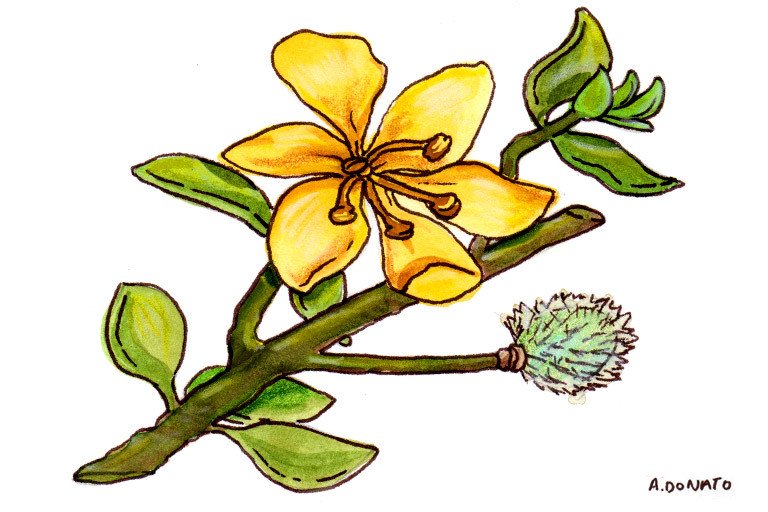
Health Care Professional Information
Scientific Name
Larrea tridentate, Larrea divaricata
Common Name
Creosate bush, greasewood, hediondilla
Clinical Summary
Chaparral is a native American herb that has purported anti-inflammatory and anticancer effects. However, a phase II clinical trial showed chaparral to be ineffective as an anticancer agent (9). Numerous reports indicate hepatotoxicity following the use of chaparral (4) (7) (8). Although a small retrospective study indicates that low intake of chaparral tincture (<10%) appears to have no adverse effects (3), correlation between length of exposure and risk is not known.
Nordihydroguaiaretic acid (NDGA), the principal ingredient in chaparral, was removed from the FDA's “Generally Recognized as Safe” (GRAS) list in 1968 (1). Due to case reports involving both reversible and irreversible liver damage, the FDA issued a health warning urging withdrawal of chaparral products in 1992. The use of chaparral as an herbal remedy cannot be recommended.
Chaparral is an ingredient in black salve, which is promoted as an alternative cancer treatment.
Purported Uses
- Arthritis
- Bronchitis
- Cancer prevention
- Cancer treatment
- Common cold
- Inflammation
- Menstrual cramps
- Promote urination
- Spasms
Constituents
- Amino Acids: Arginine, aspartine, cystine, glutamic acid, glycine, isoleucine, leucine, phenylalanine, tryptophan, tyrosine, valine
- Flavonoids: More than 20 different reported, including isorhamnetin, kaempferol and quercetin and their glycosidic and ether derivatives; gossypetin, herbacetin and their acetate derivatives
- Lignans: Nordihydroguaiaretic acid, norisoguaiacin, dihydroguaiaretic acid
- Resins: A number of flavone and flavonol glycosides
- Volatile Oils: Terpene components include calamene, eudesmol, & limonene
- Others: Two pentacyclic triterpenes and saponins. A cytotoxic naphthoquinone derivative, larreantin, has been isolated from the roots.
(1)
Mechanism of Action
Nordihydroguaiaretic acid (NDGA) a lipoxygenase inhibitor may be responsible for the biological activity of chaparral. It is believed that NDGA may have anticancer activity by blocking cellular respiration in vitro (2). However, later studies found no effect in vivo (3).
Dosage (Inside MSKCC Only)
This field is only visible to only Inside MSKCC users.
References
- Newall CA, et al. Herbal Medicines: A Guide for Health-Care Professionals. London: Pharmaceutical Press; 1996.
- Cunningham DC, et al. Proliferative responses of normal human mammary and MCF-7 breast cancer cells to linoleic, CLA and eicosanoid synthesis inhibitors in culture. Anticancer Res 1997;17:197-203.
- Pavani M, et al. Inhibition of tumoral cell respiration and growth by norhidydroguaiaretic acid. Biochem Pharmacol 1994;48:1935-42.
- Sheikh NM, et al. Chaparral-associated hepatotoxicity. Arch Intern Med 1997;157:913-9.
- Tyler V, et al. The Honest Herbal. New York: Pharmaceutical Press; 1993.
- Heron S, Yarnell E. The safety of low-dose Larrea tridentata (DC) Coville (creosote bush or chaparral): a retrospective clinical study. J Altern Complement Med 2001;7:175-85.
- Batchelor WB, et al. Chaparral-induced hepatic injury. Am J Gastroenterol 1995;90:831-3.
- Gordon DW, et al. Chaparral ingestion. The broadening spectrum of liver injury caused by herbal medications. JAMA 1995;273:489-90.
- Smart CR, et al. Clinical experience with nordihydroguaiaretic acid — “Chaparrel tea” in the treatment of cancer. Rocky Mt Med J. 1970 Nov;67(11):39-43.
- Gordon DW, et al. Chaparral ingestion. The broadening spectrum of liver injury caused by herbal medications. JAMA 1995;273:489-90.
- Kauma H, Koskela R, Mäkisalo H, et al. Toxic acute hepatitis and hepatic fibrosis after consumption of chaparral tablets. Scand J Gastroenterol. 2004 Nov;39(11):1168-71.
Consumer Information
How It Works
Bottom Line: Chaparral cannot treat or cure cancer or any other medical condition.
Chaparral is derived from the leaves and twigs of the creosate bush, a native American herb that has been used for inflammation and cancer. It contains biologically active molecules that have been found to block cellular division in laboratory studies. However, when chaparral extracts were tested in living bodies (animal studies), no such effect was found. Because several patients who regularly drank chaparral tea developed kidney cysts, kidney cancer, and liver damage, using chaparral is not worth the risks.
Purported Uses
No scientific evidence supports the use of chaparral for any of the following uses:
- To treat arthritis
- To treat bronchitis and the common cold
- To prevent and treat cancer
- To reduce inflammation
- To alleviate menstrual cramps
- To promote urination
- To stop muscle spasms
Side Effects
- Fatigue
- Contact dermatitis
- Stomach upset
- Jaundice (yellowing of the skin)
- Liver damage
- Cirrhosis of the liver
- Acute hepatitis
- Kidney failure
Last updated: February 25, 2013
acetate (A-seh-tayt)
A form of acetic acid (an acid found in vinegar).
Source: The National Cancer Institute's Dictionary of Cancer Terms
(http://www.cancer.gov/dictionary)
acid (A-sid)
A chemical that gives off hydrogen ions in water and forms salts by combining with certain metals. Acids have a sour taste and turn certain dyes red. Some acids made by the body, such as gastric acid, can help organs work the way they should. An example of an acid is hydrochloric acid. Acidity is measured on a scale called the pH scale. On this scale, a value of 7 is neutral, and a pH value of less than 7 to 0 shows increasing acidity.
Source: The National Cancer Institute's Dictionary of Cancer Terms
(http://www.cancer.gov/dictionary)
acute (uh-KYOOT)
Symptoms or signs that begin and worsen quickly; not chronic.
Source: The National Cancer Institute's Dictionary of Cancer Terms
(http://www.cancer.gov/dictionary)
arginine (AR-jih-neen)
One of the twenty common amino acids (building blocks of proteins). Arginine is being studied as a nutritional supplement in the treatment and prevention of cancer and other conditions. Also called L-arginine.
Source: The National Cancer Institute's Dictionary of Cancer Terms
(http://www.cancer.gov/dictionary)
bronchitis (bron-KY-tis)
Inflammation (swelling and reddening) of the bronchi.
Source: The National Cancer Institute's Dictionary of Cancer Terms
(http://www.cancer.gov/dictionary)
cancer (KAN-ser)
A term for diseases in which abnormal cells divide without control and can invade nearby tissues. Cancer cells can also spread to other parts of the body through the blood and lymph systems. There are several main types of cancer. Carcinoma is a cancer that begins in the skin or in tissues that line or cover internal organs. Sarcoma is a cancer that begins in bone, cartilage, fat, muscle, blood vessels, or other connective or supportive tissue. Leukemia is a cancer that starts in blood-forming tissue such as the bone marrow, and causes large numbers of abnormal blood cells to be produced and enter the blood. Lymphoma and multiple myeloma are cancers that begin in the cells of the immune system. Central nervous system cancers are cancers that begin in the tissues of the brain and spinal cord. Also called malignancy.
Source: The National Cancer Institute's Dictionary of Cancer Terms
(http://www.cancer.gov/dictionary)
cirrhosis (seh-ROH-sis)
A type of chronic, progressive liver disease in which liver cells are replaced by scar tissue.
Source: The National Cancer Institute's Dictionary of Cancer Terms
(http://www.cancer.gov/dictionary)
cytotoxic (SY-toh-TOK-sik)
Cell-killing.
Source: The National Cancer Institute's Dictionary of Cancer Terms
(http://www.cancer.gov/dictionary)
derivative (deh-RIH-vuh-tiv)
In chemistry, a compound produced from or related to another.
Source: The National Cancer Institute's Dictionary of Cancer Terms
(http://www.cancer.gov/dictionary)
fatigue (fuh-TEEG)
A condition marked by extreme tiredness and inability to function due lack of energy. Fatigue may be acute or chronic.
Source: The National Cancer Institute's Dictionary of Cancer Terms
(http://www.cancer.gov/dictionary)
FDA
An agency in the U.S. federal government whose mission is to protect public health by making sure that food, cosmetics, and nutritional supplements are safe to use and truthfully labeled. The FDA also makes sure that drugs, medical devices, and equipment are safe and effective, and that blood for transfusions and transplant tissue are safe. Also called Food and Drug Administration.
Source: The National Cancer Institute's Dictionary of Cancer Terms
(http://www.cancer.gov/dictionary)
glutamic acid (gloo-TA-mik A-sid)
One of twenty amino acids (molecules that join together to form proteins). Glutamic acid may help nerve cells send and receive information from other cells. It is being studied for its ability to decrease or prevent nerve damage caused by anticancer drugs. Also called L-glutamic acid.
Source: The National Cancer Institute's Dictionary of Cancer Terms
(http://www.cancer.gov/dictionary)
herbal (ER-bul)
Having to do with plants.
Source: The National Cancer Institute's Dictionary of Cancer Terms
(http://www.cancer.gov/dictionary)
in vivo (in VEE-voh)
In the body. The opposite of in vitro (outside the body or in the laboratory).
Source: The National Cancer Institute's Dictionary of Cancer Terms
(http://www.cancer.gov/dictionary)
inflammation (IN-fluh-MAY-shun)
Redness, swelling, pain, and/or a feeling of heat in an area of the body. This is a protective reaction to injury, disease, or irritation of the tissues.
Source: The National Cancer Institute's Dictionary of Cancer Terms
(http://www.cancer.gov/dictionary)
jaundice (JAWN-dis)
A condition in which the skin and the whites of the eyes become yellow, urine darkens, and the color of stool becomes lighter than normal. Jaundice occurs when the liver is not working properly or when a bile duct is blocked.
Source: The National Cancer Institute's Dictionary of Cancer Terms
(http://www.cancer.gov/dictionary)
kidney (KID-nee)
One of a pair of organs in the abdomen. Kidneys remove waste from the blood (as urine), produce erythropoietin (a substance that stimulates red blood cell production), and play a role in blood pressure regulation.
Source: The National Cancer Institute's Dictionary of Cancer Terms
(http://www.cancer.gov/dictionary)
kidney cancer (KID-nee KAN-ser)
Cancer that forms in tissues of the kidneys. Kidney cancer includes renal cell carcinoma (cancer that forms in the lining of very small tubes in the kidney that filter the blood and remove waste products) and renal pelvis carcinoma (cancer that forms in the center of the kidney where urine collects). It also includes Wilms tumor, which is a type of kidney cancer that usually develops in children under the age of 5.
Source: The National Cancer Institute's Dictionary of Cancer Terms
(http://www.cancer.gov/dictionary)
liver (LIH-ver)
A large organ located in the upper abdomen. The liver cleanses the blood and aids in digestion by secreting bile.
Source: The National Cancer Institute's Dictionary of Cancer Terms
(http://www.cancer.gov/dictionary)
nordihydroguaiaretic acid (NOR-dy-HY-droh-GWY-uh-reh-tik A-sid)
A drug put on the skin to treat growths caused by sun exposure. A form of nordihydroguaiaretic acid that is taken by mouth is being studied in the treatment of prostate cancer. Nordihydroguaiaretic acid is an antioxidant, and it may block certain enzymes needed for tumor growth. Also called Actinex, masoprocol, and NDGA.
Source: The National Cancer Institute's Dictionary of Cancer Terms
(http://www.cancer.gov/dictionary)
retrospective (REH-troh-SPEK-tiv)
Looking back at events that have already taken place.
Source: The National Cancer Institute's Dictionary of Cancer Terms
(http://www.cancer.gov/dictionary)
stomach (STUH-muk)
An organ that is part of the digestive system. The stomach helps digest food by mixing it with digestive juices and churning it into a thin liquid.
Source: The National Cancer Institute's Dictionary of Cancer Terms
(http://www.cancer.gov/dictionary)
terpene (TER-peen)
A type of strong-smelling chemical substance found in some plants, especially trees that have cones. Terpenes are found in essential oils (scented liquid taken from plants).
Source: The National Cancer Institute's Dictionary of Cancer Terms
(http://www.cancer.gov/dictionary)
transplantation (tranz-plan-TAY-shun)
A surgical procedure in which tissue or an organ is transferred from one area of a person’s body to another area, or from one person (the donor) to another person (the recipient).
Source: The National Cancer Institute's Dictionary of Cancer Terms
(http://www.cancer.gov/dictionary)