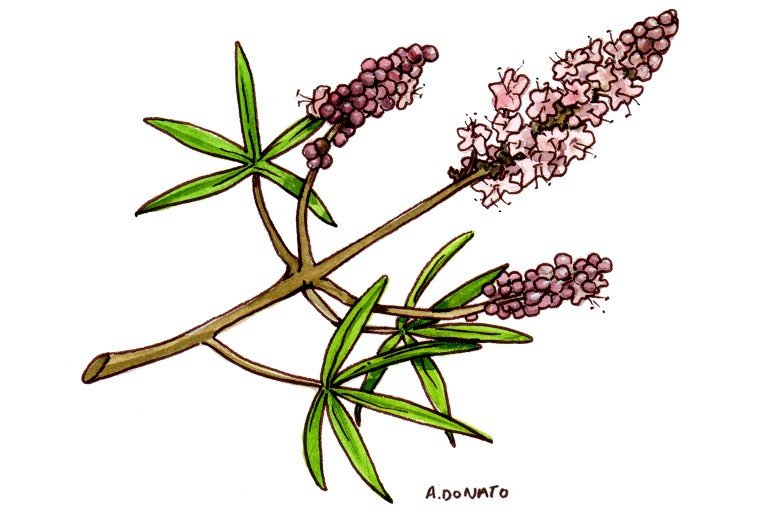
Health Care Professional Information
Common Name
Chaste tree fruit, monk’s pepper
Clinical Summary
The fruit of chasteberry is widely used to relieve symptoms associated with premenstrual syndrome and to treat infertility. It is said to have a normalizing action on the menstrual cycle. Chasteberry contains steroidal precursors and active moieties including progesterone, testosterone, and androstenedione.
It was shown to have antiproliferative (13) and hepatoprotective (14) properties in vitro. Clinical studies in women suggest its efficacy in reducing symptoms associated with PMS (8) (9) (16), and for the treatment of mastalgia (15).
Chasteberry may interact with oral contraceptives, hormonal therapy, and dopamine antagonists (such as haloperidol and prochlorperazine) (5). It also demonstrated estrogenic activity (11) (12) and should be avoided by patients with hormone-sensitive disease.
Purported Uses
- Dysmenorrhea
- Mastalgia
- Menopausal symptoms
- Uterine bleeding
Constituents
- Flavonoids: Casticin, penduletin and chrysophanol D
- Iridoid alkaloids: Viticin, angnoside and aucubin
- Progestins: Progesterone, hydroxyprogesterone, testosterone, epitestosterone, androstenedione
- Volatile oils
(1)
Mechanism of Action
Chasteberry may exert opioidergic effects through the activation of mu opioid receptors (MOR) and delta opioid receptors (DOR), but not kappa opioid receptors (KOR) (9). Chasteberry has been reported to inhibit the release of prolactin (10) (18). It also has dopaminergic activity by modulating the dopamine (d2) receptors (7). In vitro studies, constituents isolated from chasteberry can stimulate estrogen receptors (8). In human studies, it has been found to restore progesterone concentrations, prolong the hyperthermic phase in the basal temperature curve, and restore the LH-RH test to normal. It is thought to act on the pituitary-hypothalamic axis rather than directly on the ovaries (11) (4).
Contraindications
Chasteberry may have estrogenic activity (11) (12) and should be avoided or used cautiously by patients with hormone-sensitive disease.
Adverse Reactions
Reported: The most frequent adverse events are nausea, headache, gastrointestinal disturbances, menstrual disorders, acne, pruritus and erythematous rash (3) (4).
Herb-Drug Interactions
Dopamine D2-Antagonists: Theoretically, chasteberry may interfere with the action of drugs that antagonize dopamine receptors (e.g. chlorpromazine, haloperidol, prochlorperazine) (5).
Cytochrome P450 substrates: Chasteberry inhibits CYP2C19 and CYP3A4 and may affect drugs metabolized by these enzymes (17).
Literature Summary and Critique
In this study 128 women were randomized to receive forty drops of Vitex extract or matching placebo administered for 6 days before their menstrual cycle for 6 consecutive cycles. The mean ages were 30.77 years in the active group and 30.89 (SD=4.02) years in the placebo group. Participants answered a self assessment questionnaire about headache, anger, irritability, depression, breast fullness and bloating and tympani before and after 6 menstrual cycles. Each item was rated using a visual analogue scale (VAS). There was a significant difference in the variables in both the group before and after the study (P<0.0001); and between the two groups (P<0.0001). Researches concluded that Vitex agnus may be an effective treatment for controlling symptoms associated with mild and moderate PMS.
Larger studies are warranted.
Dosage (Inside MSKCC Only)
This field is only visible to only Inside MSKCC users.
References
- Schulz V, et al. Rational Phytotherapy, A Physician's Guide to Herbal Medicine, 3rd ed. New York: Springer; 1996.
- Newall C, et al. Herbal Medicines: A Guide for Health-Care Professionals. London: Pharmaceutical Press; l996.
- Daniele C, Thompson Coon J, Pittler MH, Ernst E. Vitex agnus castus: a systematic review of adverse events. Drug Saf. 2005;28(4):319-32.
- Mills S, et al. Principles and Practice of Phytotherapy. London: Churchill Livingstone; 2000.
- Brinker F. Herb Contraindications & Drug Interactions, 2nd ed. Sandy (OR): Eclectic Med Publications; 1998.
- Berger D, et al. Efficacy of Vitex agnus castus L. extract Ze 440 in patients with pre-menstrual syndrome (PMS). Arch Gyncecol Obstet 2000;264:150-3.
- Meier B, et al. Pharmacological activities of Vitex agnus-castus extracts in vitro. Phytomedicine 2000;7:373-81.
- Schellenberg R. Treatment for the premenstrual syndrom with agnus castus fruit extract: prospective, randomised, placebo controlled study. BMJ 2001;322:134-7.
- He Z, Chen R, Zhou Y, et al. Treatment for premenstrual syndrome with Vitex agnus castus: A prospective, randomized, multi-center placebo controlled study in China. Maturitas. 2009 May 20;63(1):99-103.
- Sliutz G, Speiser P, Schultz AM, et al. Agnus castus extracts inhibit prolactin secretion of rat pituitary cells. Horm Metab Res. 1993 May;25(5):253-5
- Jarry H, Spengler B, Porzel A, et al. Evidence for estrogen receptor beta-selective activity of Vitex agnus-castus and isolated flavones. Planta Med. 2003 Oct;69(10):945-7.
- Liu J, Burdette JE, Sun Y, et al. Isolation of linoleic acid as an estrogenic compound from the fruits of Vitex agnus-castus L. (chaste-berry). Phytomedicine. 2004 Jan;11(1):18-23.
- Weisskopf M, Schaffner W, Jundt G, Sulser T, Wyler S, Tullberg-Reinert H. A Vitex agnus-castus extract inhibits cell growth and induces apoptosis in prostate epithelial cell lines. Planta Med. 2005 Oct;71(10):910-6.
- Tandon VR, Khajuria V, Kapoor B, Kour D, Gupta S. Hepatoprotective activity of Vitex negundo leaf extract against anti-tubercular drugs induced hepatotoxicity. Fitoterapia. 2008 Dec;79(7-8):533-8.
- Carmichael AR. Can Vitex Agnus Castus be Used for the Treatment of Mastalgia? What is the Current Evidence? Evid Based Complement Alternat Med. 2008 Sep;5(3):247-50.
- Zamani M, Neghab N, Torabian S. Therapeutic effect of Vitex agnus castus in patients with premenstrual syndrome. Acta Med Iran. 2012;50(2):101-6.
- Ho SH, Singh M, Holloway AC, Crankshaw DJ. The effects of commercial preparations of herbal supplements commonly used by women on the biotransformation of fluorogenic substrates by human cytochromes p450. Phytother Res. 2011 Jul;25(7):983-9.
- Milewicz A, Gejdel E, Sworen H, et al. Vitex agnus castus extract in the treatment of luteal phase defects due to latent hyperprolactinemia. Results of a randomized placebo-controlled double-blind study. Arzneimittelforschung. 1993 Jul;43(7):752-6.
Consumer Information
How It Works
Bottom Line: There is evidence to suggest that chasteberry helps improve symptoms associated with premenstrual syndrome.
Chasteberry is used widely to treat infertility and for relief of symptoms of premenstrual syndrome (PMS). Laboratory analysis has shown that chasteberry contains active hormones that are also produced by the human body, such as progesterone, testosterone, and androstenedione. In studies in both laboratory animals and humans, chasteberry has been found to alter the release of gonadotropins (hormones that stimulate secretion of sex hormones from the ovaries and testes) from the pituitary gland in the brain. It is hypothesized that this has an effect on the release of sex hormones (estrogen, progesterone, and testosterone) within the body.
Purported Uses
- To ease difficult and painful menstruation
A handful of clinical trials support this use in women aged 20-40 whose ovarian function was not greatly impaired and who had no other hormone imbalances.
- To treat breast pain
A few clinical trials support this use for breast pain associated with menstruation.
- To prevent menopausal symptoms such as hot flashes, vaginal dryness, sleep disturbances, and mood disorders
There is no evidence to support this claim. Because chasteberry contains sex hormones like progesterone, it is not known whether it would be a safe alternative to hormone replacement therapy.
- To prevent premenstrual symptoms such as depression, bloating, anxiety, breast tenderness, and headaches
A few studies support this use in women aged 20-40 whose ovarian function was not greatly impaired and who had no other hormone imbalances.
- To prevent dysfunctional uterine bleeding
A few studies support this use.
Research Evidence
Premenstrual Syndrome
In this study 128 women were randomized to receive forty drops of Vitex agnus extract or matching placebo administered for 6 days before their menstrual cycle for 6 consecutive cycles. Participants answered a self assessment questionnaire about headache, anger, irritability, depression, breast fullness and bloating and tympani before and after 6 menstrual cycles. There was a significant difference in the variables in both the groups before and after the study; and between the two groups. Researches concluded that Vitex agnus may be an effective treatment for controlling symptoms associated with mild and moderate PMS.
Patient Warnings
- Chasteberry contains sex hormones such as progesterone. Therefore, it is not yet known whether chasteberry is a safe alternative to hormone replacement therapy.
Do Not Take If
- You are pregnant.
- You are taking any hormonal medications, such as oral contraceptives (birth control pills) (chasteberry may interfere with their effects).
- You have hormone-sensitive cancer (chasteberry has estrogenic activity and can stimulate cancer)
- You are taking dopamine D2-antagonists, such as chlorpromazine, haloperidol, or prochlorperazine) (chasteberry may interfere with these medications).
- You are taking drugs that are substrates of Cytochrome P450 enzymes CYP2C19 and CYP3A4 (chasteberry may increase the risk of side effects of these drugs).
Last updated: June 18, 2012
acne (AK-nee)
A disorder of the skin in which oil glands and hair glands become inflamed.
Source: The National Cancer Institute's Dictionary of Cancer Terms
(http://www.cancer.gov/dictionary)
analysis (uh-NA-lih-sis)
A process in which anything complex is separated into simple or less complex parts.
Source: The National Cancer Institute's Dictionary of Cancer Terms
(http://www.cancer.gov/dictionary)
assessment (uh-SES-ment)
In healthcare, a process used to learn about a patient’s condition. This may include a complete medical history, medical tests, a physical exam, a test of learning skills, tests to find out if the patient is able to carry out the tasks of daily living, a mental health evaluation, and a review of social support and community resources available to the patient.
Source: The National Cancer Institute's Dictionary of Cancer Terms
(http://www.cancer.gov/dictionary)
bloating (BLOH-ting)
A swelling or feeling of fullness in the abdomen. Bloating is usually the result of gas in the intestines and can be caused by many things, including overeating, lactose intolerance, and constipation. Bloating can also be a side effect of cancer or cancer treatment.
Source: The National Cancer Institute's Dictionary of Cancer Terms
(http://www.cancer.gov/dictionary)
breast (brest)
Glandular organ located on the chest. The breast is made up of connective tissue, fat, and breast tissue that contains the glands that can make milk. Also called mammary gland.
Source: The National Cancer Institute's Dictionary of Cancer Terms
(http://www.cancer.gov/dictionary)
clinical (KLIH-nih-kul)
Having to do with the examination and treatment of patients.
Source: The National Cancer Institute's Dictionary of Cancer Terms
(http://www.cancer.gov/dictionary)
depression (dee-PREH-shun)
A mental condition marked by ongoing feelings of sadness, despair, loss of energy, and difficulty dealing with normal daily life. Other symptoms of depression include feelings of worthlessness and hopelessness, loss of pleasure in activities, changes in eating or sleeping habits, and thoughts of death or suicide. Depression can affect anyone, and can be successfully treated. Depression affects 15-25% of cancer patients.
Source: The National Cancer Institute's Dictionary of Cancer Terms
(http://www.cancer.gov/dictionary)
drug (drug)
Any substance, other than food, that is used to prevent, diagnose, treat or relieve symptoms of a disease or abnormal condition. Also refers to a substance that alters mood or body function, or that can be habit-forming or addictive, especially a narcotic.
Source: The National Cancer Institute's Dictionary of Cancer Terms
(http://www.cancer.gov/dictionary)
efficacy (EH-fih-kuh-see)
Effectiveness. In medicine, the ability of an intervention (for example, a drug or surgery) to produce the desired beneficial effect.
Source: The National Cancer Institute's Dictionary of Cancer Terms
(http://www.cancer.gov/dictionary)
estrogen (ES-truh-jin)
A type of hormone made by the body that helps develop and maintain female sex characteristics and the growth of long bones. Estrogens can also be made in the laboratory. They may be used as a type of birth control and to treat symptoms of menopause, menstrual disorders, osteoporosis, and other conditions.
Source: The National Cancer Institute's Dictionary of Cancer Terms
(http://www.cancer.gov/dictionary)
extract (EK-strakt)
In medicine, a preparation of a substance obtained from plants, animals, or bacteria and used as a drug or in drugs.
Source: The National Cancer Institute's Dictionary of Cancer Terms
(http://www.cancer.gov/dictionary)
gastrointestinal (GAS-troh-in-TES-tih-nul)
Refers to the stomach and intestines. Also called GI.
Source: The National Cancer Institute's Dictionary of Cancer Terms
(http://www.cancer.gov/dictionary)
gland (gland)
An organ that makes one or more substances, such as hormones, digestive juices, sweat, tears, saliva, or milk. Endocrine glands release the substances directly into the bloodstream. Exocrine glands release the substances into a duct or opening to the inside or outside of the body.
Source: The National Cancer Institute's Dictionary of Cancer Terms
(http://www.cancer.gov/dictionary)
haloperidol (ha-loh-PAYR-ih-dol)
A drug used to treat certain mental and neurological disorders. It is also being studied in the treatment of nausea and vomiting caused by some cancer treatments. It is a type of antiemetic and a type of antipsychotic. Also called Haldol.
Source: The National Cancer Institute's Dictionary of Cancer Terms
(http://www.cancer.gov/dictionary)
herbal (ER-bul)
Having to do with plants.
Source: The National Cancer Institute's Dictionary of Cancer Terms
(http://www.cancer.gov/dictionary)
hormonal therapy (hor-MOH-nul THAYR-uh-pee)
Treatment that adds, blocks, or removes hormones. For certain conditions (such as diabetes or menopause), hormones are given to adjust low hormone levels. To slow or stop the growth of certain cancers (such as prostate and breast cancer), synthetic hormones or other drugs may be given to block the body’s natural hormones. Sometimes surgery is needed to remove the gland that makes a certain hormone. Also called endocrine therapy, hormone therapy, and hormone treatment.
Source: The National Cancer Institute's Dictionary of Cancer Terms
(http://www.cancer.gov/dictionary)
hormone (HOR-mone)
One of many chemicals made by glands in the body. Hormones circulate in the bloodstream and control the actions of certain cells or organs. Some hormones can also be made in the laboratory.
Source: The National Cancer Institute's Dictionary of Cancer Terms
(http://www.cancer.gov/dictionary)
hormone replacement therapy (HOR-mone reh-PLAYS-ment THAYR-uh-pee)
Hormones (estrogen, progesterone, or both) given to women after menopause to replace the hormones no longer produced by the ovaries. Also called HRT and menopausal hormone therapy.
Source: The National Cancer Institute's Dictionary of Cancer Terms
(http://www.cancer.gov/dictionary)
in vitro (in VEE-troh)
In the laboratory (outside the body). The opposite of in vivo (in the body).
Source: The National Cancer Institute's Dictionary of Cancer Terms
(http://www.cancer.gov/dictionary)
infertility (IN-fer-TIH-lih-tee)
The inability to produce children.
Source: The National Cancer Institute's Dictionary of Cancer Terms
(http://www.cancer.gov/dictionary)
LH-RH
A hormone that stimulates the production of sex hormones in men and women. Also called luteinizing hormone-releasing hormone.
Source: The National Cancer Institute's Dictionary of Cancer Terms
(http://www.cancer.gov/dictionary)
mean (meen)
A statistics term. The average value in a set of measurements. The mean is the sum of a set of numbers divided by how many numbers are in the set.
Source: The National Cancer Institute's Dictionary of Cancer Terms
(http://www.cancer.gov/dictionary)
medicine (MEH-dih-sin)
Refers to the practices and procedures used for the prevention, treatment, or relief of symptoms of a diseases or abnormal conditions. This term may also refer to a legal drug used for the same purpose.
Source: The National Cancer Institute's Dictionary of Cancer Terms
(http://www.cancer.gov/dictionary)
menstrual cycle (MEN-stroo-ul SY-kul)
The monthly cycle of hormonal changes from the beginning of one menstrual period to the beginning of the next.
Source: The National Cancer Institute's Dictionary of Cancer Terms
(http://www.cancer.gov/dictionary)
menstruation (MEN-stroo-WAY-shun)
Periodic discharge of blood and tissue from the uterus. From puberty until menopause, menstruation occurs about every 28 days when a woman is not pregnant.
Source: The National Cancer Institute's Dictionary of Cancer Terms
(http://www.cancer.gov/dictionary)
nausea (NAW-zee-uh)
A feeling of sickness or discomfort in the stomach that may come with an urge to vomit. Nausea is a side effect of some types of cancer therapy.
Source: The National Cancer Institute's Dictionary of Cancer Terms
(http://www.cancer.gov/dictionary)
opioid (OH-pee-OYD)
A substance used to treat moderate to severe pain. Opioids are like opiates, such as morphine and codeine, but are not made from opium. Opioids bind to opioid receptors in the central nervous system. Opioids used to be called narcotics. An opioid is a type of alkaloid.
Source: The National Cancer Institute's Dictionary of Cancer Terms
(http://www.cancer.gov/dictionary)
oral (OR-ul)
By or having to do with the mouth.
Source: The National Cancer Institute's Dictionary of Cancer Terms
(http://www.cancer.gov/dictionary)
ovarian (oh-VAYR-ee-un)
Having to do with the ovaries, the female reproductive glands in which the ova (eggs) are formed. The ovaries are located in the pelvis, one on each side of the uterus.
Source: The National Cancer Institute's Dictionary of Cancer Terms
(http://www.cancer.gov/dictionary)
placebo (pluh-SEE-boh)
An inactive substance or treatment that looks the same as, and is given the same way as, an active drug or treatment being tested. The effects of the active drug or treatment are compared to the effects of the placebo.
Source: The National Cancer Institute's Dictionary of Cancer Terms
(http://www.cancer.gov/dictionary)
progesterone (proh-JES-teh-rone)
A type of hormone made by the body that plays a role in the menstrual cycle and pregnancy. Progesterone can also be made in the laboratory. It may be used as a type of birth control and to treat menstrual disorders, infertility, symptoms of menopause, and other conditions.
Source: The National Cancer Institute's Dictionary of Cancer Terms
(http://www.cancer.gov/dictionary)
prolactin (proh-LAK-tin)
A hormone that is made by the pituitary gland (a pea-sized organ in the center of the brain). Prolactin causes a woman’s breasts to make milk during and after pregnancy, and has many other effects in the body.
Source: The National Cancer Institute's Dictionary of Cancer Terms
(http://www.cancer.gov/dictionary)
pruritus (proo-RY-tus)
Itching. Severe itching may be a side effect of some cancer treatments and a symptom of some types of cancers.
Source: The National Cancer Institute's Dictionary of Cancer Terms
(http://www.cancer.gov/dictionary)
randomized
Describes an experiment or clinical trial in which animal or human subjects are assigned by chance to separate groups that compare different treatments.
Source: The National Cancer Institute's Dictionary of Cancer Terms
(http://www.cancer.gov/dictionary)
significant (sig-NIH-fih-kunt)
In statistics, describes a mathematical measure of difference between groups. The difference is said to be significant if it is greater than what might be expected to happen by chance alone. Also called statistically significant.
Source: The National Cancer Institute's Dictionary of Cancer Terms
(http://www.cancer.gov/dictionary)
syndrome (SIN-drome)
A set of symptoms or conditions that occur together and suggest the presence of a certain disease or an increased chance of developing the disease.
Source: The National Cancer Institute's Dictionary of Cancer Terms
(http://www.cancer.gov/dictionary)
testosterone (tes-TOS-teh-rone)
A hormone made mainly in the testes (part of the male reproductive system). It is needed to develop and maintain male sex characteristics, such as facial hair, deep voice, and muscle growth. Testosterone may also be made in the laboratory and is used to treat certain medical conditions.
Source: The National Cancer Institute's Dictionary of Cancer Terms
(http://www.cancer.gov/dictionary)
therapy (THAYR-uh-pee)
Treatment.
Source: The National Cancer Institute's Dictionary of Cancer Terms
(http://www.cancer.gov/dictionary)
Vitex (VY-tex)
An extract made from the fruit of the chaste tree () found in parts of Asia and Europe. It is claimed to treat infertility and to lessen symptoms that may occur before or during a woman’s menstrual period, such as headaches and irregular bleeding. Vitex may affect levels of reproductive hormones in the blood. It is a type of phytomedicine. Also called chaste tree berry and monk’s pepper.
Source: The National Cancer Institute's Dictionary of Cancer Terms
(http://www.cancer.gov/dictionary)