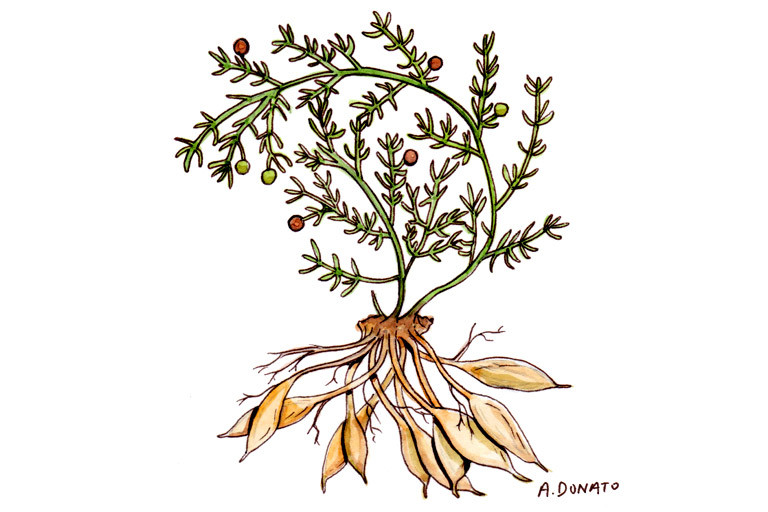
Common Names
- Tian Dong; Tian Men Dong
- Radix asparagi
- Tenmondo
- Asparagus root
For Patients & Caregivers
Tell your healthcare providers about any dietary supplements you’re taking, such as herbs, vitamins, minerals, and natural or home remedies. This will help them manage your care and keep you safe.
Although Chinese asparagus has been used in traditional Chinese medicine for various conditions, human studies have not been conducted.
Derived from the root of the plant, Chinese asparagus is used in traditional Chinese medicine as a tonic, an expectorant, and to treat a variety of conditions including liver and airway inflammatory diseases.
Scientists are not sure how Chinese asparagus works, since little research has been performed on this botanical. In the lab, Chinese asparagus extracts slowed the growth of lung cancer cells and protected liver cells from toxins. Animal studies suggest it may help reduce airway inflammation. However, it is not known whether these effects could occur in the human body and additional studies are needed to evaluate its safety and effectiveness.
- To treat cancer
Limited laboratory research shows some activity against isolated lung cancer cell lines. Human data are needed. - To treat lung diseases
Preliminary laboratory studies suggest that compounds found in Chinese asparagus may protect against airway inflammatory diseases, but no human studies have been conducted. - To treat hepatitis
Limited laboratory research shows a protective effect against alcohol toxicity in isolated liver cells. Human studies have not been conducted.
Do Not Take if:
You are taking CYP2E1 or 1A2 substrate drugs: Animal studies suggest that Chinese asparagus may affect how certain drugs are metabolized or increase the risk of side effects. Clinical relevance has yet to be determined.
For Healthcare Professionals
Derived from the root of the plant, Chinese asparagus is used in traditional Chinese medicine as a tonic, an expectorant, and to treat a variety of conditions including liver and airway inflammatory diseases (1) (10).
In vitro studies indicate that it has anti-inflammatory effects (5) (8) (11), and can prevent ethanol-induced cytotoxicity (3). Other preclinical studies suggest antioxidant (17) (18), neuroprotective (9) (19), and anti-asthmatic effects (20) (21).
Some isolated compounds like aspacochioside C and a few spirostanol saponins exhibit moderate cytotoxicity (12) (22), and the compound methylprotodioscin downregulated proinflammatory cytokine production (13). However, Chinese asparagus or these constituents have not been studied in humans as a treatment for cancer.
Chinese asparagus induced CYP2E1 and 1A2 in animal studies, suggesting potential interactions with drugs metabolized by these enzymes (14). Clinical relevance has yet to be determined.
- Cancer
- Health maintenance
- Hepatitis
- Lung diseases
Compounds isolated from this species include norlignans (15), steroidal saponins (16), pregnane glycosides, aspacochinosides, and furostanol glycosides, some of which may have anti-neuroinflammatory effects in lipopolysaccharide-induced murine microglial cells via inhibition of nitric oxide production (11). An aqueous extract of asparagus root inhibits tumor necrosis factor-alpha secretion in mouse astrocytes (4). Asparagus root also reduces alcohol-induced hepatotoxicity in Hep G2 cell lines (3).
In vitro and murine models of lung inflammation suggest that methylprotodioscin is the active constituent that protects against airway inflammation (10) (13). Dioscin and methylprotodioscin suppressed airway mucin gene expression and production by acting directly on airway epithelial cells (10). Methylprotodioscin inhibited production of proinflammatory cytokines such as IL-6, TNF-alpha, and IL-1beta in lung tissue (13), and downregulated proinflammatory cytokine production via c-Jun N-terminal kinase/c-Jun pathway inhibition in lung cancer cells (13).
CYP450 substrates: Chinese asparagus induced CYP2E1 and 1A2 in animal studies, suggesting potential interactions with drugs metabolized by these enzymes (14). Clinical relevance has yet to be determined.