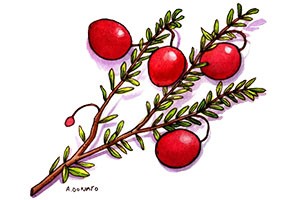
Common Names
- Mossberry
- Sassamanash
- Bounceberry
For Patients & Caregivers
Tell your healthcare providers about any dietary supplements you’re taking, such as herbs, vitamins, minerals, and natural or home remedies. This will help them manage your care and keep you safe.
Cranberry juice or extracts may be helpful for urinary tract infections (UTIs) in limited populations, but there is not enough evidence to recommend it for UTI prevention.
Cranberries contain compounds called proanthocyanidins that may prevent bacteria from attaching to the bladder wall, which could cause UTIs. Human studies suggest possible benefit in some populations including prostate cancer patients, but overall evidence is conflicting. Cranberry may also prevent bacteria from attaching to the stomach lining and areas in the mouth. Although lab studies suggest activity against several types of cancer cells, these properties have yet to be evaluated in human studies.
In patients who are prone to kidney stones, regular use of cranberry should be avoided as it contains oxalates, a compound found in the most common form of kidney stones.
- Urinary tract infections
The evidence for prevention or treatment of UTIs is mixed. - Anticancer effects
Lab studies suggest cranberry juice extract and isolated compounds may inhibit various types of cancer cells, but these observations have not been studied in humans. - Stomach ulcers
Studies suggest cranberry juice may help prevent or suppress H. pylori infection. - Atherosclerosis
Evidence on whether cranberry juice can help reduce cardiovascular disease risk factors are limited and unclear. - Gum disease/cavities
Lab studies suggest cranberry juice prevents bacteria from attaching, thereby slowing plaque formation, but additional studies are needed.
- Nausea, vomiting and diarrhea with large amounts of cranberry juice (3 cups daily)
Case reports
- Increased International Normalized Ratio (INR) and/or bleeding: Several cases due to suspected interactions between cranberry juice and warfarin.
- Internal hemorrhage resulting in death: In 2 patients, following concurrent use of warfarin and cranberry juice.
Do Not Take if:
- You are taking tacrolimus: Serum levels of tacrolimus dropped when taken with cranberry extract. Levels returned to the desired range after stopping cranberry intake.
- You are taking warfarin: Because data is mixed on whether cranberry juice may increase bleeding, usage of cranberry juice should be monitored by a healthcare professional, if not avoided. Case reports of bleeding and death in 2 elderly patients who used cranberry juice and warfarin have occurred.
- You are taking CYP450 substrate drugs: Cranberry may increase blood levels of these drugs or their adverse effects.
- You are taking UGT substrate drugs: Cranberry may increase the risk of side effects for these drugs.
- You have a history of kidney stones: Cranberry contains high concentrations of oxalates, a component common to kidney stones.
For Healthcare Professionals
Cranberry is an evergreen shrub that is grown in North America and Europe. The processed fruit and juice, both rich in vitamin C, are widely consumed as food. The juice extract is marketed as a dietary supplement for urinary tract health and to prevent urinary tract infections (UTIs). It has also been used for oral and gastrointestinal infections, cardiovascular diseases, and to protect against cancer. In preclinical studies, cranberry juice extracts and constituents exhibited antibacterial (1), antimicrobial (45), antifungal (46), anti-inflammatory (47), antioxidant (48), and antiadherence (49) properties.
Studies on whether cranberry products can prevent UTIs have been conducted in various populations, but results are mixed. Cranberry extracts can help prevent UTIs in adults (2) (3), children (4), prostate cancer patients undergoing radiation therapy (5) (50), and patients following urostomy (68). In women undergoing pelvic floor surgery, cranberry prophylaxis had no beneficial effects against UTIs, although UTI prevalence overall was lower than expected (72). A large double-blind study of older adults with high-baseline UTI risk showed benefit (51), but another similar study reported negative findings (52). A subsequent analysis revealed increased costs with no meaningful reduction in UTI rates in a geriatric nursing home environment (53). Studies of cranberry juice for recurrent UTIs have also been mixed, with one study finding no benefit among college-aged women (6), and another observing significant reductions in UTI relapse in women over age 50 (54). Cranberry was not as effective or cost-effective as trimethoprim-sulfamethoxazole in preventing UTIs in premenopausal women, but patients were less likely to develop antibiotic-resistant bacteria (8) (55). In volunteers from different regions, anti-adhesion activity with cranberry powder was found to be dose-dependent (7). Overall, a systematic review determined that cranberry juice was more effective than capsules or tablets (56), but despite some support for recurrent UTI prophylaxis (69), there is not enough evidence to recommend cranberry juice for UTI prevention (9) (70).
In other studies, cranberry juice inhibited adhesion of H. pylori to human gastric mucosa (18), and regular consumption may suppress H. pylori infection (19) (20), a major factor in peptic ulcer disease and gastric cancer. When used with standard treatment, cranberry juice helped eradicate H. pylori (21). It potential to prevent plaque formation and gum disease as well may be due to its anticolonizing and antiadhesion properties (22) (23).
Preclinical studies suggest antiproliferative effects against prostate (10) (11) (12), liver (13), lung (57), neuroblastoma (58), breast (14), ovarian (15), gastric (59), colon (12) (16), esophageal (60), and oral (12) cancer cells with cranberry extracts and proanthocyanidins. In humans however, cranberry juice did not lower oxidative status, suggesting a lack of protective effect against cancer or heart disease (17).
Cranberry juice has high concentrations of oxalates, and should be avoided in patients at risk for kidney stones (40) (73). Other data suggest it may be helpful in uncommon forms including struvite stones, which are associated with bladder infections (33) (62) (63).
Cranberry can be consumed as juice, sauce, or dried fruit.
- Urinary tract infections
- Cancer
- Ulcers
- Atherosclerosis
- Gum disease
The A-type linkages in cranberry proanthocyanidins (C-PACs) may enhance urinary bacterial antiadhesion activities to prevent UTIs (25) (26) (27) (28) (64). Similarly, bioactivity against C. albicans biofilm formation is due to anti-adherence properties and/or iron chelation (46). In susceptible populations, improved preventive effects with cranberry juice over capsules or tablets may be related to better hydration with liquid, and/or additive effects with additional compounds in juice not contained in supplements (56). Anti-adhesion properties were also demonstrated in other microenvironments. Cranberry prevented H. pylori-induced stomach ulcers by inhibiting bacterial adhesions in the stomach lining (18) (29), decreased adherence of oral streptococci strains to saliva-coated hydroxyapatite (23) and glucan-coated hydroxyapatite, and impaired biofilm formation (22) (30) indicating it may slow dental plaque development and protect against plaque-related diseases. Cranberry also regulated aggressive human periodontitis fibroblast inflammatory responses via nuclear factor-kappaB and matrix metalloproteinase-3 (MMP3) inhibition (47).
Additional studies have shown that C-PACs may play a role in enhancing host innate immunity. In a worm model, a standardized cranberry extract mediated host immune response via p38 MAPK signaling, insulin/insulin-like growth factor 1 signaling, and heat shock factor 1 (45). Antiatherogenic effects of cranberry juice occur via reductions in serum glucose and apoB, and increases in serum and apoA-1 and paraoxonase, associated with stabilizing HDL (61).
Mechanisms underlying the anticancer effects of cranberry extracts and C-PACs have also been investigated. A cranberry extract inhibited prostate cancer cell growth by decreasing cyclins, cyclin-dependant kinase expression (10) , and MMP activity (31). Dose-response inhibition of gastric cancer cells to cranberry is in part due to decreased proliferating cell nuclear antigen expression and apoptotic induction (59). A proanthocyanidin isolate arrested ovarian cancer cell growth by inhibiting VEGF and generating ROS (15). C-PACs induced cell death in esophageal adenocarcinoma via microRNA modifications within cancer cells (60), and in human lung cancer cells, they altered gene expression, induced apoptosis, and modulated cell-cycle processes (57). In high-risk neuroblastoma cells, a purified C-PAC induced apoptosis and ROS generation, and encouraged cyclophosphamide retention with synergistic cytotoxic benefits (58).
Cranberry juice increases the risk of uric acid stone formation because of its acidifying effect and slowing of urate synthesis, thereby decreasing urinary pH (32) (33).
- Cranberry products can increase urine oxalate excretion and may promote formation of the most common type of kidney stones (32) (33) (40). Its use should therefore be avoided in patients at increased risk for this condition (40) (73).
- A Japanese case report describes the formation of precipitates in the stomach and esophagus of a patient with multiple system atrophy which was attributed to the use of a pH neutral enteral formula along with cranberry juice via nasogastric feeding (74).
Ingesting large amounts of cranberry juice (3 cups daily) has been associated with gastrointestinal upset including nausea, vomiting, and diarrhea (66).
Case Reports
Recurrent stones: In a 47-year-old man with severe right renal colic and hematuria who took cranberry concentrate tablets twice daily over 6 months (40).
Increased INR: Several cases of increased International Normalized Ratio due to suspected interactions between warfarin and cranberry juice (36) (37).
Internal hemorrhage and subsequent death: In 2 patients with concurrent use of warfarin and cranberry juice (38) (39).
Tacrolimus: Concurrent use with cranberry extracts resulted in subtherapeutic serum levels of tacrolimus in a renal transplant patient (71). The levels returned to desired range following cessation of cranberry.
Cyclosporin: A randomized controlled trial has shown that 240 mL of cranberry juice had no clinically significant effect on the disposition of a 200 mg dose of cyclosporin (42).
Warfarin: Cranberry juice may potentiate warfarin-induced anticoagulation, but data are conflicting (34) (41) (65). Although consumption of cranberry juice in large quantities (1–2 L daily or supplements for >3–4 weeks) may alter warfarin effects, monitoring intake rather than total avoidance of cranberry juice by warfarin users in other cases may be warranted (67).
UGT (Uridine 5’-diphospho-glucuronosyltransferase) substrates: Cranberry modulates UGT enzymes in vitro and can increase risk of side effects of drugs metabolized by them (35).
Cytochrome P450 substrates: Cranberry inhibits enteric CYP3A activities and may interfere with the absorption of substrate drugs (43). Cranberry inhibits CYP2C9 in vitro, but this activity was not observed in humans (44).