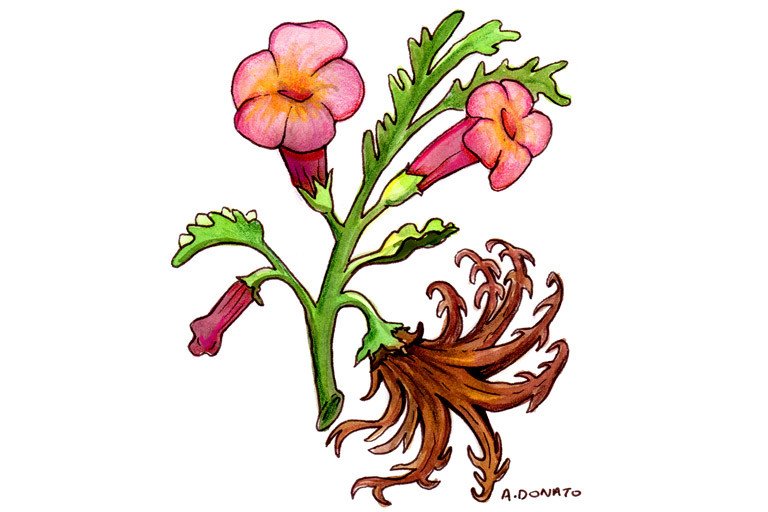
Health Care Professional Information
Common Name
Grapple plant, wood spider
Clinical Summary
Derived from the root or tuber. Clinical studies reveal conflicting data about efficacy of devil's claw as an anti-inflammatory or analgesic. It has been thought that the iridoid glucosides may be responsible for activity, but they are not active when administered separately from whole root extract. The basis for chemical standardization is unknown. Analysis of commercial products reveals wide variance in chemical components. Limited side effects have been reported; diarrhea and bradycardia also occur (1). An open clinical study suggests that Devil's claw may benefit patients with osteoarthritis of the hip or knee (6). A systematic review of clinical trials suggests that it may also be effective in treating low back pain (7). Devil's claw increases gastric acid secretions and may interfere with the activity of antacids and histamine-2 blockers (e.g. ranitidine and famotidine) (3). Other possible drug interactions include increased activity of anticoagulants and cardiac and anti-arrhythmic drugs (1).
Purported Uses
- Anorexia
- GI disorders
- Inflammation
- Muscle pain
- Osteoarthritis
- Pain
Constituents
- Iridoid glucosides: Harpagoside, harpagide and procumbide
- Phytosterols: B-sitosterol, oleanolic acid
- Flavonoids: Kaempferol and luteolin
- Phenolic acids
- Glycosidic phenylpropanoic esters: Verbascoside and isoacteoside
(1)
Mechanism of Action
In animal studies, an aqueous extract containing chiefly harpagoside showed significant dose-dependent anti-inflammatory and analgesic effects. Harpagoside is not implicated in the anti-inflammatory action, but, along with other constituents, it does appear to be involved in the peripheral analgesic properties. Devils claw also has antioxidant effects by scavenging both superoxide and peroxyl in a dose dependent manner (5). The bitter iridoids are responsible for the use of the herb as a stomachic. In vitro and in vivo animal studies have shown some evidence that devil's claw might be cardioactive. Lower doses seem to cause bradycardia and increase the strength of contraction, and high doses seem to weaken heart contractions and coronary blood flow (2).
Herb-Drug Interactions
Antacids / H2 Antagonists: Devil's claw may reduce efficacy due to increased production of stomach acid.
Beta blockers / Digoxin: Devil's claw may cause bradycardia and weaken heart contractions and coronary blood flow.
Anticoagulants: Devil's claw may have additive anticoagulant activity.
Cytochrome P450 enzymes: Devil's claw root can inhibit CYP1A2/2C8/2C9/2C19/2D6 and 3A4, and may interact with substances metabolized by these enzymes (8).
Literature Summary and Critique
Dosage (Inside MSKCC Only)
This field is only visible to only Inside MSKCC users.
References
- Newall CA, et al.Herbal Medicine: A Guide for Healthcare Professionals. London: Pharmaceutical Press; 1996.
- Wichtl MW. Herbal Drugs and Phytopharmaceuticals. Boca Raton: CRC Press; 1994.
- Schulz V, et al. Rational Phytotherapy: A Physicians Guide to the Use of Herbs and Related Remedies, 3rd ed. Berlin (Germany): Springer; 1998.
- Fiebich BL, et al. Inhibition of TNF-alpha synthesis in LPS-stimulated primary human monocytes by Harpagophytum extract SteiHap 69. Phytomedicine 2001;8:28-30.
- Langmead L, et al. Antioxidant effects of herbal therapies used by patients with inflammatory bowel disease: an in vitro study. Aliment Pharmacol Ther 2002;16:197-205.
- Wegener T, Lupke NP. Treatment of patients with arthrosis of hip or knee with an aqueous extract of devil's claw (Harpagophytum procumbens DC.). Phytother Res. 2003 Dec;17(10):1165-72.
- Gagnier JJ, van Tulder MW, Berman B, et al. Herbal medicine for low back pain. Spine 2007;32(1):82-92.
- Unger M, Frank A. Simultaneous determination of the inhibitory potency of herbal extracts on the activity of six major cytochrome P450 enzymes using liquid chromatography/mass spectrometry and automated online extraction. Rapid Commun Mass Spectrom. 2004;18(19):2273-81.
Consumer Information
How It Works
Bottom Line: There is limited proof from clinical trials that devil's claw can reduce inflammation or relieve pain.
Devil's claw is a root extract. It has been studied to some extent in test tubes and in animals, but its biological effects in humans are still not sorted out. In laboratory animals, devil's claw extracts reduce inflammation and cause pain relief, and also acts as an antioxidant. One study showed possible benefits for relieving some forms of arthritis, however, another study showed that devil's claw is not as effective as drugs such as aspirin in reducing inflammation. In rats, different doses of devil's claw have different effects on the heart: low doses seem to cause reduced heart rate and increased strength of contraction, while high doses seem to weaken heart contractions and coronary blood flow. These effects have not been shown in humans.
Purported Uses
- To increase appetite
No scientific evidence supports this use.
- To treat gastrointestinal disorders
No scientific evidence supports this use. Devil's claw might increase acid production by the stomach.
- To reduce inflammation
Studies in animals show a weak anti-inflammatory activity, but studies in humans do not support this use.
- To relieve pain
Studies in animals suggest that devil's claw can relieve pain, but there is no proof from clinical trials that this effect occurs in humans.
- To treat osteoarthritis
Studies in animals suggest that devil's claw can reduce inflammation, but there is limited proof from clinical trials that this herb can treat osteoarthritis.
Research Evidence
Only a few clinical trials have tested the anti-inflammatory properties of devil's claw, with weak and conflicting results. More research is needed to test whether this herb is safe and effective.
Osteoarthritis:
75 patients with osteoarthritis of the hip or knee participated in a study of a supplement that includes Devil's Claw. Patients received the supplement for 12 weeks after which time measurements of their level of pain, stiffness and physical function were shown to decrease by about a quarter. Because the study was not randomized, it is unclear if these findings are significant or are rather the result of a placebo effect.
Patient Warnings
- This product is regulated by the F.D.A. as a dietary supplement. Unlike approved drugs, supplements are not required to be manufactured under specific standardized conditions. This product may not contain the labeled amount or may be contaminated. In addition, it may not have been tested for safety or effectiveness.
Do Not Take If
- You are pregnant.
- You are taking antacids or H2 blockers (Devil's claw can increase the production of stomach acid and reduce the effectiveness of these medications).
- You are taking beta blockers or digoxin (Devil's claw might interfere with these medications).
- You are taking warfarin or other blood thinners (Devil's claw might increase the risk of bleeding).
Side Effects
- Diarrhea
- Slowed heart rate (bradycardia) is a potential side effect
- Upset stomach
Last updated: February 17, 2011
acid (A-sid)
A chemical that gives off hydrogen ions in water and forms salts by combining with certain metals. Acids have a sour taste and turn certain dyes red. Some acids made by the body, such as gastric acid, can help organs work the way they should. An example of an acid is hydrochloric acid. Acidity is measured on a scale called the pH scale. On this scale, a value of 7 is neutral, and a pH value of less than 7 to 0 shows increasing acidity.
Source: The National Cancer Institute's Dictionary of Cancer Terms
(http://www.cancer.gov/dictionary)
anti-inflammatory (AN-tee-in-FLA-muh-TOR-ee)
Having to do with reducing inflammation.
Source: The National Cancer Institute's Dictionary of Cancer Terms
(http://www.cancer.gov/dictionary)
antioxidant (AN-tee-OK-sih-dent)
A substance that protects cells from the damage caused by free radicals (unstable molecules made by the process of oxidation during normal metabolism). Free radicals may play a part in cancer, heart disease, stroke, and other diseases of aging. Antioxidants include beta-carotene, lycopene, vitamins A, C, and E, and other natural and manufactured substances.
Source: The National Cancer Institute's Dictionary of Cancer Terms
(http://www.cancer.gov/dictionary)
arthritis (ar-THRY-tis)
A disease that causes inflammation and pain in the joints.
Source: The National Cancer Institute's Dictionary of Cancer Terms
(http://www.cancer.gov/dictionary)
aspirin (AS-pih-rin)
A drug that reduces pain, fever, inflammation, and blood clotting. Aspirin belongs to the family of drugs called nonsteroidal anti-inflammatory agents. It is also being studied in cancer prevention.
Source: The National Cancer Institute's Dictionary of Cancer Terms
(http://www.cancer.gov/dictionary)
biological (BY-oh-LAH-jih-kul)
Pertaining to biology or to life and living things. In medicine, refers to a substance made from a living organism or its products. Biologicals may be used to prevent, diagnose, treat or relieve of symptoms of a disease. For example, antibodies, interleukins, and vaccines are biologicals. Biological also refers to parents and children who are related by blood.
Source: The National Cancer Institute's Dictionary of Cancer Terms
(http://www.cancer.gov/dictionary)
blood (blud)
A tissue with red blood cells, white blood cells, platelets, and other substances suspended in fluid called plasma. Blood takes oxygen and nutrients to the tissues, and carries away wastes.
Source: The National Cancer Institute's Dictionary of Cancer Terms
(http://www.cancer.gov/dictionary)
cardiac (KAR-dee-ak)
Having to do with the heart.
Source: The National Cancer Institute's Dictionary of Cancer Terms
(http://www.cancer.gov/dictionary)
clinical (KLIH-nih-kul)
Having to do with the examination and treatment of patients.
Source: The National Cancer Institute's Dictionary of Cancer Terms
(http://www.cancer.gov/dictionary)
diarrhea (dy-uh-REE-uh)
Frequent and watery bowel movements.
Source: The National Cancer Institute's Dictionary of Cancer Terms
(http://www.cancer.gov/dictionary)
dietary supplement (DY-uh-TAYR-ee SUH-pleh-ment)
A product that is added to the diet. A dietary supplement is taken by mouth, and usually contains one or more dietary ingredient (such as vitamin, mineral, herb, amino acid, and enzyme). Also called nutritional supplement.
Source: The National Cancer Institute's Dictionary of Cancer Terms
(http://www.cancer.gov/dictionary)
drug (drug)
Any substance, other than food, that is used to prevent, diagnose, treat or relieve symptoms of a disease or abnormal condition. Also refers to a substance that alters mood or body function, or that can be habit-forming or addictive, especially a narcotic.
Source: The National Cancer Institute's Dictionary of Cancer Terms
(http://www.cancer.gov/dictionary)
dyspepsia (dis-PEP-see-uh)
Upset stomach.
Source: The National Cancer Institute's Dictionary of Cancer Terms
(http://www.cancer.gov/dictionary)
extract (EK-strakt)
In medicine, a preparation of a substance obtained from plants, animals, or bacteria and used as a drug or in drugs.
Source: The National Cancer Institute's Dictionary of Cancer Terms
(http://www.cancer.gov/dictionary)
gastric (GAS-trik)
Having to do with the stomach.
Source: The National Cancer Institute's Dictionary of Cancer Terms
(http://www.cancer.gov/dictionary)
GI
Refers to the stomach and intestines. Also called gastrointestinal.
Source: The National Cancer Institute's Dictionary of Cancer Terms
(http://www.cancer.gov/dictionary)
herbal (ER-bul)
Having to do with plants.
Source: The National Cancer Institute's Dictionary of Cancer Terms
(http://www.cancer.gov/dictionary)
in vitro (in VEE-troh)
In the laboratory (outside the body). The opposite of in vivo (in the body).
Source: The National Cancer Institute's Dictionary of Cancer Terms
(http://www.cancer.gov/dictionary)
in vivo (in VEE-voh)
In the body. The opposite of in vitro (outside the body or in the laboratory).
Source: The National Cancer Institute's Dictionary of Cancer Terms
(http://www.cancer.gov/dictionary)
inflammation (IN-fluh-MAY-shun)
Redness, swelling, pain, and/or a feeling of heat in an area of the body. This is a protective reaction to injury, disease, or irritation of the tissues.
Source: The National Cancer Institute's Dictionary of Cancer Terms
(http://www.cancer.gov/dictionary)
L
A measure of volume for a liquid, using the metric system. One L is equal to 1,000 cubic centimeters (cc), 1,000 milliliters (mm), or 1.0567 quarts (qt). Also called liter.
Source: The National Cancer Institute's Dictionary of Cancer Terms
(http://www.cancer.gov/dictionary)
open label study (OH-pen LAY-bel STUH-dee)
A type of study in which both the health providers and the patients are aware of the drug or treatment being given.
Source: The National Cancer Institute's Dictionary of Cancer Terms
(http://www.cancer.gov/dictionary)
placebo (pluh-SEE-boh)
An inactive substance or treatment that looks the same as, and is given the same way as, an active drug or treatment being tested. The effects of the active drug or treatment are compared to the effects of the placebo.
Source: The National Cancer Institute's Dictionary of Cancer Terms
(http://www.cancer.gov/dictionary)
placebo-controlled (pluh-SEE-boh-kun-TROLD)
Refers to a clinical study in which the control patients receive a placebo.
Source: The National Cancer Institute's Dictionary of Cancer Terms
(http://www.cancer.gov/dictionary)
randomized
Describes an experiment or clinical trial in which animal or human subjects are assigned by chance to separate groups that compare different treatments.
Source: The National Cancer Institute's Dictionary of Cancer Terms
(http://www.cancer.gov/dictionary)
significant (sig-NIH-fih-kunt)
In statistics, describes a mathematical measure of difference between groups. The difference is said to be significant if it is greater than what might be expected to happen by chance alone. Also called statistically significant.
Source: The National Cancer Institute's Dictionary of Cancer Terms
(http://www.cancer.gov/dictionary)
stomach (STUH-muk)
An organ that is part of the digestive system. The stomach helps digest food by mixing it with digestive juices and churning it into a thin liquid.
Source: The National Cancer Institute's Dictionary of Cancer Terms
(http://www.cancer.gov/dictionary)
VAS
A tool used to help a person rate the intensity of certain sensations and feelings, such as pain. The visual analog scale for pain is a straight line with one end meaning no pain and the other end meaning the worst pain imaginable. A patient marks a point on the line that matches the amount of pain he or she feels. It may be used to help choose the right dose of pain medicine. Also called visual analog scale.
Source: The National Cancer Institute's Dictionary of Cancer Terms
(http://www.cancer.gov/dictionary)