Health Care Professional Information
Clinical Summary
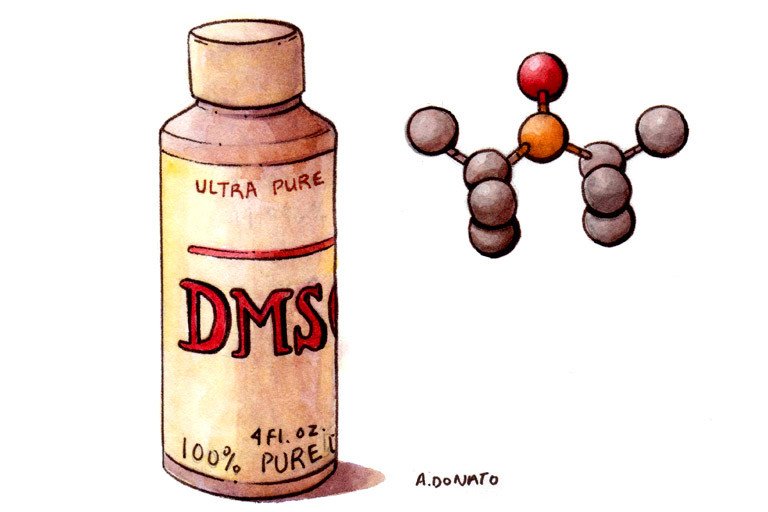
Dimethylsulfoxide (DMSO) is a widely used chemical solvent because of its high polarity. It is used in the laboratories as a cryopreservative. DMSO is readily absorbed by the skin and has been studied as a vehicle for topical drugs. DMSO is thought to have analgesic and anti-inflammatory properties and has been used topically to relieve pain and to treat arthritis.
Small scale studies conducted in the early 1980s suggested that DMSO may help to relieve peripheral neuropathy (1) and post-thoracotomy pain (2). But a systematic review of DMSO reported a lack of definitive evidence against osteoarthritis (3) and painful bladder syndrome/interstitial cystitis (4) (5) (14).
DMSO has been used to prevent or treat extravasations of chemotherapeutic agents (6) (7). It may also slow down the progression of cancer cells; however, data are inconsistent (2) (8).
DMSO has been shown to cause neural damage in animals (9). Topical application of DMSO leads to a strong garlic taste in the mouth (10). Intravesical DMSO is an approved prescription drug for the treatment of interstitial cystitis. DMSO is not approved for use in other forms due to lack of studies analyzing its efficacy and potential toxicities.
Purported Uses
- Cancer treatment
- Chemotherapy side effects
- Pain
- Rheumatoid arthritis
- Sedation
Mechanism of Action
DMSO is diluted on exposure to air. Upon topical application, it rapidly penetrates the skin; however, unlike most penetrating solvents, it is not associated with irreversible membrane damage. DMSO can enhance the skin penetration of other drugs. Analgesic and anti-inflammatory effects may benefit patients with rheumatoid arthritis (2). In addition, DMSO traps free radical hydroxide; its antioxidant properties are thought to be responsible for the prevention of chemotherapy extravasations (7). A strong garlic taste in the mouth following DMSO administration comes from the exhaled dimethylsulfide (DMS) metabolite (11).
Pharmacokinetics
Absorption
After topical application, DMSO can be located in the blood within five minutes, all organs within 20 minutes and bones within an hour (2).
Metabolism/Excretion
Elimination half-time is about four days, however cutaneous application prolongs elimination by about one third. Excretion of DMSO is primarily via urine (2).
Warnings
DMSO is an approved prescription drug for the treatment of interstitial cystitis intravesically only. It is not approved for over-the-counter use in any form due to inadequate evidences of efficacy and potential toxicities. The industrial form of DMSO may be contaminated with other chemicals.
Contraindications
Do not use if pregnant (12).
Adverse Reactions
Reported (Topical): Garlic taste in mouth, dry skin, erythema and pruritis (2) urine discoloration, halitosis, agitation, hypotension, sedation dizziness (13). Changes in eye lens have been reported in animals following administration of DMSO (12).
Literature Summary and Critique
Most of the clinical studies done on DMSO were published in the 1980s and early 1990s. Reliable data to verify its purported uses are limited.
Dosage (Inside MSKCC Only)
This field is only visible to only Inside MSKCC users.
References
- Kingery WS. A critical review of controlled clinical trials for peripheral neuropathic pain and complex regional pain syndromes. Pain 1997;73:123-39.
- Brayton CF. Dimethyl sulfoxide (DMSO): a review. Cornell Vet. 1986;76:61-90.
- Brien S, Prescott P, Bashir N, Lewith H, Lewith G. Systematic review of the nutritional supplements dimethyl sulfoxide (DMSO) and methylsulfonylmethane (MSM) in the treatment of osteoarthritis.Osteoarthritis Cartilage. Nov 2008;16(11):1277-1288.
- Dawson TE, Jamison J. Intravesical treatments for painful bladder syndrome/ interstitial cystitis. Cochrane Database Syst Rev. 2007(4):CD006113.
- Dimitrakov J, Kroenke K, Steers WD, et al. Pharmacologic management of painful bladder syndrome/interstitial cystitis: a systematic review. Arch Intern Med. Oct 8 2007;167(18):1922-1929.
- Bertelli G. Prevention and management of extravasation of cytotoxic drugs. Drug Saf 1995;12:245-55.
- Dorr RT. Antidotes to vesicant chemotherapy extravasations. Blood Rev. 1990;4:41-60.
- Jacob SW,.Herschler R. Pharmacology of DMSO. Cryobiology 1986;23:14-27.
- Hanslick JL, Lau K, Noguchi KK, et al. Dimethyl sulfoxide (DMSO) produces widespread apoptosis in the developing central nervous system. Neurobiol Dis. Apr 2009;34(1):1-10.
- Prior D, Mitchell A, Nebauer M, Smith M. Oncology nurses' experience of dimethyl sulfoxide odor. Cancer Nurs 2000;23:134-40.
- Rosenstein ED. Topical agents in the treatment of rheumatic disorders. Rheum.Dis.Clin North Am 1999;25:899-918, viii.
- Physicians' Desk Reference. Montvale, NJ: Thomson, 2004.
- MICROMEDEX(R) Healthcare Series. 120. Thomson, 2004.
- French LM, Bhambore N. Interstitial cystitis/painful bladder syndrome. Am Fam Physician. 2011 May 15;83(10):1175-81.
Consumer Information
How It Works
Bottom Line: DMSO may help relieve pain but more studies are needed to confirm its safety and efficacy. There is no evidence that DMSO can treat cancer in humans.
DMSO is a widely used chemical solvent. It is rapidly absorbed when applied to the skin and has been shown to reduce pain and inflammation. However, there are concerns of adverse effects including damage to the nerves. DMSO is used as a prescription drug to treat inflammation and pain of the bladder and as an antidote for chemotherapy drugs that leak and are trapped inside the body. DMSO has not been shown to be an effective treatment for cancer in humans.
Purported Uses
- To reduce pain
Applying DMSO to the skin appears to reduce pain in humans.
- To treat arthritis and osteoarthritis
A few studies show that application of DMSO to the skin reduces pain and inflammation in humans; however, more studies are needed to determine the optimal dose to be used.
- As a cancer treatment
Some laboratory studies have shown that DMSO may slow down the progression of cancer; however, no clinical studies have been performed.
- To treat chemotherapy extravasations (chemotherapy that has leaked and become trapped in surrounding tissue)
DMSO may be used to treat this condition in a hospital setting.
- To treat interstitial cystitis (inflammation and pain of the bladder of unknown origin)
DMSO is an accepted treatment for interstitial cystitis; however, more studies are needed to establish this use.
Research Evidence
Most of the clinical studies done on DMSO were published in the 1980s and early 1990s. Available data are limited to verify its effects.
Side Effects
- Garlic taste in mouth
- Dry, itchy, scaly skin
- Urine discoloration
- Agitation
Last updated: April 25, 2012
administration (ad-MIH-nih-STRAY-shun)
In medicine, the act of giving a treatment, such as a drug, to a patient. It can also refer to the way it is given, the dose, or how often it is given.
Source: The National Cancer Institute's Dictionary of Cancer Terms
(http://www.cancer.gov/dictionary)
agitation (A-jih-TAY-shun)
A condition in which a person is unable to relax and be still. The person may be very tense and irritable, and become easily annoyed by small things. He or she may be eager to have an argument, and be unwilling to work with caregivers to make the situation better.
Source: The National Cancer Institute's Dictionary of Cancer Terms
(http://www.cancer.gov/dictionary)
analgesic (A-nul-JEE-zik)
A drug that reduces pain. Analgesics include aspirin, acetaminophen, and ibuprofen.
Source: The National Cancer Institute's Dictionary of Cancer Terms
(http://www.cancer.gov/dictionary)
anti-inflammatory (AN-tee-in-FLA-muh-TOR-ee)
Having to do with reducing inflammation.
Source: The National Cancer Institute's Dictionary of Cancer Terms
(http://www.cancer.gov/dictionary)
antioxidant (AN-tee-OK-sih-dent)
A substance that protects cells from the damage caused by free radicals (unstable molecules made by the process of oxidation during normal metabolism). Free radicals may play a part in cancer, heart disease, stroke, and other diseases of aging. Antioxidants include beta-carotene, lycopene, vitamins A, C, and E, and other natural and manufactured substances.
Source: The National Cancer Institute's Dictionary of Cancer Terms
(http://www.cancer.gov/dictionary)
arthritis (ar-THRY-tis)
A disease that causes inflammation and pain in the joints.
Source: The National Cancer Institute's Dictionary of Cancer Terms
(http://www.cancer.gov/dictionary)
bladder (BLA-der)
The organ that stores urine.
Source: The National Cancer Institute's Dictionary of Cancer Terms
(http://www.cancer.gov/dictionary)
blood (blud)
A tissue with red blood cells, white blood cells, platelets, and other substances suspended in fluid called plasma. Blood takes oxygen and nutrients to the tissues, and carries away wastes.
Source: The National Cancer Institute's Dictionary of Cancer Terms
(http://www.cancer.gov/dictionary)
cancer (KAN-ser)
A term for diseases in which abnormal cells divide without control and can invade nearby tissues. Cancer cells can also spread to other parts of the body through the blood and lymph systems. There are several main types of cancer. Carcinoma is a cancer that begins in the skin or in tissues that line or cover internal organs. Sarcoma is a cancer that begins in bone, cartilage, fat, muscle, blood vessels, or other connective or supportive tissue. Leukemia is a cancer that starts in blood-forming tissue such as the bone marrow, and causes large numbers of abnormal blood cells to be produced and enter the blood. Lymphoma and multiple myeloma are cancers that begin in the cells of the immune system. Central nervous system cancers are cancers that begin in the tissues of the brain and spinal cord. Also called malignancy.
Source: The National Cancer Institute's Dictionary of Cancer Terms
(http://www.cancer.gov/dictionary)
chemical (KEH-mih-kul)
A substance made up of elements, such as hydrogen or sodium.
Source: The National Cancer Institute's Dictionary of Cancer Terms
(http://www.cancer.gov/dictionary)
chemotherapy (KEE-moh-THAYR-uh-pee)
Treatment with drugs that kill cancer cells.
Source: The National Cancer Institute's Dictionary of Cancer Terms
(http://www.cancer.gov/dictionary)
clinical (KLIH-nih-kul)
Having to do with the examination and treatment of patients.
Source: The National Cancer Institute's Dictionary of Cancer Terms
(http://www.cancer.gov/dictionary)
condition (kun-DIH-shun)
In medicine, a health problem with certain characteristics or symptoms.
Source: The National Cancer Institute's Dictionary of Cancer Terms
(http://www.cancer.gov/dictionary)
cutaneous (kyoo-TAY-nee-us)
Having to do with the skin.
Source: The National Cancer Institute's Dictionary of Cancer Terms
(http://www.cancer.gov/dictionary)
dose (dose)
The amount of medicine taken, or radiation given, at one time.
Source: The National Cancer Institute's Dictionary of Cancer Terms
(http://www.cancer.gov/dictionary)
drug (drug)
Any substance, other than food, that is used to prevent, diagnose, treat or relieve symptoms of a disease or abnormal condition. Also refers to a substance that alters mood or body function, or that can be habit-forming or addictive, especially a narcotic.
Source: The National Cancer Institute's Dictionary of Cancer Terms
(http://www.cancer.gov/dictionary)
efficacy (EH-fih-kuh-see)
Effectiveness. In medicine, the ability of an intervention (for example, a drug or surgery) to produce the desired beneficial effect.
Source: The National Cancer Institute's Dictionary of Cancer Terms
(http://www.cancer.gov/dictionary)
erythema (AYR-ih-THEE-muh)
Redness of the skin.
Source: The National Cancer Institute's Dictionary of Cancer Terms
(http://www.cancer.gov/dictionary)
free radical (free RA-dih-kul)
A type of unstable molecule that is made during normal cell metabolism (chemical changes that take place in a cell). Free radicals can build up in cells and cause damage to other molecules, such as DNA, lipids, and proteins. This damage may increase the risk of cancer and other diseases.
Source: The National Cancer Institute's Dictionary of Cancer Terms
(http://www.cancer.gov/dictionary)
garlic (GAR-lik)
A European plant that has a bulb used to flavor food. It has also been used in some cultures to treat certain medical conditions including high cholesterol, high blood pressure, infections, and cancer. The scientific name is .
Source: The National Cancer Institute's Dictionary of Cancer Terms
(http://www.cancer.gov/dictionary)
hypotension (HY-poh-TEN-shun)
Abnormally low blood pressure.
Source: The National Cancer Institute's Dictionary of Cancer Terms
(http://www.cancer.gov/dictionary)
inflammation (IN-fluh-MAY-shun)
Redness, swelling, pain, and/or a feeling of heat in an area of the body. This is a protective reaction to injury, disease, or irritation of the tissues.
Source: The National Cancer Institute's Dictionary of Cancer Terms
(http://www.cancer.gov/dictionary)
intravesical (IN-truh-VEH-sih-kul)
Within the bladder.
Source: The National Cancer Institute's Dictionary of Cancer Terms
(http://www.cancer.gov/dictionary)
lens (lenz)
A clear disk that focuses light, as in a camera or microscope. In the eye, the lens is a clear, curved structure at the front of the eye behind the pupil. It focuses light rays that enter the eye through the pupil, making an image on the retina (light-sensitive layers of nerve tissue at the back of the eye).
Source: The National Cancer Institute's Dictionary of Cancer Terms
(http://www.cancer.gov/dictionary)
membrane (MEM-brayn)
A very thin layer of tissue that covers a surface.
Source: The National Cancer Institute's Dictionary of Cancer Terms
(http://www.cancer.gov/dictionary)
metabolite (meh-TA-boh-lite)
A substance made or used when the body breaks down food, drugs or chemicals, or its own tissue (for example, fat or muscle tissue). This process, called metabolism, makes energy and the materials needed for growth, reproduction, and maintaining health. It also helps get rid of toxic substances.
Source: The National Cancer Institute's Dictionary of Cancer Terms
(http://www.cancer.gov/dictionary)
neural (NOOR-ul)
Having to do with nerves or the nervous system, including the brain and the spinal cord.
Source: The National Cancer Institute's Dictionary of Cancer Terms
(http://www.cancer.gov/dictionary)
over-the-counter (OH-ver-the-KOWN-ter)
A medicine that can be bought without a prescription (doctor's order). Examples include analgesics (pain relievers) such as aspirin and acetaminophen. Also called nonprescription and OTC.
Source: The National Cancer Institute's Dictionary of Cancer Terms
(http://www.cancer.gov/dictionary)
prescription (prih-SKRIP-shun)
A doctor's order for medicine or another intervention.
Source: The National Cancer Institute's Dictionary of Cancer Terms
(http://www.cancer.gov/dictionary)
prevention (pree-VEN-shun)
In medicine, action taken to decrease the chance of getting a disease or condition. For example, cancer prevention includes avoiding risk factors (such as smoking, obesity, lack of exercise, and radiation exposure) and increasing protective factors (such as getting regular physical activity, staying at a healthy weight, and having a healthy diet).
Source: The National Cancer Institute's Dictionary of Cancer Terms
(http://www.cancer.gov/dictionary)
progression (pruh-GREH-shun)
In medicine, the course of a disease, such as cancer, as it becomes worse or spreads in the body.
Source: The National Cancer Institute's Dictionary of Cancer Terms
(http://www.cancer.gov/dictionary)
solvent (SOL-vent)
A liquid that is able to dissolve a solid.
Source: The National Cancer Institute's Dictionary of Cancer Terms
(http://www.cancer.gov/dictionary)
topical (TAH-pih-kul)
On the surface of the body.
Source: The National Cancer Institute's Dictionary of Cancer Terms
(http://www.cancer.gov/dictionary)
urine (YOOR-in)
Fluid containing water and waste products. Urine is made by the kidneys, stored in the bladder, and leaves the body through the urethra.
Source: The National Cancer Institute's Dictionary of Cancer Terms
(http://www.cancer.gov/dictionary)
WS
An inherited disorder marked by rapid aging that begins in early adolescence. Patients may be shorter than average, and have health problems such as loss and graying of hair, hardening of the arteries, thinning of the bones, diabetes, and thin, hardened skin. They also have an increased risk of cancer, especially osteosarcoma (a type of bone cancer). WS is caused by a mutation (change) in a gene involved in cell division. It is a type of autosomal recessive gene disease. Also called adult progeria and Werner syndrome.
Source: The National Cancer Institute's Dictionary of Cancer Terms
(http://www.cancer.gov/dictionary)