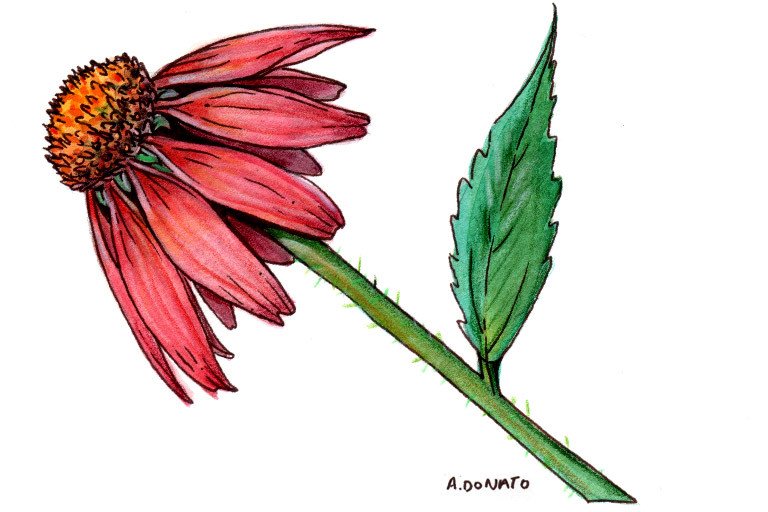
Common Names
- Coneflower; purple coneflower
- Black Sampson; Sampson root
- Sonnenhut
- Igelkopfwurzel
For Patients & Caregivers
Tell your healthcare providers about any dietary supplements you’re taking, such as herbs, vitamins, minerals, and natural or home remedies. This will help them manage your care and keep you safe.
Echinacea is a plant that belongs to the sunflower family. It’s commonly used in herbal medicine. Echinacea also comes as capsules, pills, tablets, or liquid extracts.
Echinacea is used to:
- Prevent and treat common cold
- Strengthen your immune system
- Prevent and treat influenza (the flu)
- Heal wounds
Echinacea also has other uses that haven’t been studied by doctors to see if they work.
It’s generally safe to use echinacea. But talk with your healthcare providers before taking echinacea supplements. They can have higher amounts of the herb, and can also interact with some medications and affect how they work.
For more information, read the “What else do I need to know?” section below.
Side effects of using echinacea may include:
- Headache
- Dizziness
- Nausea (feeling like you’re going to throw up)
- Constipation (having fewer bowel movements than usual)
- Mild stomach pain
- Skin rash
- Talk to your healthcare provider if you’re taking immunosuppressants like tacrolimus (Prograf®) or cyclosporine (Gengraf®, Neoral® or Sandimmune®). Echinacea may make these medications less effective.
- Talk to your healthcare provider if you’re taking etoposide (Toposar®, VePesid®, Etopophos®, VP-16). Echinacea can decrease your blood platelet count.
- Talk to your healthcare provider before taking echinacea in any form if you’re pregnant or breastfeeding. It may not be safe for you.
For Healthcare Professionals
The genus Echinacea belongs to the family Compositae, commonly referred to as the sunflower family. Of the known species, E. purpurea, E. angustifolia, and E. pallida are commonly used in herbal medicine. Extracts derived from the root and aerial parts are widely used in Europe and the United States as nonspecific immunostimulants and to prevent or treat the common cold and influenza. However, natural products differ greatly in composition (26), mainly due to the use of different species, variable plant materials or extraction methods, and the addition of other components. Preclinical studies suggest immunostimulatory and anti-inflammatory effects (27). A standardized echinacea preparation inactivated influenza viruses (28) and may improve respiratory activity (2) (3). In animal models, echinacea stimulated erythropoiesis, increased blood-oxygen transport (29) (30), produced anxiolytic effects (31), and exhibited wound-healing properties (32) (33) (34).
Clinical data indicate that echinacea is ineffective in preventing the common cold caused by rhinoviruses (4) or in treating upper respiratory infections (5) (6) (16) but positive findings were reported with higher doses (70). Studies of its ability to reduce incidence and duration of the common cold yielded mixed results (7) (8) (9) (10) (22) (35) (36). Other analyses do not indicate any benefits for treating colds, and weak evidence for a prophylactic benefit (26) (37), but a large randomized trial found an echinacea formulation to be as effective as oseltamivir for influenza, and with fewer adverse events in the echinacea group (38). In a review of 17 clinical trials involving 3,363 participants, echinacea supplements were found to affect reductions in pro-inflammatory cytokines that play a role in the progression of cytokine storm and acute respiratory distress syndrome (ARDS) (68). Echinacea was also reported useful in preventing respiratory tract infections and reducing associated antibiotic usage in children (71).
Small studies have shown that a standardized echinacea root extract has immunomodulating activity (39); an echinacea/sage spray was useful in treating acute sore throats (17); and a formula containing dry root extracts of Echinacea purpurea and Echinacea angustifolia may be useful as an adjuvant therapy for decreasing relapse incidence in patients treated for genital condylomatosis (67) and in those with cervical low-grade squamous intraepithelial lesions (72). Data on anxiolytic effects are mixed (69) (73) but findings on improving or enhancing athletic performance are mixed (40) (41). A topical echinacea extract was reported effective in alleviating symptoms associated with atopic eczema (63). Echinacea may also have anticancer potential evidenced by the cytotoxic effects exerted by an extract and a major compound, cichoric acid, in human colon cancer cells (42).
Some studies suggest that echinacea could decrease plasma levels, affect therapeutic efficacy, or cause adverse effects with some anticancer drugs (25) (43). In HIV-infected patients, co-administration with etravirine was found to be safe and well tolerated (44). In a large population-based study, use of echinacea was associated with a slight increase in diastolic blood pressure (45). There is insufficient evidence regarding the efficacy and safety of echinacea during pregnancy (46).
- Common cold
- Immunostimulation
- Viral infections
- Wound healing
Echinacea’s active constituents include cichoric and caftaric acids, polysaccharides, and alkylamides (47). Immune-modulating effects of a standardized echinacea root extract include upregulation of interleukin (IL)-2 and IL-8 and downregulation of pro-inflammatory cytokines tumor necrosis factor (TNF)-alpha and IL-6 (39). Immunemodulation by alkylamides occurs through binding to human cannabinoid receptors 1 and 2, and by inhibiting TNF-alpha (48). Alkylamides may also be responsible for anti-inflammatory effects (27). Although echinacea does not appear to have significant ergogenic or anabolizing effects, it appears to enhance the immune system and decrease oxidative damage (49).
In vitro and in vivo, echinacea extracts were shown to stimulate phagocytosis, enhance mobility of leukocytes, stimulate TNF and IL-1 secretion from macrophages and lymphocytes, and improve respiratory activity (2) (3). However, their effects on innate immunity such as phagocytosis could not be confirmed, and showed only minimal effects on tumor progression, although echinacea did stimulate natural killer cell activity (50). Other studies suggest that bacterial components of echinacea are responsible for immune benefits, as total bacterial load differences and content of bacterial lipopolysaccharides within echinacea samples have correlated with NF-kappaB activation in THP-1 cells (51).
In human colon cancer cells, cichoric acid decreased telomerase activity and induced apoptosis via DNA fragmentation, caspase-9 activation, poly-ADP-ribose polymerase (PARP) cleavage and beta-catenin downregulation (42). Differential effects of echinacea on intestinal and hepatic CYP3A activities may be due to systemic unavailability of locally-acting constituents that inhibit CYP3A, or rapid absorption of these constituents that limits intestinal exposure and CYP3A induction, or a systemically-formed constituent metabolite that is capable of inducing hepatic but not intestinal CYP3A (52).
- Patients undergoing chemotherapy should use caution with echinacea, as it may reduce the efficacy of some anticancer medications or cause adverse effects (25) (43) (53).
- Patients with allergies or asthma should exercise caution with echinacea, as allergic reactions have been reported (54).
- Patients undergoing blepharoplasty (eyelid surgery), should avoid echinacea because of added increased risk of dry eye syndrome (55).
Common: Headache, dizziness, nausea, constipation, gastrointestinal upset, rash (5) (11) (12) (54)
Rare: Dermatitis, anaphylaxis (13) (54)
Case Reports – Oral
Profound thrombocytopenia: In a 61-year-old man with nonsmall cell lung cancer who was concurrently taking echinacea while receiving chemoradiation with cisplatin and etoposide (25).
Severe thrombotic thrombocytopenic purpura (TTP): In a 32-year-old man following ingestion of echinacea to alleviate upper respiratory tract infection symptoms. TTP resolved after treatment for a month (18).
Pemphigus vulgaris exacerbation: In a 55-year-old man with a history of the condition which was controlled with immunosuppressants. Exacerbation was linked to consumption of echinacea, and only partial remission was regained after he was treated again with immunosuppressants (19).
Asymptomatic leukopenia: In a 51-year-old woman following chronic use of echinacea. Her white blood cell count returned to normal levels 7 months after discontinuing echinacea supplements (20).
Severe acute hepatitis: In a 45-year-old man who complained of fatigue and jaundice lasting one week, linked to the ingestion of daily high doses of echinacea used to strengthen his immune system after catching the cold (23).
Severe acute liver failure: In a 2-year-old girl, likely secondary to echinacea toxicity (56).
Hypereosinophilia: In a 58-year-old man following echinacea consumption, with symptoms improving after discontinuing echinacea (24).
Bilateral central facial palsy and severe quadriparesis: In a 25 year-old male after taking herbal drugs (containing echinacea and many other herbal ingredients) for two weeks. Symptoms improved after conventional treatment (64).
Acute cholestatic hepatitis: In a 41-year-old man following consumption of echinacea to strengthen immune system. His condition improved after discontinuing its use (65).
Case Reports – Topical
Eye irritation and conjunctivitis: 7 reports following use of topical echinacea were received by The National Registry of Drug-Induced Ocular Side Effects. Symptoms resolved after discontinuing echinacea (21).
Cytochrome P450 substrates: Echinacea inhibits CYP3A4 (14) (43) and CYP2C8 (66) and can affect the intracellular concentration of drugs metabolized by this enzyme. Clinical relevance is not known.
Cytochrome P3A or CYP1A2 substrate drugs: Caution should be used when echinacea is coadministered with drugs dependent on CYP3A or CYP1A2 for their elimination (57). Clinical relevance is not known.
Tamoxifen: In vitro studies suggest concurrent echinacea use may result in subtherapeutic systemic exposure of prodrugs such as tamoxifen, reducing their efficacy (43). Clinical relevance is not known.
Docetaxel: In a study of cancer patients receiving docetaxel, echinacea at the recommended dosage did not significantly alter docetaxel pharmacokinetics (58) (59).
Etoposide: Echinacea caused profound thrombocytopenia in a patient receiving etoposide, likely due to the inhibition of CYP3A4 (25).
P-glycoprotein (P-gp) substrate drugs: In vitro, echinacea has been shown to inhibit P-gp activity (60), but the clinical significance of this is uncertain as echinacea supplementation in humans did not affect digoxin pharmacokinetics (61).
Oseltamivir: In vitro, echinacea reduced the formation of the active drug and may therefore reduce efficacy, but clinical significance is as yet undetermined (62).
Immunosuppressants: Echinacea may antagonize the effects of immunosuppressants (19). Clinical relevance is not known.