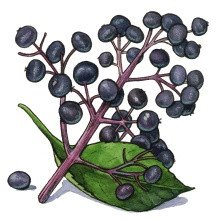
Common Names
- Elder
- elderberry
- European elderberry; black elder; black elderberry
- sambucus
For Patients & Caregivers
Tell your healthcare providers about any dietary supplements you’re taking, such as herbs, vitamins, minerals, and natural or home remedies. This will help them manage your care and keep you safe.
Elderberry is the dark purple berry that comes from the European or black elder tree. Elderberry has many nutrients. It’s used to make jams, syrups, and wine. Both elderberry flowers and fruits are used to help reduce cold and flu symptoms.
You can also take elderberry supplements as gummies, tablets, or syrup.
Elderberry is used to:
- Prevent and treat symptoms of cold and flu
- Boost the immune system
- Reduce inflammation (swelling)
- Lower cholesterol
- Relieve constipation (having fewer bowel movements than usual)
Elderberry also has other uses that haven’t been studied by doctors to see if they work.
It’s generally safe to use elderberry in food and tea. But talk with your healthcare providers before taking elderberry supplements.
Herbal supplements are stronger than the herbs you would use in cooking. They can also interact with some medications and affect how they work. For more information, read the “What else do I need to know?” section below.
Side effects of using raw elderberries can include:
- Nausea (feeling like you’re going to throw up)
- Vomiting (throwing up)
- Dizziness (feeling faint, woozy, weak or unsteady)
- Numbness (loss of feeling or sensation in a part of your body)
- Raw or unripe elderberries have chemicals that can be harmful. It’s important to cook them well before eating.
- Don’t eat elderberry leaves and stems. They may have harmful chemicals.
- Talk to your healthcare provider if you’re taking laxatives (medications to help you have a bowel movement). Elderberry can increase their effects.
For Healthcare Professionals
Elderberry belongs to a family of flowering shrubs known as Sambucus or Elder. They are native to Europe but have become naturalized in many parts of the world including the United States. Cultivated for medicinal and food purposes, the fruit is used to produce jams, syrups, and wine. Elderberry flowers and fruit are incorporated in remedies to reduce cold and flu symptoms, for inflammation and respiratory diseases (1) (2) (3), and to relieve constipation (4). The berries are a rich source of anthocyanins and other phenolics and nutrients (2). Several species of Sambucus produce elderberries with similar chemical compositions including American Elder (Sambucus canadensis) and Blue Elder (Sambucus caerulea) (1), but European Elder (Sambucus nigra) is the type most studied and used in supplements.
In vitro studies demonstrate that elderberries possess antiviral (5), antibacterial (3), antidiabetic (6), immunomodulatory (7), antioxidant, anti-inflammatory, and chemopreventive properties (1) (2) (8), although inhibition of cancer cell growth was shown to be weak (9). Flavonoids and proanthocyanidins were shown to block HIV1 infection, and may have additive effects with existing AIDS drugs such as enfuvirtide (10). Elderberry also conferred protective effects against oxidative stressors in endothelial cells (8). However, it did not demonstrate vasoprotective effects (11), and randomized trials found it ineffective in improving cardiovascular disease biomarkers (12) or for improving cholesterol levels (13). Small studies found elderberry to be safe and effective in a preparation for chronic constipation (4) and in reducing episodes of tonsillitis in children (33). It may also help reduce symptoms of influenza (14) (28) (34) (35), but larger studies are needed to confirm these findings (32) (39).
Unsubstantiated claims that elderberry prevents or treats various diseases including AIDS, diabetes, flu (15) and COVID-19 (36) (37) have been halted by the FDA. This is particularly important as patients may forego or avoid legitimate treatments.
- Cold and flu symptoms
- Immunostimulation
- Inflammation
- High cholesterol
- Constipation
Elderberry inhibits H1N1 activities by binding to H1N1 virions as well as by blocking host cell recognition and entry (5). It may also prevent HIV1 infection by binding to viral glycoproteins such as gp120 (10), but additional investigations are required to clarify those mechanisms (3). Elderberry’s anti-inflammatory effects may result from increased cytokine production (19) or inhibition of nuclear transcription factor kappaB and phosphatidylinositol 3-kinase (20). An elderberry extract improved metabolic disturbances in a murine model of obesity by lowering serum triglycerides, inflammatory markers and insulin resistance (30). Its antidiabetic properties occur via activation of peroxisome proliferator-activated receptor gamma and stimulation of insulin-dependent glucose uptake (6). Elderberry may also influence HDL dysfunction associated with chronic inflammation by affecting hepatic gene expression in hyperlipidemic mice (31). Another study indicates its chemopreventive potential is related to induction of quinone reductase as well as cyclooxygenase-2 and ornithine decarboxylase inhibition (2).
- Avoid use during pregnancy or if lactating due to risk of toxicity and potential GI distress (24).
Infrequent: Type 1 allergy (25), gastrointestinal (GI) distress (23).
Case Reports:
- Eleven people experienced nausea and vomiting, eight of whom had acute GI and neurologic symptoms after ingesting an elderberry juice made from raw elderberries, leaves, and branches. Other symptoms included dizziness and numbness and one person who had consumed the most juice was hospitalized (23).
- Acute pancreatitis: In a 51-year-old man following use of black elderberry. His symptoms resolved after treatment with steroids (38).
- Autoimmune hepatitis: In a 60-year-old woman with a history of Hashimoto thyroiditis and Medullary sponge kidneys, with long-term use of supplements containing elderberry. Her liver function tests normalized after stopping supplements and administering immuno-suppressive therapy (40).
Antidiabetic drugs: Elderberry has hypoglycemic activity and may have additive effects with antidiabetic drugs (6). Clinical relevance has yet to be determined.
Diuretics: Elderberry promotes urination and may have additive effects with diuretics (26). Clinical relevance has yet to be determined.
Laxatives: Elderberry was reported to have laxative effects in clinical studies, and can therefore, have additive effects (4) (24).