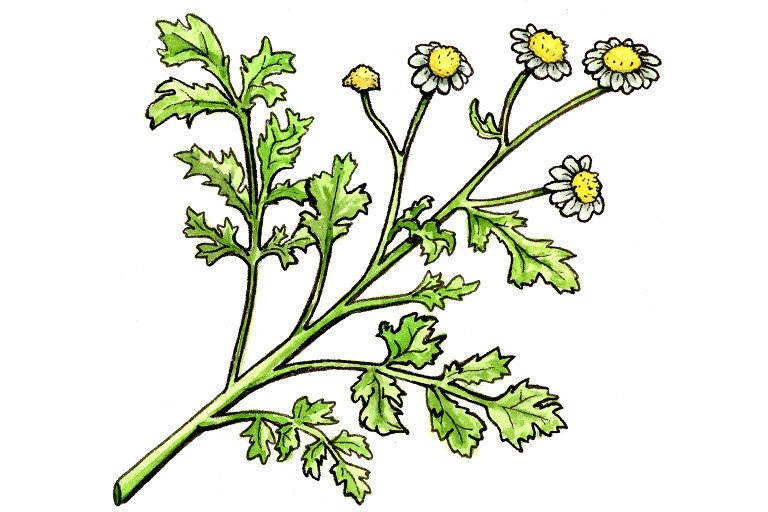
Common Names
- Featherfew
- Santa Maria
- wild chamomile
- wild quinine
For Patients & Caregivers
Tell your healthcare providers about any dietary supplements you’re taking, such as herbs, vitamins, minerals, and natural or home remedies. This will help them manage your care and keep you safe.
Feverfew may benefit patients with migraine headaches.
One or more compounds found in feverfew are thought to prevent migraines. One such compound, parthenolide, was found to block the formation of inflammatory proteins. A feverfew extract was shown to reduce the number of migraine attacks and also decrease the mild headache that occurs before a migraine attack. Feverfew also showed anticancer effects in lab studies. Human studies are needed.
-
To prevent migraine headaches
A few studies support this use. Post-feverfew withdrawal syndrome (consisting of muscle stiffness, anxiety, headaches, nausea, and vomiting) can occur after patients discontinue using this herb. -
To treat arthritis
Although compounds in feverfew show anti-inflammatory activity in the laboratory, a clinical trial did not support this use. -
To relieve painful and heavy menstruation
No scientific evidence supports this use. -
To treat psoriasis
Although compounds in feverfew show anti-inflammatory activity in the laboratory, human data are lacking.
- Stomach upset
- Red, itchy rash
- Mouth ulcerations when chewing fresh feverfew leaves
- Withdrawal symptoms (post-feverfew syndrome): May occur when patients stop taking feverfew after a long period of time. These include muscle stiffness, anxiety, moderate pain, headache, nausea, and vomiting.
Do Not Take if:
You are allergic to ragweed, chrysanthemums, marigolds, or other members of the Compositae family.
You are taking Cytochrome P450 3A4 substrate drugs: Feverfew may increase the risk of side effects of these drugs. Clinical relevance is not known.
You are taking anticoagulant/antiplatelet drugs: Feverfew may increase the risk of bleeding. Clinical relevance is not known.
For Healthcare Professionals
Feverfew is a plant that belongs to the daisy/sunflower family. It is widely used in traditional medicine for the treatment of fevers, migraine headaches, rheumatoid arthritis, stomach ache, toothache, insect bites and infertility. Although much of its activity is attributed to the compound parthenolide, a parthenolide-free extract of feverfew demonstrated free radical-scavenging properties, affording protection against UV-induced sun damage (1). Feverfew extracts also possess antiprotozoal (2), antibacterial (3), anti-inflammatory (1) (4), and antioxidant (5) properties.
In clinical studies, a feverfew extract reduced the frequency (6) and pain intensity (37) of migraine attacks; a formulation containing feverfew was reported useful in decreasing the duration of aura (33); and a feverfew/ginger formula prevented mild headache before the onset of moderate to severe headache in patients with migraine (7). In another study, a combination of feverfew and acupuncture treatments led to greater improvements in quality of life in women with migraine, compared with feverfew or acupuncture alone (8). However, a randomized trial found no difference in the anti-migrane effect conferred by feverfew versus placebo (38), and a systematic review concluded the overall evidence of efficacy for migraine to be mixed, citing the need for high-quality research (35). Observational data suggest feverfew may also alleviate headaches in pediatric cases (39), but it had no benefits in patients with rheumatoid arthritis (9).
In the context of cancer, parthenolide demonstrated anticancer effects in vitro (10) (11) (12) (13) (14) (15) (16) (17). A phase I clinical study involving cancer patients showed that up to 4 mg of parthenolide was well tolerated; however, it could not be detected in the plasma (18). Consequently, a synthetic analog dimethylamino-parthenolide (DMAPT), a more hydrophilic form of parthenolide, with greater bioavailability was identified. Oral administration of DMAPT has been found to be safe, and resulted in increased plasma concentrations in an animal model (19). More studies are warranted.
- Migraine
- Arthritis
- Dysmenorrhea
- Psoriasis
The sesquiterpene lactones, particularly parthenolide, are the active constituents responsible for feverfew’s beneficial effects. Parthenolide attenuates activation of the NF-kappa B complex to block transcription of inflammatory proteins (21). The inhibition of this pathway also leads to decreased platelet activity (22). Other mechanisms that produce antiplatelet activity by parthenolide include sulfhydryl group alterations, changes in protein kinase C interactions, and arachidonic acid metabolism (22) (23) (24). The flavonol content also has anti-inflammatory effects (25) (26).
In vitro studies suggest various activities induced by parthenolide can produce antiproliferative effects. In colorectal cancer cells, it suppresses angiogenesis by reducing VEGF and VEGF-receptor expression. (10) In cervical and breast cancer cell lines, parthenolide modulates apoptosis-regulating gene expression (11) and activates both apoptosis pathway and AMPK-autophagy survival pathway through ROS generation (12). In glioblastoma cells, it induces caspase 3/7-mediated apoptosis independent of NF-kappa B suppression (27). Parthenolide sensitizes the tumor necrosis factor-related apoptosis-inducing ligand (TRAIL) leading to apoptosis via activation of both caspases 8 and 3 in hepatocellular carcinoma cells (17).
Individuals allergic to ragweed, chrysanthemums, marigolds, or other members of the Compositae family may have cross-sensitivity to feverfew.
Common: Minor gastrointestinal distress; oral ulcerations from chewing fresh feverfew leaves; contact dermatitis (28) (34); and exacerbated dermatitis following use of a moisturizer containing feverfew (29).
Withdrawal symptoms: Muscle stiffness, anxiety, and moderate pain usually occur following cessation of long-term use of feverfew (referred to as the post-feverfew syndrome) (25).
Alteration of Coagulation Test Results and Vaginal Bleeding: In a 36-year-old woman with migraine after taking feverfew supplements (36).
Cytochrome P450 3A4 substrates: Feverfew inhibits CYP1A2/2C8/2C9/2C19/2D6 and 3A4, and can affect the intracellular concentration of drugs metabolized by these enzymes (30). Clinical relevance is not known.
Anticoagulants/antiplatelets: The active constituent in feverfew inhibits platelet activity and may have additive effects (22) (23) (24) (31). Clinical relevance is not known.