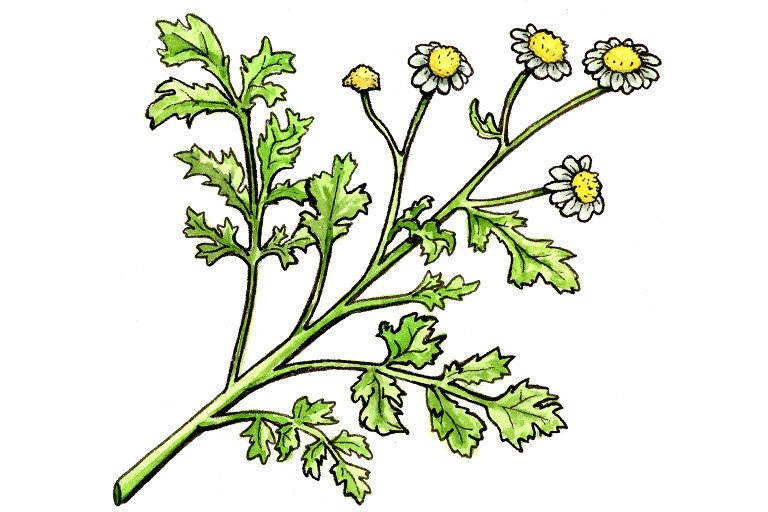
Health Care Professional Information
Common Name
Bachelor’s button, featherfew, Santa Maria, wild chamomile, wild quinine
Clinical Summary
Derived from the leaves of the plant, feverfew is used primarily to treat migraine headaches. Feverfew extracts possess antiprotozoal properties (2). Although much of its activity is attributed to a compound parthenolide, a parthenolide-free extract of feverfew demonstrated free radical-scavenging properties, affording protection against UV-induced sun damage (3).
In clinical trials a feverfew extract reduced the frequency of migraine attacks (1) and a feverfew/ginger formulation prevented mild headache before the onset of moderate to severe headache in patients with migraine (16).
Feverfew also exhibited anticancer effects in vitro (4) (5) (6) (17) (18). A Phase I clinical study involving cancer patients showed that up to 4 mg of parthenolide was well tolerated; however, parthenolide could not be detected in the plasma (7).
More studies are warranted.
Purported Uses
- Arthritis
- Dysmenorrhea
- Migraine prophylaxis
- Psoriasis
Constituents
- Terpenoids: Chrysantemonin, chrysanthemolide, magnoliolide, parthenolide, santamarine, reynosin
- Volatile oils: Camphor, borneol, farnesene and their esters
- Pyrethrin
- Flavonols
- Tannins
(11)
Mechanism of Action
The sesquiterpene lactones, particularly parthenolide, are the active ingredients and are responsible for feverfew's beneficial effects; parthenolide attenuates activation of the NF-kappa B complex to block transcription of inflammatory proteins (12). In glioblastoma cells, parthenolide induces caspase 3/7-mediated apoptosis independent of NF-kappa B suppression (13). It is believed that all the feverfew constituents have a synergistic effect in preventing migraines. Some researchers believe that the flavonol content also has anti-inflammatory effects (8) (9).
Parthenolide sensitizes the tumor necrosis factor-related apoptosis-inducing ligand (TRAIL) leading to apoptosis via activation of both caspases 8 and 3 in hepatocellular carcinoma cells (18).
Contraindications
Individuals allergic to ragweed, chrysanthemums, marigolds, or other members of the Compositae family may have cross-sensitivity to feverfew.
Adverse Reactions
Common: Minor gastrointestinal distress. Oral ulcerations may result from chewing fresh feverfew leaves. Cases of airborne contact dermatitis have also been reported (10).
Withdrawal symptoms: Muscle stiffness, anxiety, and moderate pain usually occur following cessation of long-term feverfew use (post-feverfew syndrome). (8)
Herb-Drug Interactions
Cytochrome P450 3A4 substrates: Feverfew inhibits CYP1A2/2C8/2C9/2C19/2D6 and 3A4, and can affect the intracellular concentration of drugs metabolized by these enzymes (15).
Literature Summary and Critique
Dosage (Inside MSKCC Only)
This field is only visible to only Inside MSKCC users.
References
- Diener HC, Pfaffenrath V, Schnitker J, Friede M, Henneicke-von Zepelin HH. Efficacy and safety of 6.25 mg t.i.d. feverfew CO2-extract (MIG-99) in migraine prevention—a randomized, double-blind, multicentre, placebo-controlled study. Cephalalgia. Nov 2005;25(11):1031-1041.
- Izumi E, Morello LG, Ueda-Nakamura T, et al. Trypanosoma cruzi: antiprotozoal activity of parthenolide obtained from Tanacetum parthenium (L.) Schultz Bip. (Asteraceae, Compositae) against epimastigote and amastigote forms. Exp Parasitol. Mar 2008;118(3):324-330.
- Martin K, Sur R, Liebel F, et al. Parthenolide-depleted Feverfew (Tanacetum parthenium) protects skin from UV irradiation and external aggression. Arch Dermatol Res. Feb 2008;300(2):69-80.
- Yip-Schneider MT, Nakshatri H, Sweeney CJ, Marshall MS, Wiebke EA, Schmidt CM. Parthenolide and sulindac cooperate to mediate growth suppression and inhibit the nuclear factor-kappa B pathway in pancreatic carcinoma cells. Mol Cancer Ther. Apr 2005;4(4):587-594.
- Zhang S, Ong CN, Shen HM. Involvement of proapoptotic Bcl-2 family members in parthenolide-induced mitochondrial dysfunction and apoptosis. Cancer Lett. Aug 10 2004;211(2):175-188.
- Parada-Turska J, Paduch R, Majdan M, Kandefer-Szerszen M, Rzeski W. Antiproliferative activity of parthenolide against three human cancer cell lines and human umbilical vein endothelial cells. Pharmacol Rep. Mar-Apr 2007;59(2):233-237.
- Curry EA, 3rd, Murry DJ, Yoder C, et al. Phase I dose escalation trial of feverfew with standardized doses of parthenolide in patients with cancer.Invest New Drugs. Aug 2004;22(3):299-305.
- Johnson ES, Kadam NP, Hylands DM, Hylands PJ. Efficacy of feverfew as prophylactic treatment of migraine. Br Med J (Clin Res Ed). Aug 31 1985;291(6495):569-573.
- Williams CA, Hoult JR, Harborne JB, Greenham J, Eagles J. A biologically active lipophilic flavonol from Tanacetum parthenium. Phytochemistry. Jan 1995;38(1):267-270.
- Paulsen E, Christensen LP, Andersen KE. Compositae dermatitis from airborne parthenolide. Br J Dermatol. Mar 2007;156(3):510-515.
- Phytotherapy ESCo. ESCOP Monographs on the medicinal uses of plant drugs. Exeter, London; March 1996.
- Reuter U, Chiarugi A, Bolay H, Moskowitz MA. Nuclear factor-kappaB as a molecular target for migraine therapy. Ann Neurol. Apr 2002;51(4):507-516.
- Anderson KN, Bejcek BE. Parthenolide induces apoptosis in glioblastomas without affecting NF-kappaB. J Pharmacol Sci. Feb 2008;106(2):318-320.
- Murphy JJ, Heptinstall S, Mitchell JR. Randomised double-blind placebo-controlled trial of feverfew in migraine prevention. Lancet. Jul 23 1988;2(8604):189-192.
- Unger M, Frank A. Simultaneous determination of the inhibitory potency of herbal extracts on the activity of six major cytochrome P450 enzymes using liquid chromatography/mass spectrometry and automated online extraction. Rapid Commun Mass Spectrom. 2004;18(19):2273-81.
- Cady RK, Goldstein J, Nett R, Mitchell R, Beach ME, Browning R. A double-blind placebo-controlled pilot study of sublingual feverfew and ginger (LipiGesic™ M) in the treatment of migraine.Headache. 2011 Jul-Aug;51(7):1078-86.
- Lesiak K, Koprowska K, Zalesna I, Nejc D, Düchler M, Czyz M. Parthenolide, a sesquiterpene lactone from the medical herb feverfew, shows anticancer activity against human melanoma cells in vitro. Melanoma Res.2010 Feb;20(1):21-34.
- Carlisi D, Anneo A, Angileri L, et al. Parthenolide sensitizes hepatocellular carcinoma cells to TRAIL by inducing the expression of death receptors through inhibition of STAT3 activation.J Cell Physiol.2011 Jun;226(6):1632-41.
Consumer Information
How It Works
Bottom Line: Feverfew may benefit patients with migraine headaches.
One or more compounds found in feverfew are thought to prevent migraines. One such compound, parthenolide, was found to block the formation of inflammatory proteins in a recent laboratory study. A feverfew extract was shown to reduce the number of migraine attacks and also decrease the mild headache that occurs before a migraine attack.
Feverfew also showed anticancer effects in lab studies. Human studies are needed.
Purported Uses
- To prevent migraine headaches
Some clinical trials support this use. Post-feverfew withdrawal syndrome (consisting of muscle stiffness, anxiety, headaches, nausea, and vomiting) can occur after patients discontinue using this herb.
- To treat arthritis
Although compounds in feverfew show anti-inflammatory activity in the laboratory, clinical trials do not support this use.
- To relieve painful and heavy menstruation
No scientific evidence supports this use.
- To treat psoriasis
Although compounds in feverfew show anti-inflammatory activity in the laboratory, but human data are lacking.
- To treat protozoal diseases
One laboratory study found that feverfew could stop the growth of the protozoa that causes Chagas disease.
- To treat sun damage
Feverfew protected against UV-induced sun damage in a laboratory study.
Research Evidence
Migraine Prevention:
One hundred and seventy patients with migraine were randomized to receive 6.25 mg feverfew CO2-extract or placebo three times a day for 16 weeks following a baseline period of 4 weeks. Results showed that the frequency of migraines decreased by 1.9 attacks in the treatment group and by 1.3 attacks in those on placebo from 4.79 attacks per month. This difference was found to be statistically significant. The feverfew extract was well tolerated with nonspecific adverse effects that were seen in the placebo group as well. Researchers conclude that feverfew is effective in reducing the frequency of migraine attacks in patients.
Side Effects
- Stomach upset
- Mouth ulcerations may result from chewing fresh feverfew leaves.
- Post-feverfew syndrome: Withdrawal symptoms often develop when patients stop taking feverfew after a long period of time. These include muscle stiffness, anxiety, moderate pain, headache, nausea, and vomiting.
Last updated: June 7, 2012
anti-inflammatory (AN-tee-in-FLA-muh-TOR-ee)
Having to do with reducing inflammation.
Source: The National Cancer Institute's Dictionary of Cancer Terms
(http://www.cancer.gov/dictionary)
anxiety (ang-ZY-eh-tee)
Feelings of fear, dread, and uneasiness that may occur as a reaction to stress. A person with anxiety may sweat, feel restless and tense, and have a rapid heart beat. Extreme anxiety that happens often over time may be a sign of an anxiety disorder.
Source: The National Cancer Institute's Dictionary of Cancer Terms
(http://www.cancer.gov/dictionary)
apoptosis (A-pop-TOH-sis)
A type of cell death in which a series of molecular steps in a cell leads to its death. This is the body’s normal way of getting rid of unneeded or abnormal cells. The process of apoptosis may be blocked in cancer cells. Also called programmed cell death.
Source: The National Cancer Institute's Dictionary of Cancer Terms
(http://www.cancer.gov/dictionary)
baseline (BAYS-line)
An initial measurement that is taken at an early time point to represent a beginning condition, and is used for comparison over time to look for changes. For example, the size of a tumor will be measured before treatment (baseline) and then afterwards to see if the treatment had an effect.
Source: The National Cancer Institute's Dictionary of Cancer Terms
(http://www.cancer.gov/dictionary)
cancer (KAN-ser)
A term for diseases in which abnormal cells divide without control and can invade nearby tissues. Cancer cells can also spread to other parts of the body through the blood and lymph systems. There are several main types of cancer. Carcinoma is a cancer that begins in the skin or in tissues that line or cover internal organs. Sarcoma is a cancer that begins in bone, cartilage, fat, muscle, blood vessels, or other connective or supportive tissue. Leukemia is a cancer that starts in blood-forming tissue such as the bone marrow, and causes large numbers of abnormal blood cells to be produced and enter the blood. Lymphoma and multiple myeloma are cancers that begin in the cells of the immune system. Central nervous system cancers are cancers that begin in the tissues of the brain and spinal cord. Also called malignancy.
Source: The National Cancer Institute's Dictionary of Cancer Terms
(http://www.cancer.gov/dictionary)
carcinoma (KAR-sih-NOH-muh)
Cancer that begins in the skin or in tissues that line or cover internal organs.
Source: The National Cancer Institute's Dictionary of Cancer Terms
(http://www.cancer.gov/dictionary)
clinical (KLIH-nih-kul)
Having to do with the examination and treatment of patients.
Source: The National Cancer Institute's Dictionary of Cancer Terms
(http://www.cancer.gov/dictionary)
compound (KOM-pownd)
In science, a substance that is made up of more than one ingredient.
Source: The National Cancer Institute's Dictionary of Cancer Terms
(http://www.cancer.gov/dictionary)
extract (EK-strakt)
In medicine, a preparation of a substance obtained from plants, animals, or bacteria and used as a drug or in drugs.
Source: The National Cancer Institute's Dictionary of Cancer Terms
(http://www.cancer.gov/dictionary)
glioblastoma (GLEE-oh-blas-TOH-muh)
A fast-growing type of central nervous system tumor that forms from glial (supportive) tissue of the brain and spinal cord and has cells that look very different from normal cells. Glioblastoma usually occurs in adults and affects the brain more often than the spinal cord. Also called GBM, glioblastoma multiforme, and grade IV astrocytoma.
Source: The National Cancer Institute's Dictionary of Cancer Terms
(http://www.cancer.gov/dictionary)
in vitro (in VEE-troh)
In the laboratory (outside the body). The opposite of in vivo (in the body).
Source: The National Cancer Institute's Dictionary of Cancer Terms
(http://www.cancer.gov/dictionary)
inflammatory (in-FLA-muh-TOR-ee)
Having to do with inflammation (redness, swelling, pain, and a feeling of heat that helps protect tissues affected by injury or disease).
Source: The National Cancer Institute's Dictionary of Cancer Terms
(http://www.cancer.gov/dictionary)
laboratory study (LA-bruh-tor-ee STUH-dee)
Research done in a laboratory. A laboratory study may use special equipment and cells or animals to find out if a drug, procedure, or treatment is likely to be useful in humans. It may also be a part of a clinical trial, such as when blood or other samples are collected. These may be used to measure the effect of a drug, procedure, or treatment on the body.
Source: The National Cancer Institute's Dictionary of Cancer Terms
(http://www.cancer.gov/dictionary)
M
In chemistry, M is the amount of a substance that has 6.023 x 10(23) atoms or molecules of that substance. Also called mole (chemical).
Source: The National Cancer Institute's Dictionary of Cancer Terms
(http://www.cancer.gov/dictionary)
nausea (NAW-zee-uh)
A feeling of sickness or discomfort in the stomach that may come with an urge to vomit. Nausea is a side effect of some types of cancer therapy.
Source: The National Cancer Institute's Dictionary of Cancer Terms
(http://www.cancer.gov/dictionary)
necrosis (neh-KROH-sis)
Refers to the death of living tissues.
Source: The National Cancer Institute's Dictionary of Cancer Terms
(http://www.cancer.gov/dictionary)
placebo (pluh-SEE-boh)
An inactive substance or treatment that looks the same as, and is given the same way as, an active drug or treatment being tested. The effects of the active drug or treatment are compared to the effects of the placebo.
Source: The National Cancer Institute's Dictionary of Cancer Terms
(http://www.cancer.gov/dictionary)
plasma (PLAZ-muh)
The clear, yellowish, fluid part of the blood that carries the blood cells. The proteins that form blood clots are in plasma.
Source: The National Cancer Institute's Dictionary of Cancer Terms
(http://www.cancer.gov/dictionary)
randomized
Describes an experiment or clinical trial in which animal or human subjects are assigned by chance to separate groups that compare different treatments.
Source: The National Cancer Institute's Dictionary of Cancer Terms
(http://www.cancer.gov/dictionary)
significant (sig-NIH-fih-kunt)
In statistics, describes a mathematical measure of difference between groups. The difference is said to be significant if it is greater than what might be expected to happen by chance alone. Also called statistically significant.
Source: The National Cancer Institute's Dictionary of Cancer Terms
(http://www.cancer.gov/dictionary)
statistically significant (stuh-TIS-tih-kuh-lee sig-NIH-fih-kunt)
Describes a mathematical measure of difference between groups. The difference is said to be statistically significant if it is greater than what might be expected to happen by chance alone. Also called significant.
Source: The National Cancer Institute's Dictionary of Cancer Terms
(http://www.cancer.gov/dictionary)
stomach (STUH-muk)
An organ that is part of the digestive system. The stomach helps digest food by mixing it with digestive juices and churning it into a thin liquid.
Source: The National Cancer Institute's Dictionary of Cancer Terms
(http://www.cancer.gov/dictionary)
syndrome (SIN-drome)
A set of symptoms or conditions that occur together and suggest the presence of a certain disease or an increased chance of developing the disease.
Source: The National Cancer Institute's Dictionary of Cancer Terms
(http://www.cancer.gov/dictionary)
synergistic (SIH-ner-JIS-tik)
In medicine, describes the interaction of two or more drugs when their combined effect is greater than the sum of the effects seen when each drug is given alone.
Source: The National Cancer Institute's Dictionary of Cancer Terms
(http://www.cancer.gov/dictionary)