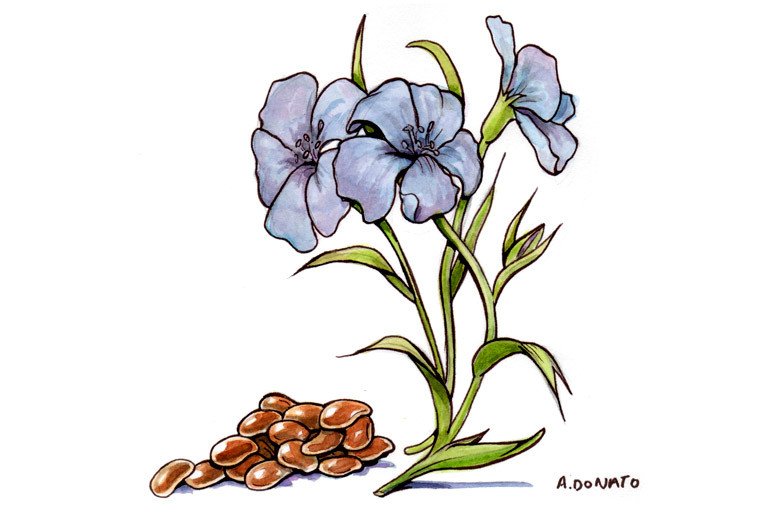
About Herbs, Botanicals & Other Products

Scientific Name
Linum usitatissimum
Common Name

Flax, linseed, lint bells, linum

Brand Name

Salinum ®, Brevail®

Clinical Summary

Flaxseed has been used in traditional medicine to treat coughs, colds, constipation, urinary tract infections, as a topical demulcent and an emollient (1). It is rich in omega-3 fatty acids and phytoestrogenic lignans. Flaxseed was shown to have chemoprotective (2) and renoprotective effects in patients with lupus nephritis (3). Flaxseed ingestion can increase urinary lignan excretion (4) and the length of the luteal phase of the menstrual cycle (5). It also improved mild menopausal symptoms (11). Supplementation with a major lignan derived from flaxseed improved glycemic control in Type 2 diabetic patients (13). Although flaxseed-derived lignan reduces blood glucose levels in hypercholesterolemic individuals (14), reports of flaxseed’s cholesterol-lowering effects have been mixed (11) (15) (26). Flaxseed supplementation may benefit women with polycystic ovarian syndrome by reducing androgen levels (23); a moderate reduction of estrogens and androgens was also seen in postmenopausal women (24).

Studies in mice have shown that flaxseed inhibits the growth and metastasis of human breast cancer (6), prostate cancer (7) and melanoma (8); it also reduces radiation therapy-induced lung damage and improves survival (27).
Flaxseed was shown to lower tumor biomarkers in men with prostate cancer (9) (25) and in patients with breast cancer (10), but a flaxseed extract was ineffective in preventing oral infection after radiation treatment for head and neck cancer (12).

Supplementation can cause minor gastrointestinal distress (9) (16). However case reports of anaphylaxis (17) and immunologically positive antigen response (1) have been reported as well. In addition, ingestion of flaxseed may interfere with radiology procedures (18).

Purported Uses
  • Cancer prevention
  • Constipation
  • High cholesterol
  • Menopausal symptoms
  • Mucositis
  • Periodontal disease
  • Premenstrual syndrome
  • Radiation therapy side effects
Constituents

Flaxseed Oil: unsaturated fatty acids including linolenic, linoleic and oleic acids.
Flaxseed soluble fiber: D-xylose, L-galactose, L-rhamnose, D-galacturonic acid and linusitamarin.
Flax leaves and seed chaff: cyanogenic glycosides linamarin, linustatin and neolinustatin.(1)

Mechanism of Action

Flaxseed is the most concentrated food source of the plant lignan, secoisolariciresinol, a precursor for enterolactone. It is thought that these phytoestrogenic lignans contributes to its hormonal effects (4). Flaxseed has been shown to affect the length of the menstrual cycle in premenopausal women (5). In addition, flaxseed’s inhibition of human breast cancer growth and metastasis in mice is due in part to its down-regulation of insulin-like growth factor I and epidermal growth factor receptor expression (6) while its inhibition of prostate cancer in mice is attributed to its inhibition of cellular proliferation (7). Flaxseed may also alter estrogen metabolism, increasing the ratio of 2-hydroxyestrogen to 16 alpha-hydroxyestrone in a dose dependent fashion (2). The hormonal effects of flaxseed may also play a role in its ability to modulate prostate cancer biology and associated biomarkers (9) and lower serum lipid levels (10). Flaxseed’s renoprotective effects are thought to come from high concentration of alpha-linolenic acid, an omega-3 fatty acid precursor (3) or through inhibition of angiogenesis, tyrosine protein kinases and cytokine-induced activation of transcription factors (16). Flaxseed may have laxative effect due to its fiber content (22).

Pharmacokinetics

Absorption: Dose-dependant urinary lignan response to ingested flaxseed has been observed. Processing flaxseed does not affect lignan absorption. Plasma lignan concentration was greater than baseline, nine hours after flaxseed ingestion. No plateau in serum lignan concentration was observable in dosages up to 25 grams (20).

Contraindications

Because flaxseed has phytoestrogenic effects, patients with estrogen receptor positive (ER+) type of breast cancer should avoid it.

Adverse Reactions

Reported: A Case of anaphylaxis due to flax ingestion has been reported (17) and workers regularly exposed to flax at their job show immunologically positive antigen tests (1). A case of false polyposis coli on double contrast barium enema has also been reported (18) in the literature and an increase in the luteal phase of the menstrual cycle has also been observed (5) after flaxseed supplementation.
Common: Increased bowel movements (16), constipation and flatulence (9).

Herb Lab Interactions

A case report of filling defects on double contrast barium enema evident after linseed ingestion has been reported (18).

Literature Summary and Critique

Zhang W, Wang X, Liu Y, et al. Dietary flaxseed lignan extract lowers plasma cholesterol and glucose concentrations in hypercholesterolaemic subjects. Br J Nutr. 2008;99:1301-9.
Fifty-five individuals with high cholesterol participated in this randomized, double-blind, placebo-controlled study. Participants were given flaxseed-derived lignan extracts (300 or 600 mg/day) or placebo for 8 weeks after which fasting blood glucose levels and lipid profiles were determined. Subjects who received 600 mg of extract had reductions in total cholesterol, LDL, and fasting blood glucose levels. Although other studies have reported discrepant effects on cholesterol levels by flaxseed, the authors postulate that these inconsistencies are due at least in part to the variable quantity of lignan within whole or defatted flaxseeds, a complication that is overcome with use of an extract.

Brooks JD, et al. Supplementation with flaxseed alters estrogen metabolism in postmenopausal women to a greater extent than does supplementation with an equal amount of soy. Am J Clin Nutr 2004;79:318-25.
In this study, 46 postmenopausal women were randomized to receive a placebo, soy (25 g soy flour), or flaxseed (25 g ground flaxseed) muffin for 16 weeks. Blood and 24-h urine samples were analyzed at baseline and at the endpoint for estrogen metabolites, serum hormones, and biochemical markers of bone metabolism. Results showed that the urinary concentrations of 2-hydroxyestrone, but not of 16alpha-hydroxyestrone increased significantly in the flaxseed group. There was no effect on the biochemical markers of bone metabolism. But since the study was limited by a short treatment time and fewer subjects, long-term studies with larger treatment groups are warranted.

Pan A, Sun J, Chen Y, et al. Effects of a flaxseed-derived lignan supplement in type 2 diabetic patients: a randomized, double-blind, cross-over trial. PLoS ONE 2(11):e1148.
Effects of flaxseed-derived lignan supplementation in 68 type II diabetic participants were analyzed in this randomized, double-blind, cross-over study. After 12 weeks of receiving lignan supplements (360 mg/day) or placebo, the participants underwent an 8-week washout period before completing the remaining treatment arm. Glycemic control (as determined by HbA1c) was modestly affected by lignan supplementation; however, fasting glucose and insulin levels, insulin resistance, and blood lipid concentrations were unaltered. Because the influence of lignan on glycemic control was modest, additional studies are required to determine if it is clinically meaningful.

Clark WF, Kortas C, Heidenheim AP, Garland J, Spanner E, Parbtani A. Flaxseed in lupus nephritis: a two-year nonplacebo-controlled crossover study. Journal of the American College of Nutrition. 2001;20:Suppl-8.
Forty patients with lupus nephritis were recruited for a randomized crossover trial of flaxseed. Subjects were given either 30 grams of ground flaxseed daily or nothing for one year followed by a twelve-week washout period and reversal of treatment. Only fifteen of the patients completed the study and of those, only nine were adherent to the flaxseed diet. Serum creatinine levels at completion of study were lower for the compliant patients, however significant lack of compliance may have skewed results. No significant side effects were reported, nonetheless, it is worthy to note that consumption of 30 grams of ground flaxseed daily may not be easily tolerated by patients.

Demark-Wahnefried W, Price DT, Polascik TJ, Robertson CN, Anderson EE, Paulson DF et al. Pilot study of dietary fat restriction and flaxseed supplementation in men with prostate cancer before surgery: exploring the effects on hormonal levels, prostate-specific antigen, and histopathologic features. Urology 2001;58(1):47-52
Twenty-five pre-prostatectomy patients participated in a pilot study of a low-fat, flaxseed supplemented (30 grams/day) diet. Average duration on the diet was 34 days, during which time significant decreases in total testosterone and free androgen index were observed. Proliferation rate and apoptosis were significantly associated with the number of days on the diet. Further study is needed to determine if these positive effects on prostate cancer biomarkers are indicative of a preventative therapy.

References
  1. DerMarderosian A. The Review of Natural Products. St. Louis: Facts and Comparisons, 1999.
  2. Haggans CJ, Hutchins AM, Olson BA, Thomas W, Martini MC, Slavin JL. Effect of flaxseed consumption on urinary estrogen metabolites in postmenopausal women. Nutrition & Cancer. 1999;33:188-95.
  3. Clark WF, Kortas C, Heidenheim AP, Garland J, Spanner E, Parbtani A. Flaxseed in lupus nephritis: a two-year nonplacebo-controlled crossover study. Journal of the American College of Nutrition. 2001;20:Suppl-8.
  4. Hutchins AM, Martini MC, Olson BA, Thomas W, Slavin JL. Flaxseed influences urinary lignan excretion in a dose-dependent manner in postmenopausal women. Cancer Epidemiology, Biomarkers & Prevention. 2000;9:1113-8.
  5. Phipps WR, Martini MC, Lampe JW, Slavin JL, Kurzer MS. Effect of flax seed ingestion on the menstrual cycle. J Clin Endocrinol.Metab 1993;77:1215-9.
  6. Chen J, Stavro PM, Thompson LU. Dietary flaxseed inhibits human breast cancer growth and metastasis and downregulates expression of insulin-like growth factor and epidermal growth factor receptor. Nutrition & Cancer. 2002;43:187-92.
  7. Lin X, Gingrich JR, Bao W, Li J, Haroon ZA, Demark-Wahnefried W. Effect of flaxseed supplementation on prostatic carcinoma in transgenic mice. Urology 2002;60:919-24.
  8. Yan L, Yee JA, Li D, McGuire MH, Thompson LU. Dietary flaxseed supplementation and experimental metastasis of melanoma cells in mice. Cancer Letters. 1998;124:181-6.
  9. Demark-Wahnefried W, Price DT, Polascik TJ, Robertson CN, Anderson EE, Paulson DF et al. Pilot study of dietary fat restriction and flaxseed supplementation in men with prostate cancer before surgery: exploring the effects on hormonal levels, prostate-specific antigen, and histopathologic features. Urology 2001;58:47-52.
  10. Thompson LU, Chen JM, Li T, Strasser-Weippl K, Goss, PE. Dietary flaxseed alters tumor biological markers in postmenopausal breast cancer. Clin Cancer Res. 2005;11(10):3828-3835.
  11. Lemay A, Dodin S, Kadri N, Jacques H, Forest JC. Flaxseed dietary supplement versus hormone replacement therapy in hypercholesterolemic menopausal women. Obstetrics & Gynecology. 2002;100:495-504.
  12. Johansson G, Andersson G, Attstom R, Edwardsson S. Oral mucous membrane flora in patients using saliva substitutes. Gerodontology. 2000;17:87-90.
  13. Pan A, Sun J, Chen Y, et al. Effects of a flaxseed-derived lignan supplement in type 2 diabetic patients: a randomized, double-blind, cross-over trial. PLoS ONE 2(11):e1148.
  14. Zhang W, Wang X, Liu Y, et al. Dietary flaxseed lignan extract lowers plasma cholesterol and glucose concentrations in hypercholesterolaemic subjects.Br J Nutr. 2008 Jun;99(6):1301-9. Epub 2007 Dec 6.
  15. Jenkins DJ, Kendall CW, Vidgen E, Agarwal S, Rao AV, Rosenberg RS et al. Health aspects of partially defatted flaxseed, including effects on serum lipids, oxidative measures, and ex vivo androgen and progestin activity: a controlled crossover trial. Am J Clin Nutr. 1999;69:395-402.
  16. Cunnane SC, Hamadeh MJ, Liede AC, Thompson LU, Wolever TM, Jenkins DJ. Nutritional attributes of traditional flaxseed in healthy young adults. Am J Clin Nutr 1995;61:62-8.
  17. Leon F, Rodriguez M, Cuevas M. Anaphylaxis to Linum. Allergologia et Immunopathologia. 2003;31:47-9.
  18. Petty DR,.Mannion RA. A case of multiple linseeds mimicking polyposis coli on double contrast barium enema. Clinical Radiology. 2003;58:87-8.
  19. Ranich T, Bhathena SJ, Velasquez MT. Protective effects of dietary phytoestrogens in chronic renal disease. Journal of Renal Nutrition. 2001;11:183-93.
  20. Nesbitt PD, Lam Y, Thompson LU. Human metabolism of mammalian lignan precursors in raw and processed flaxseed. Am J Clin Nutr. 1999;69:549-55.
  21. Brooks JD, Ward WE, Lewis JE, et al. Supplementation with flaxseed alters estrogen metabolism in postmenopausal women to a greater extent than does supplementation with an equal amount of soy. Am J Clin Nutr 2004 Feb;79(2):318-25.
  22. Dahl WJ, Lockert EA, Cammer AL, et al. Effects of flax fiber on laxation and glycemic response in healthy volunteers. J Med Food. 2005 Winter;8(4):508-11.
  23. Nowak DA, Snyder DC, Brown AJ, Demark-Wahnefried W. The Effect of Flaxseed Supplementation on Hormonal Levels Associated with Polycystic Ovarian Syndrome: A Case Study. Curr Top Nutraceutical Res. 2007;5(4):177-181.
  24. Sturgeon SR, Heersink JL, Volpe SL, et al. Effect of dietary flaxseed on serum levels of estrogens and androgens in postmenopausal women. Nutr Cancer. 2008;60(5):612-8.
  25. Demark-Wahnefried W, Polascik TJ, George SL, et al. Flaxseed supplementation (not dietary fat restriction) reduces prostate cancer proliferation rates in men presurgery. Cancer Epidemiol Biomarkers Prev. 2008 Dec;17(12):3577-87.
  26. Fukumitsu S, Aida K, Shimizu H, Toyoda K. Flaxseed lignan lowers blood cholesterol and decreases liver disease risk factors in moderately hypercholesterolemic men. Nutr Res. 2010 Jul;30(7):441-6.
  27. Christofidou-Solomidou M, Tyagi S, Tan KS, et al. Dietary flaxseed administered post thoracic radiation treatment improves survival and mitigates radiation-induced pneumonopathy in mice. BMC Cancer. 2011 Jun 24;11:269.
How It Works

Bottom Line: Flaxseed appears to be effective in reducing menopausal symptoms, however there is mixed evidence of its ability to reduce cholesterol levels. Further study is necessary to understand flaxseed’s anticancer effects.

Flaxseed is a very concentrated source of phytoestrogenic compounds called lignans. These lignans can have hormone-like effects on the body. (Soybeans are another source of phytoestrogens). These lignans are likely the reason why flaxseed can affect menstrual cycle length and menopausal symptoms. Flaxseed has also been shown to affect intracellular signals within the body that may play a role in breast and prostate cancer growth. Flaxseed also contains alpha-linolenic acid (ALA) a building block of omega-3 fatty acids. ALA has been shown to have numerous effects on the body including protecting the kidneys from damage.

Purported Uses
  • Cancer prevention
    Studies of postmenopausal women showed that flaxseed supplementation improved the ratio of hormones that are thought to help prevent breast cancer. Studies in animals have shown promising results, however further human study is warranted.
  • Constipation
    Flaxseed may have laxative effect due to its fiber content.
  • High cholesterol
    Study results are mixed.
  • Menopausal symptoms
    A study showed flaxseed to be as effective as hormone replacement therapy in the management of menopausal symptoms.
  • Mucositis
    One study indicated that flaxseed was not effective for mucositis.
  • Periodontal disease
    Flaxseed was shown ineffective against periodontal disease in a study.
Research Evidence

Cancer Prevention:
Twenty-eight postmenopausal women participated in a study to determine the effect of flaxseed on estrogen levels. The women were divided into three groups and given zero, five or 10 grams per day ground flaxseed for seven weeks. The study showed that the ratio between two different kinds of estrogen, increased depending on the dosage of flaxseed ingested. These estrogen levels may help prevent breast cancer, although further study is advised.

Another study of twenty-five patients awaiting prostatectomy showed that supplementation with 30 grams of flaxseed per day showed significant reduction in certain hormones that are considered prostate cancer biomarkers. Whether or not this has effect on prostate cancer itself requires further study.

Lupus Nephritis:
Forty patients with lupus nephritis took part in a study of flaxseed. Subjects were given either 30 grams of ground flaxseed daily or nothing for one year after which time they switched to the other treatment. The study showed that patients taking flaxseed had lower serum creatinine levels, a positive outcome. Unfortunately, only nine out of the forty actually stuck to the diet, so the results are not very reliable.

High Cholesterol:
Twenty-nine patients with high cholesterol took part in a study of flaxseed. Subjects received either muffins made from flaxseed or wheat bran. The subjects eating the flaxseed muffins received the equivalent of 50 grams of flaxseed per day. Patients were also asked to eat a cholesterol control diet. After three weeks, the patients switched treatment. Results show a reduction in total cholesterol and LDL “bad” cholesterol while patients consumed the flaxseed, however the reporting in the study does not seem to take into account the possible effect of the wheat bran muffin. In addition, a study of twenty-five women with high cholesterol and menopausal symptoms showed no improvement in the patients cholesterol profile. The mixed results warrant further study.

Menopausal Symptoms:
Twenty-five women with high cholesterol and menopausal symptoms took part in a study of flaxseed. The women were either given 40 grams of crushed flaxseed per day or hormone replacement therapy (HRT) for two months. Reductions in menopausal symptoms, glucose and insulin levels were comparable between subjects taking flaxseed and those taking HRT, however only those subjects taking HRT improved their cholesterol profile.

Premenopausal Symptoms:
Eighteen premenopausal women participated in a study of flaxseed. Subjects were randomly assigned to receive 10 grams of flaxseed powder daily or nothing from three menstrual cycles to determine effect on menstrual cycle length. The luteal phase of menopause (from egg release until beginning of menstrual flow) was increased by one day in women who took the flaxseed powder. Significance of this finding is not yet known.

Patient Warnings
  • A 39-year-old woman developed a severe allergic reaction after ingesting flaxseed.
  • Because flaxseed has phytoestrogenic effects, patients with certain forms of breast cancer should use flaxseed with caution.
Do Not Take If
  • You are undergoing radiological procedures as linseed may interfere with the reading of certain tests.
Side Effects
  • Allergic reaction
  • Interaction with radiology procedures
  • Increase of the luteal phase of the menstrual cycle
  • Increased bowel movement
  • Constipation
  • Flatulence
Dosage (Inside MSKCC Only)
This field is only visible to only Inside MSKCC users.
Aliases
Linseed
E-mail your questions and comments to aboutherbs@mskcc.org.