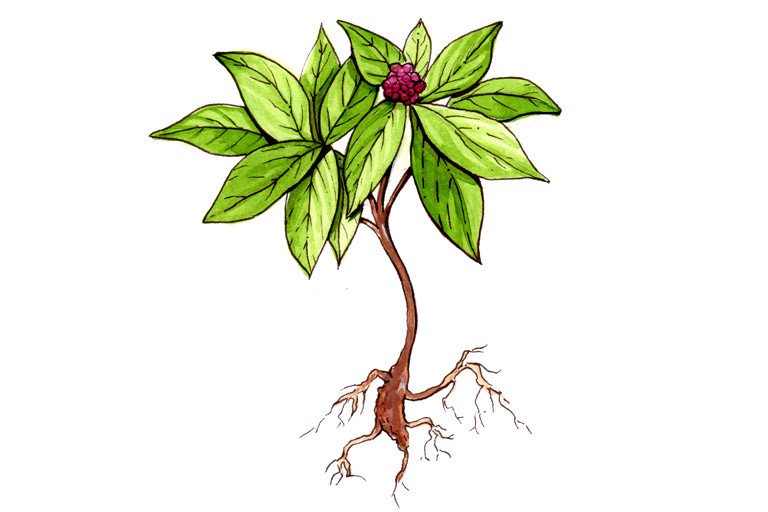
Health Care Professional Information
Common Name
Xi yang shen, Tienchi ginseng, western ginseng, five-fingers
Clinical Summary
American ginseng is cultivated in the northwest regions of United States and Canada. Patients take this supplement to improve athletic performance, strength, and stamina, and to treat diabetes and cancer. In Chinese herbal formulas, American ginseng is frequently used to nourish “Yin” (1). The saponin glycosides, also known as ginsenosides or panaxosides, are thought responsible for American ginseng's effects.
Ginsenosides have both stimulatory and inhibitory effects on the CNS (4), alter cardiovascular tone, enhance humoral and cellular-dependent immunity, and have anticancer effects in vitro (3) (15) (16).
Current data suggest that ginseng may improve glucose control in diabetics (2) (6), but additional research is necessary. It demonstrated a modest effect in reducing the number and severity of colds (12); and enhanced working memory in healthy adults (21).
The anticancer effects of ginseng were enhanced when combined with antioxidants (14). Ginseng also acts synergistically with 5-fluorouracil against colorectal cancer cells (17) and demonstrated radioprotective effects in irradiated human lymphocytes (18).
Data from an epidemiological study show that ginseng improves survival and quality of life in breast cancer patients (13). A perspective trial also shows it can improve cancer-related fatigue (23).
Purported Uses
- Cancer prevention
- Cancer treatment
- Diabetes
- Health maintenance
- Immunostimulation
- Strength and stamina
Constituents
- Saponin glycosides: Panaquilon, ginsenosides
- Volatile oils
- Antioxidants
- Polysaccharides
- Fatty acids
- Vitamins
- Polyacetylenes
(1) (5)
Mechanism of Action
Ginsenosides are thought responsible for American ginseng's activity, although the exact mechanism of action is unknown. American ginseng lowers serum glucose and may affect carbohydrate metabolism (2) (6). Related species, such as Panax ginseng, have been the focus of most laboratory and clinical research. Experiments using extracts from these species indicate that ginsenosides stimulate and inhibit the CNS (4). The extracts also stimulate TNF alpha production by alveolar macrophages (10). The Rg1 ginsenoside is associated with improvements in humoral and cell-mediated immune response and increases in T helper cells, T lymphocytes, and NK cells in mice (5). Ginseng's antagonistic effect on warfarin is not due to vitamin K (11).
Several ginsenosides demonstrated anticancer properties in vitro (3). However, current data suggest that the antiproliferative effects of American ginseng are due to compound K, a metabolite of the ginsenoside Rb1, but not Rb1 as previously thought (22).
Pharmacokinetics
Evaluation of A1, A2, B2, and C ginsenosides in the rabbit suggests one compartment pharmacokinetics for all ginsenosides following intravenous administration. Elimination half-lives range from 20-500 minutes. Ginsenoside A1 is rapidly absorbed after intraperitoneal administration. All ginsenosides are primarily eliminated unchanged in the urine.
(1)
Contraindications
Breast cancer patients should use this product with caution as ginseng may stimulate the growth of breast cancer cells (9).
Herb-Drug Interactions
Insulin and sulfonylureas: American ginseng may increase the hypoglycemic effect of insulin and sulfonylureas (7).
Warfarin: Ginseng has been shown to antagonize warfarin's effects (11).
Cytochrome P450 (CYP) 3A4 substrates: Certain ginsenosides can induce CYP3A4 and may affect the metabolism of some drugs that are substrates of this enzyme (19) (20).
Herb Lab Interactions
Reductions in PT, PTT, and INR and blood glucose may occur.
(8) (11)
Literature Summary and Critique
Dosage (Inside MSKCC Only)
This field is only visible to only Inside MSKCC users.
References
- Huang KC. The Pharmacology of Chinese Herbs, 2nd ed. New York: CRC Press; 1999.
- Vuksan V, et al. American ginseng (Panax quinquefolius L) reduces postprandial glycemia in nondiabetic subjects and subjects with type 2 diabetes mellitus. Arch Intern Med 2000;160:1009-13.
- Shin HR, et al. The cancer-preventive potential of Panax ginseng: a review of human and experimental evidence. Cancer Causes Control 2000;11:565-76.
- Attele AS, Wu JA, Yuan CS. Ginseng pharmacology: multiple constituents and multiple actions. Biochem Pharmacol 1999;58:1685-93.
- Chen SE. American ginseng. III. Pharmacokinetics of ginsenosides in the rabbit. Eur J Drug Metab Pharmacokinet 1980;5:161-8.
- Vuksan V, et al. American ginseng (Panax quinquefolius L.) attenuates postprandial glycemia in a time-dependent but not dose-dependent manner in healthy individuals. Am J Clin Nutr 2001;73:753-8.
- Brinker F. Herb Contraindications and Drug Interactions, 3rd ed. Sandy (OR): Eclectic Medical Publications; 2001.
- Vuksan V, et al. American ginseng improves glycemia in individuals with normal glucose tolerance: effect of dose and time escalation. J Am Coll Nutr 2000;6:738-44.
- Amato P, Christophe S, Mellon PL. Estrogenic activity of herbs commonly used as remedies for menopausal symptoms. Menopause 2002;9:145-50.
- Assinewe VA, et al. Extractable polysaccharides of Panax quinquefolius L. (North American ginseng) root stmulate TNFalpha production by alveolar macrophages. Phytomedicine 2002;9:398-404.
- Yuan CS, et al. Brief Communication: American Ginseng reduces Warfarin's effect in healthy patients. Annals of Internal Medicine 2004;141:23-27.
- Predy GN, et al. Efficacy of an extract of North American ginseng containing poly-furanosyl-pyranosyl-saccharides for preventing upper respiratory tract infectons: a randomized controlled trial. CMAJ 2005;173(9):1043-8.
- Cui Yong, et al. Association of ginseng use with survival and quality of life among breast cancer patients. Am J Epidemiol 2006; 163(7):645-53.
- Li B, Wang CZ, He TC, et al. Antioxidants potentiate American ginseng-induced killing of colorectal cancer cells. Cancer Letters. 2010;289(1):62-70.
- Li B, Zhao J, Wang CZ, et al. Ginsenoside Rh2 induces apoptosis and paraptosis-like cell death in colorectal cancer cells through activation of p53. Cancer Lett. 2011 Feb 28;301(2):185-92.
- Xie JT, Du GJ, McEntee E, et al. Effects of Triterpenoid Glycosides from Fresh Ginseng Berry on SW480 Human Colorectal Cancer Cell Line. Cancer Res Treat. 2011 Mar;43(1):49-55.
- Li XL, Wang CZ, Sun S, et al. American ginseng berry enhances chemopreventive effect of 5-FU on human colorectal cancer cells. Oncol Rep. 2009 Oct;22(4):943-52.
- Lee TK, O'Brien KF, Wang W, et al. Radioprotective effect of American ginseng on human lymphocytes at 90 minutes postirradiation: a study of 40 cases. J Altern Complement Med. 2010 May;16(5):561-7.
- Hao M, Ba Q, Yin J, et al. Deglycosylated ginsenosides are more potent inducers of CYP1A1, CYP1A2 and CYP3A4 expression in HepG2 cells than glycosylated ginsenosides. Drug Metab Pharmacokinet. 2011;26(2):201-5.
- Hao M, Zhao Y, Chen P, et al. Structure-activity relationship and substrate-dependent phenomena in effects of ginsenosides on activities of drug-metabolizing P450 enzymes. PLoS One. 2008 Jul 16;3(7):e2697.
- Scholey A, Ossoukhova A, Owen L, et al. Effects of American ginseng (Panax quinquefolius) on neurocognitive function: an acute, randomised, double-blind, placebo-controlled, crossover study. Psychopharmacology (Berl). 2010 Oct;212(3):345-56.
- Wang CZ, Du GJ, Zhang Z, et al. Ginsenoside compound K, not Rb1, possesses potential chemopreventive activities in human colorectal cancer. Int J Oncol. 2012 Jun;40(6):1970-6.
- Debra L. Barton, Heshan Liu, Shaker R. Dakhil, et al. Phase III evaluation of American ginseng (panax quinquefolius) to improve cancer-related fatigue: NCCTG trial N07C2. J Clin Oncol 30, 2012 (suppl; abstr 9001)
Consumer Information
How It Works
Bottom Line: American ginseng has not been shown to treat or prevent cancer.
American ginseng has been shown to lower blood sugar levels in humans. Scientists think that the effects of ginseng come from its components called ginsenosides. Most research has been done on another species, Panax ginseng. These studies indicate that ginsenosides both stimulate and inhibit the central nervous system in humans and stimulate the immune system in mice. Laboratory studies in mice and population studies in humans suggest that Panax ginseng has cancer-preventative properties.
American ginseng was shown to reduce the number and severity of colds, and improve working memory in healthy adults.
It also decreases the anticoagulant effects of warfarin, an anticoagulant.
Purported Uses
- To improve athletic performance
No scientific evidence supports this use.
- To prevent and treat cancer
There are no data to back this claim.
- To treat diabetes
A few studies show a blood glucose-lowering effect of American ginseng in humans, but there is not enough evidence to support replacing diabetes medications with American ginseng.
- To stimulate the immune system
Some studies show an immunostimulant effect in animals. Human data are lacking.
- For increased strength and stamina
Although ginseng is often promoted for this use, human data are lacking.
Research Evidence
Interaction with Warfarin:
Twenty healthy adults received warfarin during weeks 1 and 4 in this study. They were then randomized to receive either 1.0 gram American ginseng or placebo twice daily starting in week 2. Subjects who received ginseng had signficantly lowered International Normalized Ratios (INR) when compared with those receiving placebo. Researchers conclude that ginseng reduces warfarin's anticoagulant effect and suggest that physicians ask their patients about ginseng use before prescribing warfarin.
Do Not Take If
- You are diabetic (American ginseng may interfere with insulin or cause very low blood sugar).
- You are taking warfarin or other blood thinners (American ginseng may interfere with the action of the anticoagulant).
- You are taking drugs that are substrates of cytochrome P450 (CYP) 3A4 (American ginseng may make the drugs less effective).
Side Effects
- Inability to fall asleep (insomnia)
- Drowsiness
- Nervousness
- Fast heart rate
- Headache
- Low blood sugar (hypoglycemia)
Special Point
Ginseng should not be used continuously for more than one month.
Last updated: October 10, 2012
5-fluorouracil (5-FLOOR-oh-YOOR-uh-sil)
A drug used to treat cancers of the breast, stomach, and pancreas, and certain types of colorectal and head and neck cancers. It is also used in a cream to treat basal cell skin cancer and actinic keratosis (a skin condition that may become cancer). It is being studied in the treatment of other conditions and types of cancer. 5-fluorouracil stops cells from making DNA and it may kill cancer cells. It is a type of antimetabolite. Also called 5-FU, Adrucil, Efudex, Fluoroplex, and fluorouracil.
Source: The National Cancer Institute's Dictionary of Cancer Terms
(http://www.cancer.gov/dictionary)
anticoagulant (AN-tee-koh-A-gyuh-lunt)
A substance that is used to prevent and treat blood clots in blood vessels and the heart. Also called blood thinner.
Source: The National Cancer Institute's Dictionary of Cancer Terms
(http://www.cancer.gov/dictionary)
blood (blud)
A tissue with red blood cells, white blood cells, platelets, and other substances suspended in fluid called plasma. Blood takes oxygen and nutrients to the tissues, and carries away wastes.
Source: The National Cancer Institute's Dictionary of Cancer Terms
(http://www.cancer.gov/dictionary)
blood sugar (blud SHUH-ger)
Glucose (a type of sugar) found in the blood. Also called glycemia.
Source: The National Cancer Institute's Dictionary of Cancer Terms
(http://www.cancer.gov/dictionary)
breast (brest)
Glandular organ located on the chest. The breast is made up of connective tissue, fat, and breast tissue that contains the glands that can make milk. Also called mammary gland.
Source: The National Cancer Institute's Dictionary of Cancer Terms
(http://www.cancer.gov/dictionary)
cancer (KAN-ser)
A term for diseases in which abnormal cells divide without control and can invade nearby tissues. Cancer cells can also spread to other parts of the body through the blood and lymph systems. There are several main types of cancer. Carcinoma is a cancer that begins in the skin or in tissues that line or cover internal organs. Sarcoma is a cancer that begins in bone, cartilage, fat, muscle, blood vessels, or other connective or supportive tissue. Leukemia is a cancer that starts in blood-forming tissue such as the bone marrow, and causes large numbers of abnormal blood cells to be produced and enter the blood. Lymphoma and multiple myeloma are cancers that begin in the cells of the immune system. Central nervous system cancers are cancers that begin in the tissues of the brain and spinal cord. Also called malignancy.
Source: The National Cancer Institute's Dictionary of Cancer Terms
(http://www.cancer.gov/dictionary)
carbohydrate (KAR-boh-HY-drayt)
A sugar molecule. Carbohydrates can be small and simple (for example, glucose) or they can be large and complex (for example, polysaccharides such as starch, chitin or cellulose).
Source: The National Cancer Institute's Dictionary of Cancer Terms
(http://www.cancer.gov/dictionary)
cardiovascular (KAR-dee-oh-VAS-kyoo-ler)
Having to do with the heart and blood vessels.
Source: The National Cancer Institute's Dictionary of Cancer Terms
(http://www.cancer.gov/dictionary)
central nervous system (SEN-trul NER-vus SIS-tem)
The brain and spinal cord. Also called CNS.
Source: The National Cancer Institute's Dictionary of Cancer Terms
(http://www.cancer.gov/dictionary)
clinical (KLIH-nih-kul)
Having to do with the examination and treatment of patients.
Source: The National Cancer Institute's Dictionary of Cancer Terms
(http://www.cancer.gov/dictionary)
CNS
The brain and spinal cord. Also called central nervous system.
Source: The National Cancer Institute's Dictionary of Cancer Terms
(http://www.cancer.gov/dictionary)
colorectal (KOH-loh-REK-tul)
Having to do with the colon or the rectum.
Source: The National Cancer Institute's Dictionary of Cancer Terms
(http://www.cancer.gov/dictionary)
compound (KOM-pownd)
In science, a substance that is made up of more than one ingredient.
Source: The National Cancer Institute's Dictionary of Cancer Terms
(http://www.cancer.gov/dictionary)
diabetes (dy-uh-BEE-teez)
Any of several diseases in which the kidneys make a large amount of urine. Diabetes usually refers to diabetes mellitus in which there is also a high level of glucose (a type of sugar) in the blood because the body does not make enough insulin or use it the way it should.
Source: The National Cancer Institute's Dictionary of Cancer Terms
(http://www.cancer.gov/dictionary)
fatigue (fuh-TEEG)
A condition marked by extreme tiredness and inability to function due lack of energy. Fatigue may be acute or chronic.
Source: The National Cancer Institute's Dictionary of Cancer Terms
(http://www.cancer.gov/dictionary)
ginseng (JIN-seng)
An herb with a root that has been used in some cultures to treat certain medical problems. It may have anticancer effects.
Source: The National Cancer Institute's Dictionary of Cancer Terms
(http://www.cancer.gov/dictionary)
glucose (GLOO-kose)
A type of sugar; the chief source of energy for living organisms.
Source: The National Cancer Institute's Dictionary of Cancer Terms
(http://www.cancer.gov/dictionary)
gram (gram)
A unit of weight in the metric system. One gram is equal to one thousandth of a kilogram and is approximately 30-times less than an ounce.
Source: The National Cancer Institute's Dictionary of Cancer Terms
(http://www.cancer.gov/dictionary)
immune response (ih-MYOON reh-SPONTS)
The activity of the immune system against foreign substances (antigens).
Source: The National Cancer Institute's Dictionary of Cancer Terms
(http://www.cancer.gov/dictionary)
immune system (ih-MYOON SIS-tem)
The complex group of organs and cells that defends the body against infections and other diseases.
Source: The National Cancer Institute's Dictionary of Cancer Terms
(http://www.cancer.gov/dictionary)
immunity (ih-MYOO-nih-tee)
The condition of being protected against an infectious disease. Immunity can be caused by a vaccine, previous infection with the same agent, or by transfer of immune substances from another person or animal.
Source: The National Cancer Institute's Dictionary of Cancer Terms
(http://www.cancer.gov/dictionary)
immunostimulant (IH-myoo-noh-STIH-myoo-lunt)
A substance that increases the ability of the immune system to fight infection and disease.
Source: The National Cancer Institute's Dictionary of Cancer Terms
(http://www.cancer.gov/dictionary)
in vitro (in VEE-troh)
In the laboratory (outside the body). The opposite of in vivo (in the body).
Source: The National Cancer Institute's Dictionary of Cancer Terms
(http://www.cancer.gov/dictionary)
insulin (IN-suh-lin)
A hormone made by the islet cells of the pancreas. Insulin controls the amount of sugar in the blood by moving it into the cells, where it can be used by the body for energy.
Source: The National Cancer Institute's Dictionary of Cancer Terms
(http://www.cancer.gov/dictionary)
irradiated (ih-RAY-dee-AY-ted)
Treated with radiation.
Source: The National Cancer Institute's Dictionary of Cancer Terms
(http://www.cancer.gov/dictionary)
metabolism (meh-TA-buh-lih-zum)
The chemical changes that take place in a cell or an organism. These changes make energy and the materials cells and organisms need to grow, reproduce, and stay healthy. Metabolism also helps get rid of toxic substances.
Source: The National Cancer Institute's Dictionary of Cancer Terms
(http://www.cancer.gov/dictionary)
metabolite (meh-TA-boh-lite)
A substance made or used when the body breaks down food, drugs or chemicals, or its own tissue (for example, fat or muscle tissue). This process, called metabolism, makes energy and the materials needed for growth, reproduction, and maintaining health. It also helps get rid of toxic substances.
Source: The National Cancer Institute's Dictionary of Cancer Terms
(http://www.cancer.gov/dictionary)
pharmacology (FAR-muh-KAH-loh-jee)
The study of the origin, chemistry, and uses of drugs and their effects on the body.
Source: The National Cancer Institute's Dictionary of Cancer Terms
(http://www.cancer.gov/dictionary)
placebo (pluh-SEE-boh)
An inactive substance or treatment that looks the same as, and is given the same way as, an active drug or treatment being tested. The effects of the active drug or treatment are compared to the effects of the placebo.
Source: The National Cancer Institute's Dictionary of Cancer Terms
(http://www.cancer.gov/dictionary)
plasma (PLAZ-muh)
The clear, yellowish, fluid part of the blood that carries the blood cells. The proteins that form blood clots are in plasma.
Source: The National Cancer Institute's Dictionary of Cancer Terms
(http://www.cancer.gov/dictionary)
quality of life (KWAH-lih-tee ... life)
The overall enjoyment of life. Many clinical trials assess the effects of cancer and its treatment on the quality of life. These studies measure aspects of an individual’s sense of well-being and ability to carry out various activities.
Source: The National Cancer Institute's Dictionary of Cancer Terms
(http://www.cancer.gov/dictionary)
randomized
Describes an experiment or clinical trial in which animal or human subjects are assigned by chance to separate groups that compare different treatments.
Source: The National Cancer Institute's Dictionary of Cancer Terms
(http://www.cancer.gov/dictionary)
saponin (SA-poh-nin)
A substance found in soybeans and many other plants. Saponins may help lower cholesterol and may have anticancer effects.
Source: The National Cancer Institute's Dictionary of Cancer Terms
(http://www.cancer.gov/dictionary)
serum (SEER-um)
The clear liquid part of the blood that remains after blood cells and clotting proteins have been removed.
Source: The National Cancer Institute's Dictionary of Cancer Terms
(http://www.cancer.gov/dictionary)
significant (sig-NIH-fih-kunt)
In statistics, describes a mathematical measure of difference between groups. The difference is said to be significant if it is greater than what might be expected to happen by chance alone. Also called statistically significant.
Source: The National Cancer Institute's Dictionary of Cancer Terms
(http://www.cancer.gov/dictionary)
TNF
A protein made by white blood cells in response to an antigen (substance that causes the immune system to make a specific immune response) or infection. TNF can also be made in the laboratory. It may boost a person’s immune response, and also may cause necrosis (cell death) of some types of tumor cells. TNF is being studied in the treatment of some types of cancer. It is a type of cytokine. Also called tumor necrosis factor.
Source: The National Cancer Institute's Dictionary of Cancer Terms
(http://www.cancer.gov/dictionary)
vitamin (VY-tuh-min)
A nutrient that the body needs in small amounts to function and stay healthy. Sources of vitamins are plant and animal food products and dietary supplements. Some vitamins are made in the human body from food products. Vitamins are either fat-soluble (can dissolve in fats and oils) or water-soluble (can dissolve in water). Excess fat-soluble vitamins are stored in the body’s fatty tissue, but excess water-soluble vitamins are removed in the urine. Examples are vitamin A, vitamin C, and vitamin E.
Source: The National Cancer Institute's Dictionary of Cancer Terms
(http://www.cancer.gov/dictionary)
warfarin (WOR-fuh-rin)
A drug that prevents blood from clotting. It belongs to the family of drugs called anticoagulants (blood thinners).
Source: The National Cancer Institute's Dictionary of Cancer Terms
(http://www.cancer.gov/dictionary)