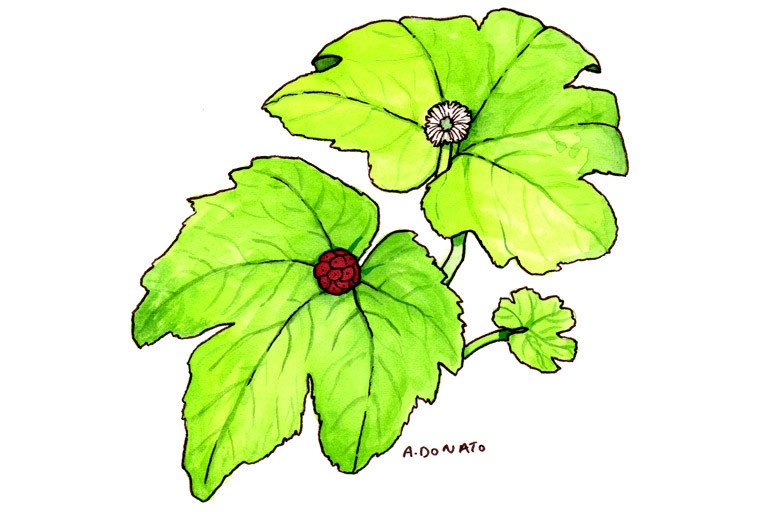
Common Names
- Goldenroot
- Eye root
- Turmeric root
- Yellow paint root
For Patients & Caregivers
Tell your healthcare providers about any dietary supplements you’re taking, such as herbs, vitamins, minerals, and natural or home remedies. This will help them manage your care and keep you safe.
Although goldenseal is popular for minor infections or as a tonic, human data are lacking.
Goldenseal is a North American botanical with origins as a traditional remedy among Native Americans. It has historically been used for skin and eye irritations, as a bitter tonic, and to improve digestive function. It is also marketed as an antioxidant and is often combined with echinacea in supplements to support immune function.
Two of its compounds, berberine and hydrastine, have been studied in the lab. In animal studies, goldenseal compounds appeared to kill bacteria and other microbes, and slow tumor growth. Anti-inflammatory, spasm-reducing, and muscle-contracting properties have also been observed. However, other animal studies suggest potential toxicity with long-term use and there are no human data to confirm supposed effects.
- To treat infections
Although goldenseal has been traditionally used for eye and skin ailments, human data are lacking. There is also no evidence for its use against the common cold. Lab studies indicate that goldenseal compounds have antimicrobial properties, but also suggest potential sensitivity to sunlight with topical products that contain goldenseal. - To control muscle spasms
Lab studies suggest goldenseal may relax muscle tissue, but human data are lacking. - To treat gastrointestinal disorders
Lab studies show that a goldenseal extract causes relaxation of smooth muscle like that found in the gastrointestinal tract, but it is not known if goldenseal helps treat GI disorders.
Case reports
- Photosensitivity: In a patient following use of a dietary supplement containing ginseng, goldenseal, bee pollen, and other ingredients. It is suggested that the combination rather than the individual herbs contributed to this side effect.
- High salt concentrations in the blood: In a pre-teen with diabetic ketoacidosis (DKA) who took goldenseal for 2 weeks prior. This side effect did not occur again during a later episode of DKA when the individual was not taking goldenseal. Diuretic properties in goldenseal may have contributed.
Patient Warnings:
- Avoid long-term use of this product due to potential toxicity issues raised in animal studies.
Do Not Take if:
- You are taking bosutinib: Models predict that goldenseal can affect systemic concentrations of this oral chemotherapy.
- You are taking metformin: Goldenseal can affect metformin absorption, and may therefore adversely affect blood sugar control.
- You are taking CYP450 substrate drugs, especially 3A4 and 2D6: Human studies suggest goldenseal may increase the risk of side effects of these drugs.
- You are pregnant or nursing: Berberine in goldenseal may cause or worsen jaundice in newborns.
Special Point:
- The berberine content in goldenseal can vary widely.
- Goldenseal is sometimes referred to as turmeric root, but should not be confused with turmeric (Curcuma longa).
For Healthcare Professionals
Derived from the root of the plant, goldenseal is a North American botanical with origins as a traditional remedy among Native Americans. It has historically been used for skin and eye irritations, as a bitter tonic, and to improve digestive function. Purported properties have led to its use for a variety of ailments including the common cold, fever, infections, constipation, and muscle spasms. Goldenseal is also marketed as an antioxidant and is often combined with echinacea in supplements to support immune function.
Studies on goldenseal and its compounds are limited. The primary active constituents are hydrastine and berberine. Among several herbs tested in vitro, goldenseal extract was the most active growth inhibitor of H. pylori (1). Studies of berberine suggest that it has antimicrobial (3), cytotoxic, and apoptotic effects (2) (4) (6). Other animal studies have suggested potential liver toxicity with goldenseal root, but this occurred at very high doses over long-term ingestion (26). Laboratory studies demonstrating phototoxicity suggest this would be more likely from topical rather than supplement use (24).
Clinical studies are lacking and would be needed to determine safety and efficacy.
- Digestive disorders
- Spasms
- Infections
The active characteristics of goldenseal are attributed to the compounds hydrastine and berberine, in which most laboratory studies have been conducted. In human prostate and breast cancer cells, berberine induced cell cycle arrest (2) (4). At the same time, tumorigenicity in rodents from long-term high-dose ingestion of goldenseal root powder is partly attributed to the topoisomerase inhibition properties of berberine or its metabolite (26), although the comparative doses are unlikely in humans. Still, DNA damage in liver cells via topoisomerase inhibition was attributed to berberine in goldenseal and was also observed with commercial goldenseal products, with the extent of DNA damage positively correlating with berberine content (27).
Case reports
- Hypernatremia: In a pre-teen with diabetic ketoacidosis who took goldenseal for 2 weeks prior. A subsequent episode of DKA while not taking goldenseal did not yield this effect. Diuretic properties in goldenseal may have contributed (13).
- Photosensitivity: In a patient following use of a dietary supplement containing ginseng, goldenseal, bee pollen, and other ingredients (25). It is posited that the combination rather than individual herbs contributed to this toxicity.
Bosutinib: When clinically relevant doses of goldenseal extract were coadministered, simulations predict a moderate 2-fold increase in systemic exposure to bosutinib, but not imatinib (31).
Metformin: In a study of healthy volunteers, goldenseal altered intestinal permeability, transport, or other processes involved in metformin absorption, and may therefore adversely affect glucose control (32).
CYP450 substrates: In healthy volunteers, goldenseal inhibits 3A4 and 2D6 isoenzymes and can affect the intracellular concentration of drugs metabolized by these enzymes (11) (18) (30). Preclinical data have additionally identified inhibition of 2C9 and 3A5 by major isoquinoline alkaloids from goldenseal (33).