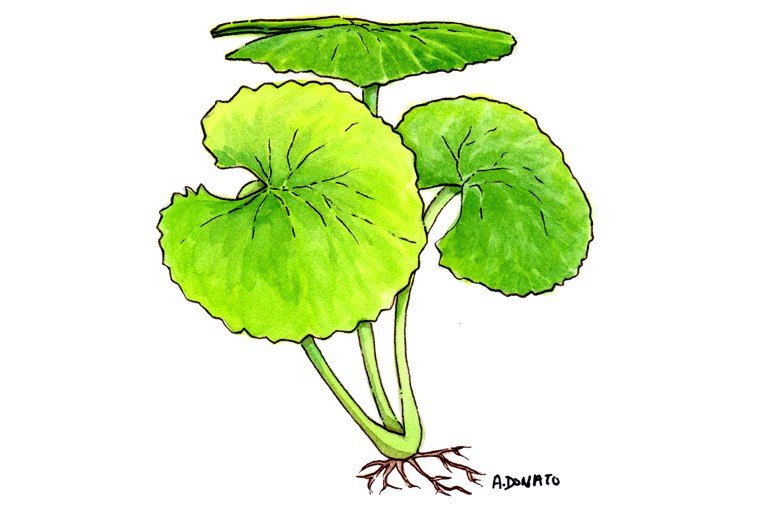
About Herbs, Botanicals & Other Products

Scientific Name
Centella asiatica, Hydrocotyle asiatica
Common Name

Indian pennywort, hydrocotyle, mandukaparni, madecassol, TECA, centelase, tsubo-kusa, luei gong gen, idrocotyle, kaki kuda

Clinical Summary

Extracts from the leaf and the entire plant of gotu kola are used for a variety of conditions including venous insufficiency, varicose veins, wound healing, scleroderma, and scars.
In vitro and in vivo analyses indicate that gotu kola has neuroprotective (13) and chemopreventive (14) (19) properties, and protects against cognitive impairment (20). Madecassoside, an active constituent, also exerts protective effects against arthritis (5) and myocardial infarction (4).

Topical application of an asiaticoside extracted from gotu kola enhanced burn wound healing (6), and an herbal preparation containing gotu kola was effective against chronic periodontitis (15). Supplementation with gotu kola improved cognitive function and mood in the elderly (7), and alleviated generalized anxiety disorder (16). Data also show a reduction in lower extremity edema with gotu kola compared to placebo in patients with chronic venous insufficiency (1) (2) (3).

Gotu kola should not be confused with kolanut. Gotu kola does not contain any caffeine and has not been shown to have stimulant properties.

Purported Uses
  • Burns
  • Cancer treatment
  • Circulatory disorders
  • GI disorders
  • Hypertension
  • Memory loss
  • Psoriasis
  • Scars
  • Sedation
  • Varicose veins
Constituents
  • Amino Acids: Alanine and serine (major components)
  • Terpenoids: Triterpenes, asiaticoside, brahmoside and brahminoside (saponin glycosides), aglycones, asiaticentoic acid, centellic acid, centoic acid and madecassic acid
  • Sesquiterpenes: Caryophyllene, trans-B-farnesene
  • Volatile Oils: Germacrene D
  • Alkaloid: Hydrocotylin
  • Flavones: Quercetin, kaempferol, sesquiterpenes, stigmasterol, and sitosterol
  • Other Constituents: Vallerine, fatty acids, resin, and tannins
    (8)
Mechanism of Action

The triterpenoids are considered to be the active constituents in gotu kola. The glycoside madecassoside has anti-inflammatory properties. Asiaticoside, a constituent of gotu kola, appears to promote wound healing by stimulating collagen and glycosaminoglycan synthesis as well as angiogenesis (6). It also elevates blood glucose and cholesterol levels. There is preliminary evidence that gotu kola might have sedative and analgesic properties (9).

Adverse Reactions
  • Isothankuniside, a glycoside isolated from gotu kola, was shown to reduce fertility in mice (12).
  • Reported:
    Contact dermatitis (17) and hepatotoxicity (18) have been reported following use of gotu kola.
Herb-Drug Interactions
  • Cytochrome P450 substrates: Goto kola inhibits CYP2C9, CYP2D6 and CYP3A4 in vitro and can affect the intracellular concentration of drugs metabolized by these enzymes (21).
Literature Summary and Critique

Wattanathorn J, et al. Positive modulation of cognition and mood in the healthy elderly volunteer following the administration of Centella asiatica. J Ethnopharmacol. Mar 5 2008;116(2):325-332.
In this randomized, placebo-controlled, double-blind study, 28 participants (> 61 years of age) were given gotu kola extracts (250, 500, or 750 mg daily) or placebo to determine the effect of gotu kola on cognitive function and mood. After 2 months, cognitive function (as assessed by event-related potential and the computerized assessment battery test) and mood (using Bond-Lader visual analogue) were determined. The greatest improvements in mood and cognitive function were detected in subjects who received 750 mg dose of gotu kola.
Larger, long-term studies are warranted.

References
  1. Cesarone MR, et al. Effects of the total triterpenic fraction of Centella asiatica in venous hypertensive microangiopathy: a prospective, placebo-controlled, randomized trial. Angiology 2001;52(Suppl 2):S15-18.
  2. Cesarone MR, et al. Evaluation of treatment of diabetic microangiopathy with total triterpenic fraction of Centella asiatica: a clinical prospective randomized trial with a microcirculatory model. Angiology 2001;52(Suppl 2):S49-54.
  3. Pointel JP, et al. Titrated extract of Centella asiatica (TECA) in the treatment of venous insufficiency of the lower limbs. Angiology 1987;38:46-50.
  4. Bian GX, Li GG, Yang Y, et al. Madecassoside reduces ischemia-reperfusion injury on regional ischemia induced heart infarction in rat.Biol Pharm Bull. Mar 2008;31(3):458-463.
  5. Liu M, Dai Y, Yao X, et al. Anti-rheumatoid arthritic effect of madecassoside on type II collagen-induced arthritis in mice. Int Immunopharmacol. Nov 2008;8(11):1561-1566.
  6. Kimura Y, Sumiyoshi M, Samukawa K, et al. Facilitating action of asiaticoside at low doses on burn wound repair and its mechanism. Eur J Pharmacol. Apr 28 2008;584(2-3):415-423.
  7. Wattanathorn J, Mator L, Muchimapura S, et al. Positive modulation of cognition and mood in the healthy elderly volunteer following the administration of Centella asiatica. J Ethnopharmacol. Mar 5 2008;116(2):325-332.
  8. Newall CA, et al. Herbal Medicines: A Guide for Health-Care Professionals. London: The Pharmaceutical Press; 1996.
  9. DerMarderosian A, editor. The Review of Natural Products. St. Louis: Facts and Comparisons; 1999.
  10. Bradwein J, et al. A double-blind, placebo-controlled study on the effects of gotu kola (Centella asiatica) on acoustic startle response in healthy subjects. J Clin Psychopharmacol 2000;20:680-4.
  11. Klovekorn W, Tepe A, Danesch U. A randomized, double-blind, vehicle-controlled, half-side comparison with a herbal ointment containing Mahonia aquifolium, Viola tricolor and Centella asiatica for the treatment of mild-to-moderate atopic dermatitis. Int J Clin Pharmacol Ther. Nov 2007;45(11):583-591.
  12. Dutta T, Basu UP. Crude extract of Centella Asiatica & Products Derived from Its Glycosides as Oral Antifertility Agents. Indian J Exp Biol. 1968;(6):181-182.
  13. Shinomol GK, Muralidhara. Prophylactic neuroprotective property of Centella asiatica against 3-nitropropionic acid induced oxidative stress and mitochondrial dysfunctions in brain regions of prepubertal mice. Neurotoxicology. 2008 Nov;29(6):948-57.
  14. Bunpo P, Kataoka K, Arimochi H, et al. Inhibitory effects of Centella asiatica on azoxymethane-induced aberrant crypt focus formation and carcinogenesis in the intestines of F344 rats. Food Chem Toxicol. 2004 Dec;42(12):1987-97.
  15. Sastravaha G, Gassmann G, Sangtherapitikul P, Grimm WD. Adjunctive periodontal treatment with Centella asiatica and Punica granatum extracts in supportive periodontal therapy. J Int Acad Periodontol. 2005 Jul;7(3):70-9.
  16. Jana U, Sur TK, Maity LN, Debnath PK, Bhattacharyya D. A clinical study on the management of generalized anxiety disorder with Centella asiatica. Nepal Med Coll J. 2010 Mar;12(1):8-11.
  17. Gomes J, Pereira T, Vilarinho C, Duarte Mda L, Brito C. Contact dermatitis due to Centella asiatica. Contact Dermatitis. 2010 Jan;62(1):54-5.
  18. Jorge OA, Jorge AD. Hepatotoxicity associated with the ingestion of Centella asiatica. Rev Esp Enferm Dig. 2005 Feb;97(2):115-24.
  19. Tang XL, Yang XY, Jung HJ, et al. Asiatic acid induces colon cancer cell growth inhibition and apoptosis through mitochondrial death cascade. Biol Pharm Bull. 2009 Aug;32(8):1399-405.
  20. Kumar A, Prakash A, Dogra S. Centella asiatica Attenuates D-Galactose-Induced Cognitive Impairment, Oxidative and Mitochondrial Dysfunction in Mice. Int J Alzheimers Dis. 2011;2011:347569.
  21. Pan Y, Abd-Rashid BA, Ismail Z, et al. In vitro modulatory effects on three major human cytochrome P450 enzymes by multiple active constituents and extracts of Centella asiatica. J Ethnopharmacol. 2010 Jul 20;130(2):275-83.
How It Works

Bottom Line: Gotu kola has not been shown to treat or prevent cancer.

Gotu kola is a plant extract that contains many biologically active compounds. Although this botanical has been studied extensively in the laboratory, very few studies have been conducted in humans. Laboratory studies have found a range of effects including improved wound healing and anti-inflammatory effects. Studies in humans have suggested that gotu kola can decrease venous pressure in people with venous insufficiency and may be able to relieve anxiety.

Purported Uses
  • To treat burns
    Laboratory data suggest that gotu kola aids in wound healing, but human data are lacking.
  • To lower high blood pressure
    Several clinical trials show that gotu kola can reduce venous hypertension in patients with chronic venous insufficiency, but there is no evidence that this herb can treat typical (arterial) high blood pressure.
  • To treat psoriasis
    Laboratory experiments suggest that gotu kola can reduce inflammation, but there is no proof that it can treat psoriasis.
  • For sedation
    One preliminary study in humans found that gotu kola can decrease people’s “startle response.”
  • To treat chronic venous insufficiency
    Several clinical trials support this use.
Research Evidence

In this randomized, placebo-controlled, double-blind study, 28 participants (> 61 years of age) received either gotu kola extracts (250, 500, or 750 mg daily) or placebo to determine the effect of gotu kola on cognitive function and mood. After 2 months, cognitive function and mood were determined. The greatest improvements in mood and cognitive function were seen in those who received the 750 mg dose of gotu kola. More research is needed.

Do Not Take If
  • You are taking drugs that are substrates of Cytochrome P450 2C9, CYP2D6 and CYP3A4 enzymes (Gotu kola may increase the risk of side effects of these drugs).
Side Effects
  • Contact dermatitis
  • Liver toxicity
  • Reduced fertility in female mice
Special Point
  • Gotu kola should not be confused with kolanut. Gotu kola does not contain any caffeine and has not been shown to have stimulant properties.
  • Depending on where gotu kola is grown, the content of active compounds in this herb can vary widely.
Dosage (Inside MSKCC Only)
This field is only visible to only Inside MSKCC users.
Aliases
Centella Asiatica
Hydrocotyle Asiatica
E-mail your questions and comments to aboutherbs@mskcc.org.