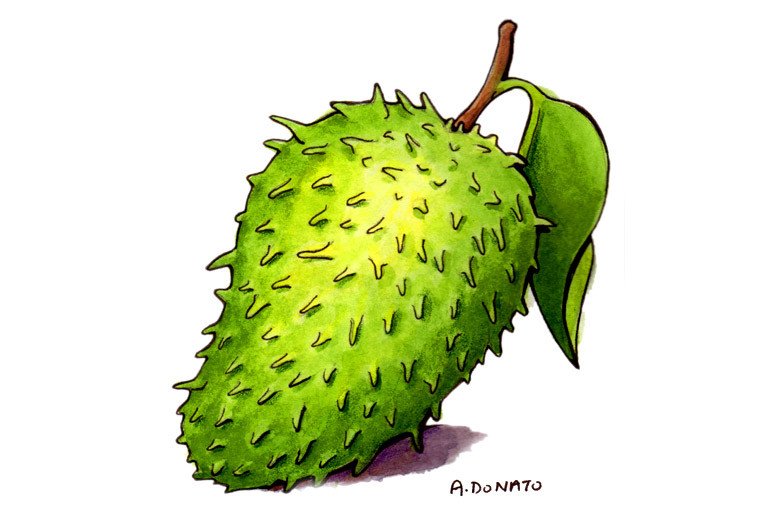
Common Names
- Guanabana
- Soursop
- Custard apple
- Brazilian paw paw
For Patients & Caregivers
Tell your healthcare providers about any dietary supplements you’re taking, such as herbs, vitamins, minerals, and natural or home remedies. This will help them manage your care and keep you safe.
Graviola is a dark green, prickly fruit that comes from the graviola tree. Graviola has many nutrients. The leaves and stems of the graviola tree are used in traditional medicine for many issues.
You can also take graviola as tablets, capsules, and as powders.
Graviola is used to:
- Fight infections
Graviola has other uses, but doctors have not studied them to see if they work.
It’s generally safe to eat graviola fruit. Talk with your healthcare provider before taking graviola supplements. Herbal supplements are stronger than the herbs you would use in cooking.
Supplements can also interact with some medications and affect how they work. For more information, read the “What else do I need to know?” section below.
Side effects have not been reported.
- Talk with your healthcare provider if you’re taking medications that lower your blood sugar. Graviola can also lower blood sugar so taking both at the same time may not be safe.
- Talk with your healthcare provider if you’re taking medications to lower your blood pressure. Graviola can also lower your blood pressure so taking both at the same time may not be safe.
- Avoid graviola if you’re having any imaging tests done, such as a positron emission tomography (PET) scan. Graviola can affect your test results.
- Graviola is promoted as an alternative medicine therapy for cancer. There is no proof that this therapy has benefits for cancer patients.
For Healthcare Professionals
Graviola is a tree prevalent in the rain forests of Africa, South America, and Southeast Asia. The fruits, also known as soursop, are consumed as food. The leaves and stems are used in traditional medicine for symptoms associated with inflammation and infection. Graviola is also available as a dietary supplement and widely promoted as an alternative treatment for cancer, although clinical evidence is lacking. In some Caribbean countries, it is one of the common herbal remedies used among prostate, breast, and colorectal cancer patients (33).
Perceived health benefits of graviola are attributed to its antioxidant properties (1) (2) (3) (4). In animal models, graviola extracts showed anti-inflammatory (5), analgesic (6), antidiabetic (7), antiulcer (8), and antiviral (9) effects. The leaf extracts also have antimicrobial activities (10) (11).
Lab studies have also evaluated extracts from the graviola leaf, fruit, and seed for their anticancer effects. Some of these studies suggest activity against breast (16), lung (12), colon (13), prostate (14), pancreatic (15), liver (17), and skin cancer (18) cell lines, but human studies are lacking. In addition, it is unclear whether the neurotoxicity identified in preclinical studies may translate to humans, as one systematic review suggests a favorable profile with graviola leaf extract (36), so more studies are needed to determine safety and efficacy.
- Infections
Annonaceous acetogenins isolated from the leaves, bark, and twigs are among the active constituents (35). Graviola-induced cell death inhibited by glucose supplementation suggests energy depletion (20). Graviola has also been shown to stimulate serotonin receptors (24). Cell-stimulating behaviors may occur either by increased mitochondrial turnover or by preparation to leave the G1 phase, possibly through a promitotic stimulus present within the extract which acts like a growth factor (28).
In animal models, antidiabetic effects are due to antioxidant, hypolipidemic, and protective effects in pancreatic beta-cells, which improves glucose metabolism (7). Antiulcer effects may occur via increased nitric oxide and prostaglandin E2 activities (8). Anti-inflammatory and analgesic actions with a fruit extract occurred via COX-1/2 inhibition and the blocking of opioid receptors (5).
Graviola extracts were effective against adriamycin-resistant human mammary adenocarcinoma by blocking ATP access and inhibiting plasma membrane glycoprotein (29). Inhibition of HIF-1α, NF-κB, glucose transporters, and glycolytic enzymes also decreased glucose uptake and ATP production in pancreatic cancer cells (15). In breast cancer cells, EGFR expression was downregulated (16) and free-radical scavenging occurred (30). In colon and in lung cancer cell lines, G1 cell-cycle arrest occurred by upregulating Bax and downregulating Bcl-2 proteins (12) (13).
In vitro, graviola alkaloids caused movement disorders and myeloneuropathy with symptoms mimicking Parkinson’s disease (20) (21). Animal studies suggest that long-term ingestion of graviola juice promotes generation of reactive nitrogen species that may accelerate development of neurodegenerative diseases involving the microtubule-associated protein tau (34).
Antidiabetics: In a murine model, graviola showed hypoglycemic effects (31), and may have additive effects with antidiabetic drugs. Clinical relevance is not known.
Antihypertensives: In a murine model, graviola showed hypotensive effects (32), and may have additive effects with antihypertensive medications. Clinical relevance has yet to be determined.
Nuclear imaging (radiopharmaceutical biodistribution): In animal models, graviola decreased uptake of radioactivity per gram of tissue in bladder, kidney, and blood (22).
Blood glucose test: In a murine model, graviola reduced blood glucose levels (31).
Blood pressure readings: In a murine model, graviola reduced blood pressure readings (32).