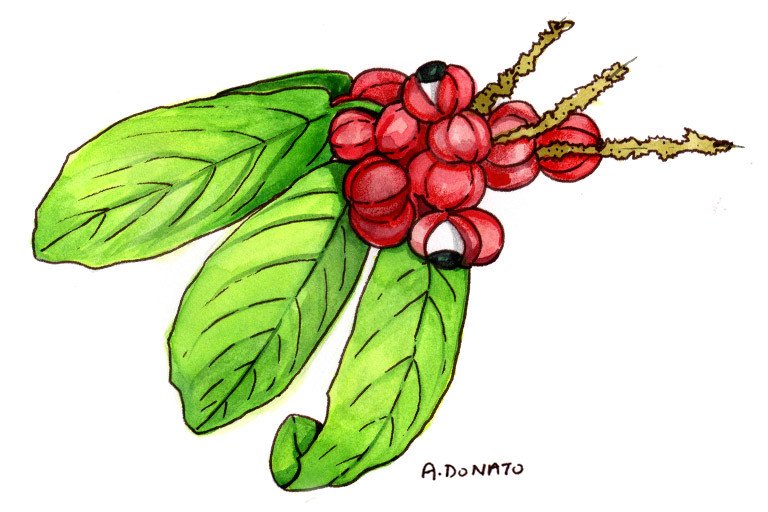
About Herbs, Botanicals & Other Products

Scientific Name
Paullinia cupana
Common Name

Guarana gum, guarana seed, zoom cocoa, Brazilian cocoa

Clinical Summary

Guarana, a bushy plant prevalent in the Amazon Basin, has been used in traditional medicine to treat fevers, headaches, and dysentery. Actions of guarana are attributed primarily to caffeine present in its seeds (2) (3). It is promoted as an appetite suppressant, stimulant, as an aphrodisiac, and to alleviate fatigue. There are extensive data regarding caffeine and its activity.
In vitro studies indicate that guarana has chemopreventive (11) (12), neuroprotective, (13) and anxiolytic (14) properties.
Epidemiological data suggest protective effects of guarana against metabolic disorders in elderly population (15). Improvements in cognitive performance and mental fatigue were also observed following supplementation of guarana in healthy adults (16). However, guarana did not confer any protection against postradiation fatigue in breast cancer patients (17). Further research is needed.

Additive effects and potential toxicity may occur when guarana is combined with other caffeine-containing beverages.
Abrupt withdrawal of guarana may result in symptoms similar to those seen with caffeine withdrawal.

Purported Uses
  • Appetite suppression
  • Central nervous system stimulation
  • Fatigue
  • Sexual performance
Constituents
  • Alkaloids: Caffeine 2.5-7.0%, Theophylline and theobromine
  • Tannins: Catechutannic acid and catechol
  • Saponins
    (1)
Mechanism of Action

Many of guarana’s effects are thought to be due to its high caffeine content. Caffeine’s actions include CNS stimulation, cardiac stimulation, diuresis, increase in blood pressure, inhibition of platelet aggregation, skeletal muscle stimulation and causing hyperglycemia (2) (3). Guarana demonstrated antioxidant effects by inhibiting lipid peroxidation (19). Chronic exposure to Guarana seed extract produced an anxiolytic effect involving the dopaminergic and seroteonergic neurotransmission systems (14).

Adverse Reactions
  • Premature ventricular contractions were reported following consumption of guarana (7).
  • Seizures were reported in four healthy young adults following consumption of energy drink that contained guarana along with other ingredients (18).
Herb-Drug Interactions

Anticoagulant or Antiplatelet drugs: Guarana demonstrated antiplatelet activity and can therefore have additive effects (20) (21).

Herb Lab Interactions

May cause arrhythmia.
Blood pressure may be elevated.
(7)

Literature Summary and Critique

Boozer C, et al. An herbal supplement containing Ma Huang-Guarana for weight loss: a randomized, double-blind trial. Int J Obes Relat Metab Disord 2001;25:316-24.
Sixty-seven subjects participated in a randomized, double-blind placebo controlled study. They were given supplements containing 72 mg of ephedra and 240 mg of caffeine per day. After eight weeks, subjects from the active treatment group lost an average of 4.0 kg as compared to 0.4 kg in the placebo group. Serum triglyceride and hip circumference were also reduced in the active treatment group. The study concluded that this mixture effectively promoted short-term weight and fat loss. However, adverse symptoms such as dry mouth, insomnia and headache were reported. More studies are needed to explore the long-term effects.

References
  1. McGuffin M. A Botanical Safety Handbook. Boca Raton (FL): CRC Press; 1997.
  2. Gruenwald J, et al. PDR for Herbal medicines, 2nd ed. Montvale (NJ): Medical Economics Company; 1998.
  3. Schulz V, et al. Rational Phytotherapy: A Physicians Guide to the Use of Herbs and Related Remedies, 3rd ed. Berlin (Germany): Springer; 1998.
  4. Fetrow CW, et al. Professional’s Handbook of Complementary and Alternative Medicines. Philadelphia: Springhouse; 1999.
  5. McEvoy GK, et al. AHFS Drug Information. Bethesda (MD): ASHP; 1998.
  6. Brinker F. Herb Contraindications and Drug Interactions, 2nd ed. Sandy (OR): Eclectic; 1998.
  7. Cannon ME, Cooke CT, McCarthy JS. Caffeine-induced cardiac arrhythmia: an unrecognized danger of healthfood products. Med J Aust 2001;174:520-1.
  8. Robbers JE. Tyler’s Herbs of Choice: The Therapeutic Use of Phytomedicinals. New York: Haworth Herbal Press; 1999.
  9. Wallach J. Interpretation of Diagnostic Tests: A synopsis of laboratory medicine. Boston: Little, Brown, & Company; 1992.
  10. Boozer CN, et al. An herbal supplement containing Ma Huang-Guarana for weight loss: a randomized, double-blind trial. Int J Obes Related Metab Disord 2001;25:316-24.
  11. Fukumasu H, Cristina da Silva T, Avanzo JL, et al. Chempreventive effects fo Puallinia cupana Mart var. sorbilis, the guarana, on mouse hepatocarcinogenesis. Cancer Lett 2006 20;233(1):158-64.
  12. Fukumasu H, Latorre AO, Zaidan-Dagli ML. Paullinia cupana Mart. var. sorbilis, guarana, increases survival of Ehrlich ascites carcinoma (EAC) bearing mice by decreasing cyclin-D1 expression and inducing a G0/G1 cell cycle arrest in EAC cells. Phytother Res. 2011 Jan;25(1):11-6.
  13. de Oliveira DM, Barreto G, Galeano P, et al. Paullinia cupana Mart. var. Sorbilis protects human dopaminergic neuroblastoma SH-SY5Y cell line against rotenone-induced cytotoxicity. Hum Exp Toxicol. 2010 Nov 16. [Epub ahead of print]
  14. Roncon CM, Biesdorf de Almeida C, Klein T, Palazzo de Mello JC, Audi EA. Anxiolytic effects of a semipurified constituent of guaraná seeds on rats in the elevated T-maze test. Planta Med. 2011 Feb;77(3):236-41.
  15. Costa Krewer C, Ribeiro EE, Ribeiro EA, et al. Habitual Intake of Guaraná and Metabolic Morbidities: An Epidemiological Study of an Elderly Amazonian Population. Phytother Res. 2011 Feb 22.
  16. Kennedy DO, Haskell CF, Robertson B, et al. Improved cognitive performance and mental fatigue following a multi-vitamin and mineral supplement with added guaraná (Paullinia cupana). Appetite. 2008 Mar-May;50(2-3):506-13. Epub 2007 Oct 30.
  17. da Costa Miranda V, Trufelli DC, Santos J, et al. Effectiveness of guaraná (Paullinia cupana) for postradiation fatigue and depression: results of a pilot double-blind randomized study. J Altern Complement Med. 2009 Apr;15(4):431-3.
  18. Iyadurai SJ, Chung SS. New-onset seizures in adults: possible association with consumption of popular energy drinks. Epilepsy Behav. 2007 May;10(3):504-8.
  19. Mattei R, Dias RF, Espínola EB, Carlini EA, Barros SB. Guarana (Paullinia cupana): toxic behavioral effects in laboratory animals and antioxidants activity in vitro. J Ethnopharmacol. 1998 Mar;60(2):111-6.
  20. Bydlowski SP, Yunker RL, Subbiah MT. A novel property of an aqueous guaraná extract (Paullinia cupana): inhibition of platelet aggregation in vitro and in vivo. Braz J Med Biol Res. 1988;21(3):535-8.
  21. Bydlowski SP, D’Amico EA, Chamone DA. An aqueous extract of guaraná (Paullinia cupana) decreases platelet thromboxane synthesis. Braz J Med Biol Res. 1991;24(4):421-4.
How It Works

Bottom Line: Guarana contains caffeine, and therefore has stimulant effects. Long-term effects of using guarana are not known.

Guarana is extracted from the seed and gum of a plant found in teh Amazon Basin. It is commonly used in beverages because of its flavor and because it contains high levels of caffeine. Scientists are very familiar with how caffeine affects the body: it prolongs the action of the sympathetic nervous system (responsible for our “fight or flight” response) and therefore stimulates the brain, heart and muscles, and increases blood pressure.
Guarana showed anticancer, neuroprotective, and anti-anxiety properties in laboratory studies. One epidemiological study showed that guarana intake protected elderly subjects agaisnt metabolic disorders. Guarana improved fatigue in healthy young adults but was not useful in reducing fatigue following radiation therapy in breast cancer patients. More studies are needed.

Purported Uses
  • As an appetite suppressant
    No scientific evidence supports this use.
  • As a stimulant
    Guarana contains caffeine, which has known stimulant effects.
  • To treat fatigue
    Guarana was shown to be effective against mental fatigue in young healthy adults but did not protect against post radiation fatigue in breast cancer patients. More studies are needed.
  • To improve sexual performance
    No scientific evidence supports this use.
Research Evidence

Weight loss:
The effect of a supplement containing ephedra and guarana on weight loss was examined in a randomized controlled trial with 67 overweight subjects. They were given either the active supplement (containing 72 mg of ephedra and 240 mg of caffeine) or a placebo pill every day for eight weeks. At the end of the study, subjects taking the active supplement lost an average of 8.8 lb as compared to 0.88 lb in the placebo group. Several adverse symptoms such as dry mouth, insomnia and headache were reported. It is unclear from this study if the effects were more from ephedra or guarana, or what the long-term health effects are. Ephedra supplements should not be used because they are known to cause serious cardiac side effects, including heart attack and death.

Patient Warnings
  • This product is regulated by the FDA as a dietary supplement. Unlike approved drugs, supplements are not required to be manufactured under specific standardized conditions. This product may not contain the labeled amount or may be contaminated. In addition, it may not have been tested for safety or effectiveness.
Do Not Take If
  • You are taking anticoagulant or antiplatelet medications (guarana has antiplatelet activity and can have additive effects.)
Side Effects
  • Diuresis (increased water lost from the body as urine)
  • Insomnia
  • Premature ventricular contractions have been reported with use of guarana.
  • Seizures were reported in four healthy young adults following consumption of energy drink that contained guarana along with other ingredients.
Dosage (Inside MSKCC Only)
This field is only visible to only Inside MSKCC users.
Aliases
Paullinia cupana
E-mail your questions and comments to aboutherbs@mskcc.org.