Health Care Professional Information
Common Name
Guarana gum, guarana seed, zoom cocoa, Brazilian cocoa
Clinical Summary
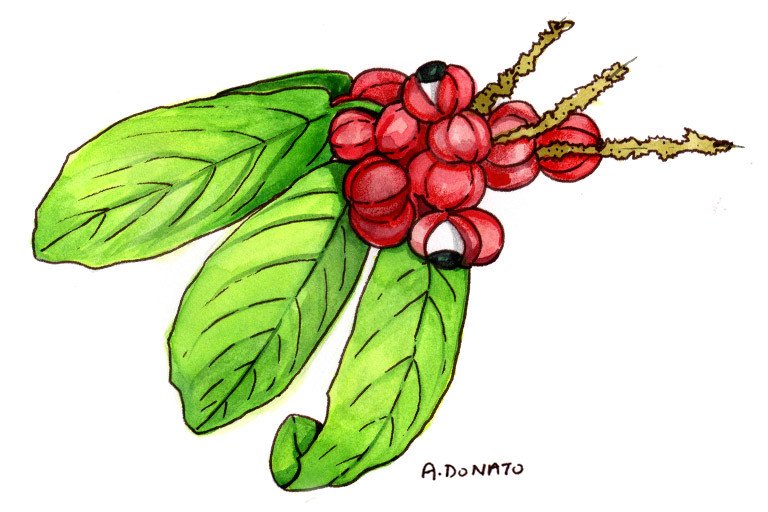
Guarana, a bushy plant prevalent in the Amazon Basin, has been used in traditional medicine to treat fevers, headaches, and dysentery. Actions of guarana are attributed primarily to caffeine present in its seeds (2) (3). It is promoted as an appetite suppressant, stimulant, as an aphrodisiac, and to alleviate fatigue. There are extensive data regarding caffeine and its activity.
In vitro studies indicate that guarana has chemopreventive (11) (12), neuroprotective, (13) and anxiolytic (14) properties.
Epidemiologic data suggest its protective effects against metabolic disorders in elderly population (15). Improvements in cognitive performance and mental fatigue were also observed following supplementation of guarana in healthy adults (16).
In studies of breast cancer patients, guarana did not confer any protection against post-radiation fatigue (17), but was useful as a short-term treatment for fatigue during chemotherapy (22). Further research is needed.
Constituents
- Caffeine, catechin, epicatechin, ent-epicatechin, and procyanidins B1, B2, B3, B4, A2, and C1
(23)
Mechanism of Action
Many of guarana's effects are thought to be due to its high caffeine content. Caffeine's actions include CNS stimulation, cardiac stimulation, diuresis, increase in blood pressure, inhibition of platelet aggregation, skeletal muscle stimulation and causing hyperglycemia (2) (3). Guarana demonstrated antioxidant effects by inhibiting lipid peroxidation (19). Chronic exposure to Guarana seed extract produced an anxiolytic effect involving the dopaminergic and serotonergic neurotransmission systems (14).
Adverse Reactions
- Premature ventricular contractions were reported following consumption of guarana (7).
- Seizures were reported in four healthy young adults following consumption of energy drink that contained guarana along with other ingredients (18).
Herb-Drug Interactions
Anticoagulant or Antiplatelet drugs: Guarana demonstrated antiplatelet activity and can therefore have additive effects (20) (21).
Herb Lab Interactions
May cause arrhythmia
Blood pressure may be elevated
(7)
Dosage (Inside MSKCC Only)
This field is only visible to only Inside MSKCC users.
References
- McGuffin M. A Botanical Safety Handbook. Boca Raton (FL): CRC Press; 1997.
- Gruenwald J, et al. PDR for Herbal medicines, 2nd ed. Montvale (NJ): Medical Economics Company; 1998.
- Schulz V, et al. Rational Phytotherapy: A Physicians Guide to the Use of Herbs and Related Remedies, 3rd ed. Berlin (Germany): Springer; 1998.
- Fetrow CW, et al. Professional's Handbook of Complementary and Alternative Medicines. Philadelphia: Springhouse; 1999.
- McEvoy GK, et al. AHFS Drug Information. Bethesda (MD): ASHP; 1998.
- Brinker F. Herb Contraindications and Drug Interactions, 2nd ed. Sandy (OR): Eclectic; 1998.
- Cannon ME, Cooke CT, McCarthy JS. Caffeine-induced cardiac arrhythmia: an unrecognized danger of healthfood products. Med J Aust 2001;174:520-1.
- Robbers JE. Tyler's Herbs of Choice: The Therapeutic Use of Phytomedicinals. New York: Haworth Herbal Press; 1999.
- Wallach J. Interpretation of Diagnostic Tests: A synopsis of laboratory medicine. Boston: Little, Brown, & Company; 1992.
- Boozer CN, et al. An herbal supplement containing Ma Huang-Guarana for weight loss: a randomized, double-blind trial. Int J Obes Related Metab Disord 2001;25:316-24.
- Fukumasu H, Cristina da Silva T, Avanzo JL, et al. Chempreventive effects fo Puallinia cupana Mart var. sorbilis, the guarana, on mouse hepatocarcinogenesis. Cancer Lett 2006 20;233(1):158-64.
- Fukumasu H, Latorre AO, Zaidan-Dagli ML. Paullinia cupana Mart. var. sorbilis, guarana, increases survival of Ehrlich ascites carcinoma (EAC) bearing mice by decreasing cyclin-D1 expression and inducing a G0/G1 cell cycle arrest in EAC cells. Phytother Res. 2011 Jan;25(1):11-6.
- de Oliveira DM, Barreto G, Galeano P, et al. Paullinia cupana Mart. var. Sorbilis protects human dopaminergic neuroblastoma SH-SY5Y cell line against rotenone-induced cytotoxicity. Hum Exp Toxicol. 2010 Nov 16. [Epub ahead of print]
- Roncon CM, Biesdorf de Almeida C, Klein T, Palazzo de Mello JC, Audi EA. Anxiolytic effects of a semipurified constituent of guaraná seeds on rats in the elevated T-maze test. Planta Med. 2011 Feb;77(3):236-41.
- Costa Krewer C, Ribeiro EE, Ribeiro EA, et al. Habitual Intake of Guaraná and Metabolic Morbidities: An Epidemiological Study of an Elderly Amazonian Population. Phytother Res. 2011 Feb 22.
- Kennedy DO, Haskell CF, Robertson B, et al. Improved cognitive performance and mental fatigue following a multi-vitamin and mineral supplement with added guaraná (Paullinia cupana). Appetite. 2008 Mar-May;50(2-3):506-13. Epub 2007 Oct 30.
- da Costa Miranda V, Trufelli DC, Santos J, et al. Effectiveness of guaraná (Paullinia cupana) for postradiation fatigue and depression: results of a pilot double-blind randomized study. J Altern Complement Med. 2009 Apr;15(4):431-3.
- Iyadurai SJ, Chung SS. New-onset seizures in adults: possible association with consumption of popular energy drinks. Epilepsy Behav. 2007 May;10(3):504-8.
- Mattei R, Dias RF, Espínola EB, Carlini EA, Barros SB. Guarana (Paullinia cupana): toxic behavioral effects in laboratory animals and antioxidants activity in vitro. J Ethnopharmacol. 1998 Mar;60(2):111-6.
- Bydlowski SP, Yunker RL, Subbiah MT. A novel property of an aqueous guaraná extract (Paullinia cupana): inhibition of platelet aggregation in vitro and in vivo. Braz J Med Biol Res. 1988;21(3):535-8.
- Bydlowski SP, D'Amico EA, Chamone DA. An aqueous extract of guaraná (Paullinia cupana) decreases platelet thromboxane synthesis. Braz J Med Biol Res. 1991;24(4):421-4.
- de Oliveira Campos MP, Riechelmann R, Martins LC, et al. Guarana (Paullinia cupana) improves fatigue in breast cancer patients undergoing systemic chemotherapy. J Altern Complement Med. 2011 Jun;17(6):505-12.
- Yamaguti-Sasaki E, Ito LA, Canteli VC, et al. Antioxidant capacity and in vitro prevention of dental plaque formation by extracts and condensed tannins of Paullinia cupana. Molecules. 2007 Aug 20;12(8):1950-63.
Consumer Information
How It Works
Bottom Line: Guarana contains caffeine, and therefore has stimulant effects. Long-term effects of using guarana are not known.
Guarana is extracted from the seed and gum of a plant found in teh Amazon Basin. It is commonly used in beverages because of its flavor and because it contains high levels of caffeine. Scientists are very familiar with how caffeine affects the body: it prolongs the action of the sympathetic nervous system (responsible for our “fight or flight” response) and therefore stimulates the brain, heart and muscles, and increases blood pressure.
Guarana showed anticancer, neuroprotective, and anti-anxiety properties in laboratory studies. An epidemiological study showed that guarana intake protected elderly subjects against metabolic disorders.
Guarana improved fatigue in healthy young adults and in breast cancer patients undergoing chemotherapy, but was not useful in reducing fatigue following radiation therapy. More studies are needed.
Purported Uses
- As an appetite suppressant
No scientific evidence supports this use.
- As a stimulant
Guarana contains caffeine, which has known stimulant effects.
- To treat fatigue
Guarana was shown to be effective against mental fatigue in young healthy adults. Its effects in treating fatigue in cancer patients are mixed.
- To improve sexual performance
No scientific evidence supports this use.
Do Not Take If
- You are taking anticoagulant or antiplatelet medications (guarana has antiplatelet activity and can have additive effects.)
Side Effects
- Diuresis (increased water lost from the body as urine)
- Insomnia
- Premature ventricular contractions have been reported with use of guarana.
- Seizures were reported in four healthy young adults following consumption of energy drink that contained guarana along with other ingredients.
Last updated: October 17, 2012
antioxidant (AN-tee-OK-sih-dent)
A substance that protects cells from the damage caused by free radicals (unstable molecules made by the process of oxidation during normal metabolism). Free radicals may play a part in cancer, heart disease, stroke, and other diseases of aging. Antioxidants include beta-carotene, lycopene, vitamins A, C, and E, and other natural and manufactured substances.
Source: The National Cancer Institute's Dictionary of Cancer Terms
(http://www.cancer.gov/dictionary)
anxiolytic (ANG-zee-oh-LIH-tik)
A drug used to treat symptoms of anxiety, such as feelings of fear, dread, uneasiness, and muscle tightness, that may occur as a reaction to stress. Most anxiolytics block the action of certain chemicals in the nervous system. Also called antianxiety agent and anxiolytic agent.
Source: The National Cancer Institute's Dictionary of Cancer Terms
(http://www.cancer.gov/dictionary)
appetite (A-peh-tite)
A desire to satisfy a physical or mental need, such as for food, sex, or adventure.
Source: The National Cancer Institute's Dictionary of Cancer Terms
(http://www.cancer.gov/dictionary)
blood (blud)
A tissue with red blood cells, white blood cells, platelets, and other substances suspended in fluid called plasma. Blood takes oxygen and nutrients to the tissues, and carries away wastes.
Source: The National Cancer Institute's Dictionary of Cancer Terms
(http://www.cancer.gov/dictionary)
botanical (buh-TA-nih-kul)
Having to do with, or derived from, plants.
Source: The National Cancer Institute's Dictionary of Cancer Terms
(http://www.cancer.gov/dictionary)
breast (brest)
Glandular organ located on the chest. The breast is made up of connective tissue, fat, and breast tissue that contains the glands that can make milk. Also called mammary gland.
Source: The National Cancer Institute's Dictionary of Cancer Terms
(http://www.cancer.gov/dictionary)
breast cancer (brest KAN-ser)
Cancer that forms in tissues of the breast, usually the ducts (tubes that carry milk to the nipple) and lobules (glands that make milk). It occurs in both men and women, although male breast cancer is rare.
Source: The National Cancer Institute's Dictionary of Cancer Terms
(http://www.cancer.gov/dictionary)
caffeine (ka-FEEN)
A substance found in the leaves and beans of the coffee tree, in tea, yerba mate, guarana berries, and in small amounts in cocoa. It can also be made in the laboratory, and is added to some soft drinks, foods, and medicines. Caffeine increases brain activity, alertness, attention, and energy. It may also increase blood pressure, heart rate, breathing rate, and the loss of water from the body in urine.
Source: The National Cancer Institute's Dictionary of Cancer Terms
(http://www.cancer.gov/dictionary)
cancer (KAN-ser)
A term for diseases in which abnormal cells divide without control and can invade nearby tissues. Cancer cells can also spread to other parts of the body through the blood and lymph systems. There are several main types of cancer. Carcinoma is a cancer that begins in the skin or in tissues that line or cover internal organs. Sarcoma is a cancer that begins in bone, cartilage, fat, muscle, blood vessels, or other connective or supportive tissue. Leukemia is a cancer that starts in blood-forming tissue such as the bone marrow, and causes large numbers of abnormal blood cells to be produced and enter the blood. Lymphoma and multiple myeloma are cancers that begin in the cells of the immune system. Central nervous system cancers are cancers that begin in the tissues of the brain and spinal cord. Also called malignancy.
Source: The National Cancer Institute's Dictionary of Cancer Terms
(http://www.cancer.gov/dictionary)
central nervous system (SEN-trul NER-vus SIS-tem)
The brain and spinal cord. Also called CNS.
Source: The National Cancer Institute's Dictionary of Cancer Terms
(http://www.cancer.gov/dictionary)
chemotherapy (KEE-moh-THAYR-uh-pee)
Treatment with drugs that kill cancer cells.
Source: The National Cancer Institute's Dictionary of Cancer Terms
(http://www.cancer.gov/dictionary)
chronic (KRAH-nik)
A disease or condition that persists or progresses over a long period of time.
Source: The National Cancer Institute's Dictionary of Cancer Terms
(http://www.cancer.gov/dictionary)
diuresis (DY-yoo-REE-sis)
An increase in the amount of urine made by the kidney and passed from the body.
Source: The National Cancer Institute's Dictionary of Cancer Terms
(http://www.cancer.gov/dictionary)
drug (drug)
Any substance, other than food, that is used to prevent, diagnose, treat or relieve symptoms of a disease or abnormal condition. Also refers to a substance that alters mood or body function, or that can be habit-forming or addictive, especially a narcotic.
Source: The National Cancer Institute's Dictionary of Cancer Terms
(http://www.cancer.gov/dictionary)
extract (EK-strakt)
In medicine, a preparation of a substance obtained from plants, animals, or bacteria and used as a drug or in drugs.
Source: The National Cancer Institute's Dictionary of Cancer Terms
(http://www.cancer.gov/dictionary)
fatigue (fuh-TEEG)
A condition marked by extreme tiredness and inability to function due lack of energy. Fatigue may be acute or chronic.
Source: The National Cancer Institute's Dictionary of Cancer Terms
(http://www.cancer.gov/dictionary)
in vitro (in VEE-troh)
In the laboratory (outside the body). The opposite of in vivo (in the body).
Source: The National Cancer Institute's Dictionary of Cancer Terms
(http://www.cancer.gov/dictionary)
lipid (LIH-pid)
Fat.
Source: The National Cancer Institute's Dictionary of Cancer Terms
(http://www.cancer.gov/dictionary)
M
In chemistry, M is the amount of a substance that has 6.023 x 10(23) atoms or molecules of that substance. Also called mole (chemical).
Source: The National Cancer Institute's Dictionary of Cancer Terms
(http://www.cancer.gov/dictionary)
medicine (MEH-dih-sin)
Refers to the practices and procedures used for the prevention, treatment, or relief of symptoms of a diseases or abnormal conditions. This term may also refer to a legal drug used for the same purpose.
Source: The National Cancer Institute's Dictionary of Cancer Terms
(http://www.cancer.gov/dictionary)
metabolic (MEH-tuh-BAH-lik)
Having to do with metabolism (the total of all chemical changes that take place in a cell or an organism to produce energy and basic materials needed for important life processes).
Source: The National Cancer Institute's Dictionary of Cancer Terms
(http://www.cancer.gov/dictionary)
nervous system (NER-vus SIS-tem)
The organized network of nerve tissue in the body. It includes the central nervous system (the brain and spinal cord), the peripheral nervous system (nerves that extend from the spinal cord to the rest of the body), and other nerve tissue.
Source: The National Cancer Institute's Dictionary of Cancer Terms
(http://www.cancer.gov/dictionary)
radiation (RAY-dee-AY-shun)
Energy released in the form of particle or electromagnetic waves. Common sources of radiation include radon gas, cosmic rays from outer space, medical x-rays, and energy given off by a radioisotope (unstable form of a chemical element that releases radiation as it breaks down and becomes more stable).
Source: The National Cancer Institute's Dictionary of Cancer Terms
(http://www.cancer.gov/dictionary)
stimulant (STIM-yoo-lunt)
In medicine, a family of drugs used to treat depression, attention-deficit disorder (a common disorder in which children are inattentive, impulsive, and/or over-active), and narcolepsy (a sleep disorder that causes uncontrollable sleepiness). Stimulants increase brain activity, alertness, attention, and energy. They also raise blood pressure and increase heart rate and breathing rate.
Source: The National Cancer Institute's Dictionary of Cancer Terms
(http://www.cancer.gov/dictionary)
supplementation (SUH-pleh-men-TAY-shun)
Adding nutrients to the diet.
Source: The National Cancer Institute's Dictionary of Cancer Terms
(http://www.cancer.gov/dictionary)
therapy (THAYR-uh-pee)
Treatment.
Source: The National Cancer Institute's Dictionary of Cancer Terms
(http://www.cancer.gov/dictionary)