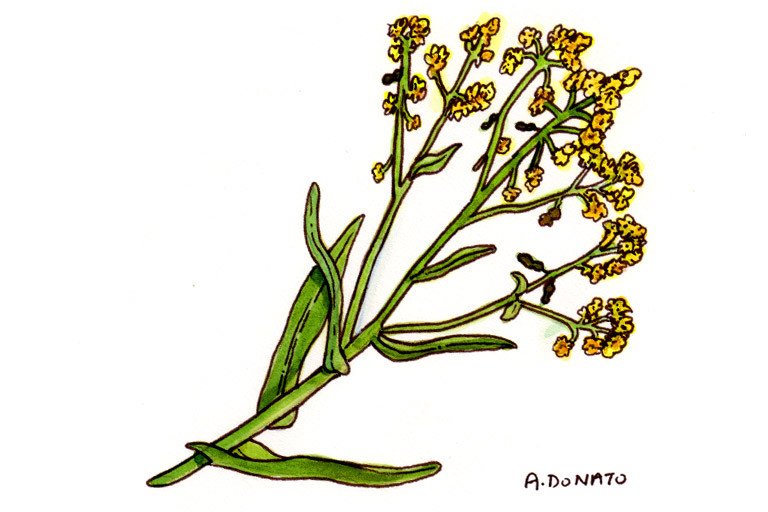
Common Names
- Dyer’s woad leaf
- Indigo
- Da Qing Ye
- Daqingye
- Qing Dai
For Patients & Caregivers
Tell your healthcare providers about any dietary supplements you’re taking, such as herbs, vitamins, minerals, and natural or home remedies. This will help them manage your care and keep you safe.
Isatis leaf has not been shown to treat or prevent cancer.
Isatis leaf extract is derived from the same plant from which indigo dye is made. It is used in combination with isatis root and other herbs both in traditional Chinese medicine (TCM) and in Ayurveda to treat the common cold, sore throat, mumps, respiratory ailments, other febrile diseases, hepatitis, and malignant tumors. Isatis root has both similar and different properties from isatis leaf.
Isatis leaf has anti-inflammatory properties. Lab studies suggest that indirubin, an active compound in isatis, stops cell duplication and therefore may be useful in cancer treatment, but studies in humans are lacking. Other lab experiments show that isatis extract can kill certain viruses and counteract some symptoms and tissue damage from bacterial infections.
Studies in humans are limited. Although it may be effective against ulcerative colitis, its use has been associated with a serious condition called pulmonary arterial hypertension. Therefore it should not be used outside of clinical trials. Additional studies are needed to determine safety and effectiveness.
- To prevent and treat cancer
Lab studies suggest an active compound in isatis stops cell duplication, but there is no evidence from clinical trials that it can prevent or treat cancer. In China, isatis is used in combination with other botanicals to treat chronic myelogenous leukemia. - To treat diarrhea or GI disorders
Isatis extracts have anti-inflammatory activity in the lab setting. A pulverized version of the extract is used in China to treat ulcerative colitis, but additional studies are needed to determine safety and effectiveness. - To treat hepatitis
Isatis extracts have anti-inflammatory effects, but clinical trials are lacking. - To treat HIV and AIDS
There is no scientific evidence to support this claim. - To treat respiratory infections
Although isatis has antiviral activity, there is no evidence from clinical trials that it can effectively treat infections.
Case reports
- Pulmonary arterial hypertension has been associated with use of Qing Dai in patients with ulcerative colitis.
- Wall thickening and swelling that affected the large bowel, abdominal pain, and bloody diarrhea were associated with use of Qing Dai in patients with ulcerative colitis.
Do Not Take if:
You are taking CYP450 3A4 substrate drugs: Lab studies suggest that indirubin, a component of the isatis plant, may affect how these drugs are metabolized. Clinical relevance has yet to be determined.
For Healthcare Professionals
Isatis leaf is derived from the isatis plant and is a source of indigo dye. In both TCM and Ayurveda, it is used in combination with isatis root and other herbs to treat the common cold, sore throat, mumps, respiratory ailments, other febrile diseases, hepatitis, and malignant tumors (1) (2). Isatis root has both overlapping and different properties from isatis leaf.
Isatis leaf is one of the ingredients used in PC-SPES, an herbal formula used to treat prostate cancer. It is also used in Danggui Longhui Wan, a formula used to treat chronic myelocytic leukemia in China (4). Preclinical studies indicate that isatis has antimicrobial, antiendotoxic (5), antiviral (6) (7) (8), immunostimulatory (9), anti-inflammatory (10) (11), and chemotherapeutic (12) properties. In several instances, the pharmacologic effects of isatis leaves were found to be greater than that of the roots (5) (8). A preliminary study in healthy volunteers reported anti-inflammatory (13) effects with use of topical isatis leaf.
The pulverized form of isatis leaf, known as Qing Dai, has been used in small studies for the treatment of ulcerative colitis and showed benefit (3) (20). However its use has also been associated with pulmonary arterial hypertension (22) (23) (32), so it should not be used outside of clinical trials. Additional studies are needed to determine safety and effectiveness.
- Cancer
- Diarrhea
- GI disorders
- Hepatitis
- HIV, AIDS
- Respiratory infections
In vitro, isatis leaf inhibits COX-2 with preferential effects on COX-2–catalysed prostaglandin synthesis (10). The alkaloid tryptanthrin has been identified as the inhibitor of COX-2 (10) and 5-lipoxygenase (5-LOX) (13) (18). Indirubin, another active component, inhibits cyclin-dependent kinases and prevents proliferation by arresting cells in the G2/M phase (4). Other alkaloids isolated from isatis inhibit leukocyte function and attenuate production of mediators related to inflammatory responses (11). A compound derived from isatisine A showed moderate anti-HIV-1 activity (7), but better virucidal activity has been reported with the leaf, not root, extracts using a swine pseudorabies model (8).
Other animal models suggest that isatis leaf can reduce allergic airway inflammation and hyper-responsiveness by inhibiting production of Th2 cytokines IL-4 and IL-5, and RANTES (9). And when used as post-exposure prophylaxis, isatis leaf attenuated lung tissue damage and reduced lung virus titers (6). Findings also showed induction of hepatocellular cancer cell death by isatis via a caspase-independent apoptotic pathway (12).
In other mechanistic studies, Qing Dai prevented bisphosphonate-induced gastrointestinal injury by suppressing mitochondrial ROS production, the main cause of cellular lipid peroxidation (27). Qing Dai may cause PAH via NO synthase inhibition and endothelial dysfunction in the pulmonary artery (32).
Case reports
- Pulmonary arterial hypertension has been associated with use of Qing Dai in patients with ulcerative colitis (22) (23) (32).
- Colitis involving wall thickening and edema that affected the large bowel, abdominal pain and bloody diarrhea were associated with use of Qing Dai in patients with ulcerative colitis (30).