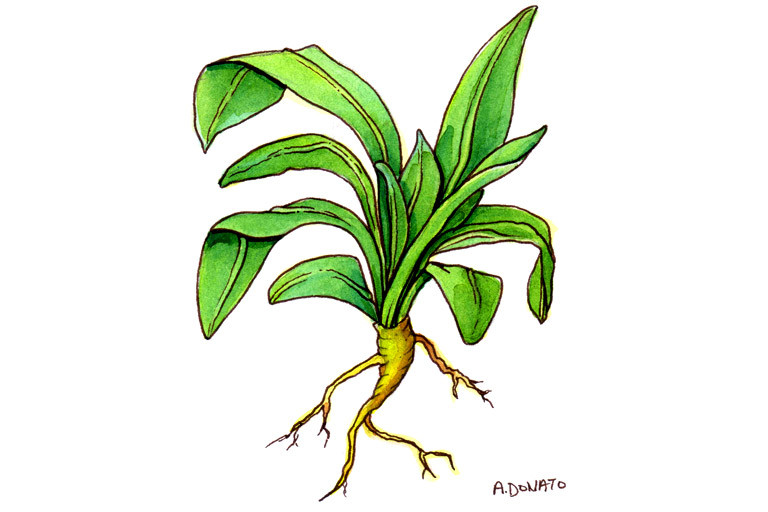
Common Names
- Ban Lan Gen
- Indigo wood
- Chinese indigo
- Woad root
For Patients & Caregivers
Tell your healthcare providers about any dietary supplements you’re taking, such as herbs, vitamins, minerals, and natural or home remedies. This will help them manage your care and keep you safe.
Isatis root has not been adequately studied in clinical trials, so it is not known if it works in humans.
Isatis root extract is derived from the same plant from which indigo dye is made. It has been used in combination with other botanicals in traditional Chinese medicine and Ayurveda for a variety of conditions. In animal tests, it reduced inflammation and fever. Other lab experiments show that isatis extract can kill certain viruses and counteract some symptoms and tissue damage from bacterial infections, but it remains uncertain whether these same effects occur in humans.
Lab studies of indirubin, an active compound in isatis, suggest it might stop cell duplication and may be useful in cancer treatment. A small study in humans indicates that an isatis root extract solution may help reduce radiation-induced mucositis in head and neck cancer patients, but more studies are needed.
Isatis leaf has both similar and different properties from isatis root.
- To treat bronchitis and relieve chest congestion
Lab research suggests that isatis root has anti-inflammatory and immune-stimulating activity, but there is no proof from clinical trials that it can relieve bronchitis and chest congestion. - To treat infections
Although antiviral and immune-stimulating activity has been shown in lab studies, there is no proof from clinical trials that isatis root can effectively treat the common cold, reduce fever, or fight viral infections. In addition, no human studies have been done to verify anecdotal reports that isatis may help ward off severe acute respiratory syndrome (SARS). - To prevent or treat cancer
Lab studies show that an active compound in isatis stops cell duplication, but there is no evidence from clinical trials that it can prevent or treat cancer. In China, isatis is used in combination with other botanicals to treat chronic myelogenous leukemia. - To reduce severity of radiation-induced mucositis
A small study in head and neck cancer patients suggested that a specific isatis root extract solution could reduce severity of mucositis, anorexia, and difficulty swallowing in treated patients compared with a control group.
Oral: None reported.
Eyedrops: Feeling a foreign substance or irritation in the eyes (one report each). Symptoms resolved after patients closed their eyes and rested for 3 minutes.
Patient Warnings:
- Some compounds in isatis root could have activity against SARS, but these are only lab experiments. These compounds would need to be further developed and tested because many compounds in isatis root occur only at low levels. Relying solely on herbal supplements to prevent or treat SARS may induce a false sense of security from this deadly disease. Patients with suspected SARS should limit interactions outside the home. The CDC recommends proper hygiene such as frequent hand washing and wearing a surgical mask to help prevent the spread of SARS.
Do Not Take if:
You are taking CYP450 3A4 substrate drugs: Lab studies suggest that indirubin, a component of the isatis plant, may affect how these drugs are metabolized. Clinical relevance has yet to be determined.
For Healthcare Professionals
Isatis root is derived from the isatis plant and is a source of indigo dye. In both traditional Chinese medicine (TCM) and Ayurveda, it is used in combination with isatis leaf and other herbs to treat the common cold, sore throat, mumps, respiratory ailments, other febrile diseases, hepatitis, and malignant tumors (1) (2). Chinese clinical practice guidelines weakly recommend Banlangen granules to treat mild influenza (25), and the formula Danggui Longhui Wan is used in China to treat chronic myelocytic leukemia (3). Isatis root has also been promoted to ward off SARS.
In vitro assays have identified specific compounds in isatis root with potential anti-SARS (4) and anti-influenza activity (5), as well as cytotoxic activity against human liver cancer and leukemia cell lines (6). Several in vitro and animal studies also demonstrate antimicrobial (7), antiviral (8) (9) (22) (23), anti-endotoxic (10), immunostimulatory (3) (11), chemotherapeutic (12), and radioprotective effects (13). Animal models indicate anti-inflammatory, antipyretic, and antinociceptive effects (13) (14).
A small randomized study demonstrated utility of an isatis root extract solution to reduce severity of radiation mucositis, anorexia, and swallowing difficulty in head and neck cancer patients (15).
Isatis leaf has both overlapping and different properties from isatis root.
- Bronchitis
- Cold, fever
- Infections
- Cancer
- Mucositis
Isatis root exerts immunostimulatory effects by enhancing reticuloendothelial system function (11). Sinigrin and indigo are compounds responsible for potential SARS inhibition (4). Clemastanin B, a major lignan compound, targets viral endocytosis, uncoating, and nuclear export of viral ribonucleoproteins (5). A crude extract of isatis root prevented influenza virus attachment to cells and therefore viral replication, but was inactive against respiratory syncytial virus, adenovirus, parainfluenza virus, and enterovirus (19). Another component of isatis root demonstrates dose-dependent anti-endotoxic effects on lipopolysaccharide-induced expression of membrane-organizing extension spike protein, a main endotoxin receptor (10). Alkaloids isolated from isatis can inhibit leukocyte function and reduce inflammatory response (20). One animal study found that indigo root extract reduced tissue injury, enhanced hematopoietic system recovery, modulated serum inflammatory cytokines, and improved severe enteropathy in whole body irradiated mice (13).
In vitro, an ethanol extract of isatis root had a dose-dependent cytotoxic effect against HL-60 cells (9). Indirubin, an active component of isatis, inhibits cyclin-dependent kinases and prevents proliferation by arresting cells in the G2/M phase (3).
Although some compounds exhibit potential for SARS inhibition, they would need to be developed and tested for efficacy. Many compounds in isatis root occur at low levels (16). In addition, as SARS is a deadly disease, reliance on herbal supplements as prevention or treatment may induce a false sense of security. Patients with suspected SARS should limit interactions outside the home. The CDC recommends proper hygiene such as frequent hand washing and wearing a surgical mask to help prevent the spread of SARS (21).
Oral: None reported.
Eyedrops: One report each of feeling a foreign substance and another of irritating pain in the eyes. Symptoms resolved after the patients closed their eyes and rested for 3 minutes (7).
CYP450 3A4 substrate drugs: Indirubin, a component of the isatis plant, activates CYP3A4 gene transcription through the human pregnane receptor. Clinical relevance is not yet known (24).