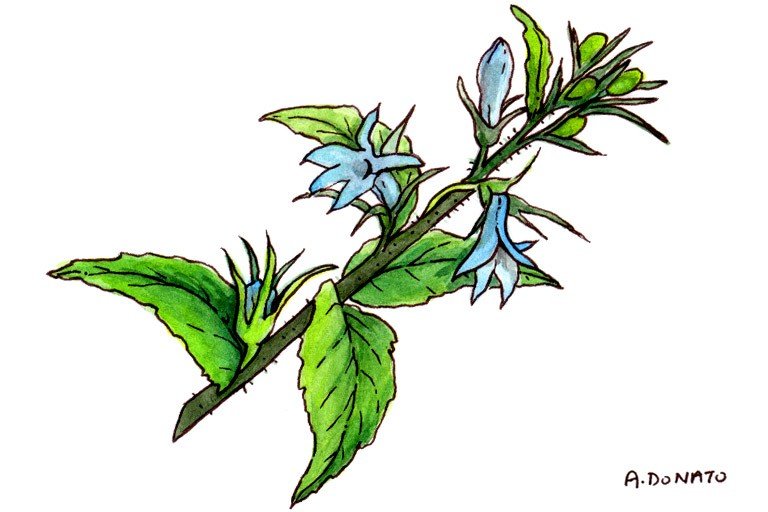
Common Names
- Lobella
- Asthma weed
- Indian tobacco
- Gagroot
- Pukeweed
- Vomit weed
For Patients & Caregivers
Tell your healthcare providers about any dietary supplements you’re taking, such as herbs, vitamins, minerals, and natural or home remedies. This will help them manage your care and keep you safe.
Current evidence shows that lobelia is not effective for smoking cessation, asthma, or any other medical condition.
The active compound in lobelia is lobeline, which has a similar activity in the body to nicotine. This explains its attempted use as an aid in smoking cessation. Like nicotine, lobelia stimulates the central nervous system (CNS), dilates lung passage ways, and increases respiration rate. However at higher doses, lobelia has the opposite effect and causes CNS depression and reduced breathing rate.
In experiments with rats and mice, lobeline increased the release of stimulatory neurotransmitters dopamine and norepinephrine from specific parts of the brain, but it is still unclear what significance this has in the human body. Lobeline can have both additive and opposing effects when used at the same time as nicotine.
Data in humans are limited. A review of studies as well as a large multicenter trial do not support its use for smoking cessation.
- To treat asthma
Although lobelia is thought to dilate the bronchial tubes, human data are lacking. - To treat depression
Lobelia causes release of excitatory neurotransmitters in the brains of research animals. Human studies are needed. - To relieve symptoms from drug withdrawal
No scientific evidence supports this use. - To induce vomiting
There is no research to back this claim. - To reduce inflammation
No scientific evidence supports this use. - To help with smoking cessation
A review of studies and a large multicenter trial concluded that this herb is not effective for smoking cessation.
Dizziness, nausea, and vomiting; possible throat irritation with tablets or pastilles.
Do Not Take if:
- You are using nicotine-containing products: Lobelia may have additive effects, resulting in toxicity.
For Healthcare Professionals
Derived from the aerial parts of the plant, patients use lobelia for smoking cessation and to treat asthma and depression. Piperidine alkaloids are thought responsible for lobelia’s activity. In vitro and animal studies show that lobeline, a major constituent, crosses the blood-brain barrier, has activity similar to that of nicotine, and stimulates the release of dopamine and norepinephrine (5). At low doses lobelia has stimulant effects, but higher doses result in CNS depression (10).
Murine studies suggest lobeline may produce anticonvulsant (21), neuroprotective (21), and antidepressive effects (22). Other preclinical studies suggest it may improve withdrawal-induced depression (19) (23), enhance the effects of other antidepressants (24), and reduce alcohol consumption (17). In other experiments, lobeline improved acute lung injury (25) and reversed multidrug resistance of tumor cells to doxorubicin (16).
Limited studies have been conducted in humans. In a small proof-of-concept study in adults with ADHD, lobeline had modest improvements in working memory but not in attention (26). Clinical studies of lobelia do not support its use for smoking cessation (15) (18) (20).
- Asthma
- Depression
- Drug withdrawal symptoms
- Induce vomiting
- Inflammation
- Smoking cessation
Lobelia has central stimulant activity, dilates bronchioles, and increases respiration rate at low doses, but higher doses cause CNS and respiratory depression (10). Lobeline, a major alkaloid constituent, is a nicotinic acetylcholine receptor ligand (24).
In vitro, lobeline redistributes dopamine pools in presynaptic vesicles and antagonizes their release following amphetamine stimulation. Lobeline can have both antagonistic and synergistic effects when combined with nicotine and does not induce receptor upregulation as seen with nicotine (10).
In rodent models, lobeline increases dopamine release from striatal synaptosomes, increases norepinephrine release from the hippocampus (5), and binds extensively to nicotinic receptors both centrally and peripherally (4). Other animal studies suggest that beta-amyrin palmitate stimulates release of norepinephrine in the brain, possibly leading to an antidepressant effect (1). Murine studies suggest attenuation of withdrawal-induced depressive behavior may occur by targeting brain nAChRs, serotonergic and noradrenergic neurotransmissions, and/or hippocampal cell proliferation (22) (23).
Intravenous administration of approximately 12 mcg/kg lobeline to healthy human subjects resulted in cough, apnea, prolonged inspiration and expiratory pause, the feeling of choking, and pressure in the throat and chest (9).
Nicotine-containing products: Lobelia may have additive effects, resulting in toxicity.