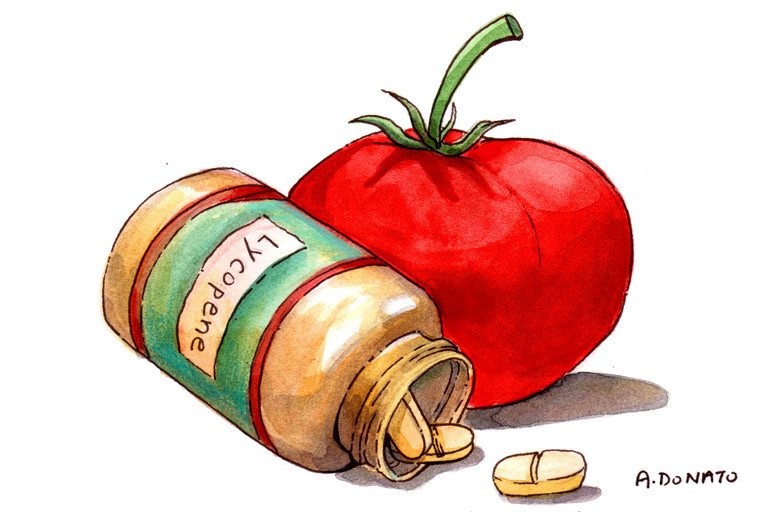
Common Names
- Nonprovitamin A carotenoid
For Patients & Caregivers
Tell your healthcare providers about any dietary supplements you’re taking, such as herbs, vitamins, minerals, and natural or home remedies. This will help them manage your care and keep you safe.
Diets that contain fruits and vegetables rich in carotenoids like lycopene can help prevent some types of cancers and heart problems. However, benefits of lycopene supplements are unclear.
Lycopene is a natural pigment that is produced by plants and microorganisms. Lab experiments confirm that it acts as an antioxidant and affects the way cells grow and communicate with each other. Scientists have proposed several different mechanisms by which lycopene might fight cancer. These include stopping cancer cell growth, preventing DNA damage, and enhancing enzymes that break down cancer-causing products.
Studies in healthy elderly patients suggest that consuming lycopene or tomato juice does not stimulate the immune system. In general, diets rich in carotenoids like lycopene have been associated with decreased risk of macular degeneration, cataracts, and some types of cancers and heart problems.
- To prevent and treat cancer
Lycopene is an antioxidant. One clinical trial suggests that preventative use of lycopene supplements may reduce the spread of localized prostate cancer, but there is no other proof from clinical trials that lycopene can treat cancer. Diets rich in carotenoids like lycopene are generally associated with a decreased risk of certain types of cancers. - To treat asthma
One clinical trial showed that daily lycopene supplementation protected against exercise-induced asthma, but no additional studies have been performed to confirm this. - To treat heart disease
Diets rich in carotenoids like lycopene are generally associated with a decreased risk of some cardiovascular events. However, there is no evidence showing that lycopene supplements have the same effect. - To prevent and treat macular degeneration
Diets rich in carotenoids like lycopene are generally associated with a decreased risk of macular degeneration. However, there is no evidence showing that lycopene supplements have the same effect.
- After long-term ingestion of large quantities of lycopene-rich foods like tomato products, orange skin discoloration may develop in some individuals.
- A possible interaction between high-dose lycopene and chronic alcohol consumption was shown in an animal model. Clinical relevance is not known.
Special Point:
An analysis of six commercially available brands revealed that lycopene content varied from the labeled dosage by as much as 43%.
For Healthcare Professionals
A natural pigment synthesized by plants and microorganisms, lycopene is used primarily as an antioxidant and to prevent and treat cancer, heart disease, and macular degeneration. Lycopene is classified as a non-provitamin A carotenoid, with other examples being lutein and zeaxanthin. Alpha-carotene, beta-carotene, and beta-cryptoxanthin are classified as provitamin A carotenoids because they can be converted into retinol.
Small clinical trials suggest possible benefit against exercise-induced asthma (1) and benign prostatic hyperplasia (2). However, no optimal dosage has been established. Data from observational studies indicate an inverse association of lycopene consumption with risk of developing cardiovascular disease (26), with a randomized study reporting endothelial function improvements in CVD patients but not healthy volunteers (27).
Epidemiologic studies suggest an inverse relationship between lycopene consumption and cancer risk (3), particularly lung (4), stomach (5), prostate (6), and hormone-positive breast cancers (7). A consistent association between lycopene consumption and endometrial cancer risk has yet to be reported (8) (9).
Clinical data on lycopene supplementation for prostate cancer prevention remain inconclusive. Whereas low intake of tomato sauce was associated with advanced prostate cancer in patients with low-grade cancer at diagnosis (10), other studies indicate that lycopene or tomato-based regimens do not prevent prostate cancer (11) (23) (31), and that circulating carotenoids are not useful dietary intervention targets for prostate cancer prevention (36). In men with high-grade prostatic intraepithelial neoplasia, a lycopene-rich extract did not confer any benefits (32), and high doses of lycopene, green tea catechins, and selenium were actually associated with higher prostate cancer incidence (28). Also, variable results were reported for lycopene supplementation in prostate cancer patients (12). In other studies, increasing lycopene intake altered serum metabolome of men at risk of prostate cancer by affecting reductions in pyruvate, higher levels of which increase the risk of prostate cancer (33). Intake of a tomato-soy juice resulted in nonsignificant decreases in prostate-specific antigen slope (34).
Lycopene enhanced docetaxel efficacy against prostate cancer in animal models (22), and preliminary data in patients with metastatic castrate-resistant prostate cancer also suggest favorable activity with docetaxel plus lycopene (37).
Given these mixed results, more studies are needed to determine whether lycopene has protective effects in prostate cancer. Furthermore, variation in genes related to carotenoid metabolism may also play a role in heterogeneous tissue responses to lycopene (35).
Quality control of lycopene supplements has been an issue of concern. An analysis of six commercially available brands revealed that lycopene content varied from the labeled dosage by as much as 43% (14).
Tomatoes, tomato products, watermelon, guava, rose hips, and pink grapefruit (15)
- Asthma
- Cancer
- Cardiovascular disease
- Macular degeneration
Lycopene is a natural pigment synthesized by plants and microorganisms. Referred to as a nonprovitamin A carotenoid, it is not known to have vitamin A activity. Biological actions include antioxidant activity via singlet oxygen quenching and peroxyl radical scavenging, induction of cell to cell communication, and growth control, although this appears to occur with less efficiency than with beta-carotene (15). Preventive consumption of lycopene attenuated effects of acetaminophen-induced liver injury in a murine model (29).
Proposed mechanisms of cancer-preventive effects include inhibition of cancer growth, induction of differentiation by modulation of cell cycle regulatory proteins, alterations in IGF-1 (16) or VEGF (17) levels, prevention of oxidative DNA damage, and possible enhancement of carcinogen-metabolizing enzymes (18). In human liver adenocarcinoma cells, antimetastatic activity was attributed to downregulation of NADPH oxidase 4, which produces ROS (30).
Other possible mechanisms for all carotenoids include immune enhancement as well as inhibition of mutagenesis and transformation, and premalignant lesions. Carotenoids are also associated with decreased risk for macular degeneration and cataracts, and some types of cancers and cardiovascular events (19).
Potential synergy of lycopene with docetaxel has been proposed to occur via downregulated IGF-I signaling inhibition and decreased survivin (37).
- CYP 2E1: A possible interaction between lycopene and alcohol consumption was demonstrated in an animal model, indicating that CYP 2E1 expression is induced by high doses of lycopene plus alcohol (13). Clinical relevance is not known.