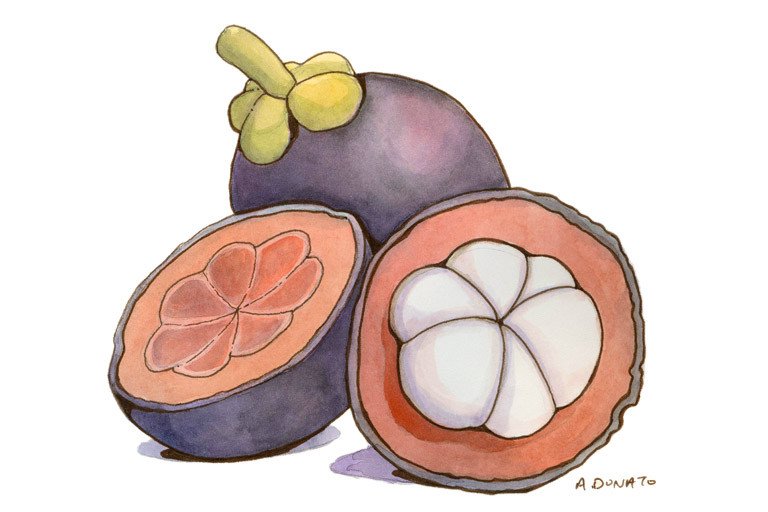
Common Names
- Mangostan
- Mangostanier
- Mangostao
- Mangostier
- Manguita
- Meseter
- Queen of Fruits
For Patients & Caregivers
Tell your healthcare providers about any dietary supplements you’re taking, such as herbs, vitamins, minerals, and natural or home remedies. This will help them manage your care and keep you safe.
Mangosteen has not been shown to treat cancer in humans.
The fruits of mangosteen are used in traditional medicine in Southeast Asia to treat skin infections, wounds, and diarrhea. Laboratory studies have shown that compounds present in mangosteen fruit are effective against bacterial and fungal infections and can reduce inflammation. Other studies have shown that mangosteen can inhibit the growth of various types of cancer cells. There is also evidence that some compounds in mangosteen act as free-radical scavengers to prevent damage by low density lipoprotein (LDL), more commonly known as bad cholesterol.
Small clinical studies suggest benefits of mangosteen-containing products as adjuncts in periodontal treatment; controlling halitosis; and in the treatment of chronic periodontitis. Mangosteen extracts were also found useful for weight management. Confirmatory studies are needed.
- Infections
Laboratory studies have shown that mangosteen has antibacterial and antifungal properties. Human data are lacking. - Diarrhea
This use is not supported by clinical trials, and in an animal study appeared to worsen ulcerative colitis. - Inflammation
Laboratory studies suggest that mangosteen inhibits enzymes involved in inflammation. - Wound healing
Clinical data are lacking.
Case Report: Severe lactic acidosis following consumption of mangosteen juice daily for 12 months.
Alpha-mangostin exacerbated symptoms of experimental colitis in a mice model. Clinical relevance is not known.
Do Not Take if:
- You are taking cytochrome P450 substrate drugs: Mangosteen may increase the risk of side effects of these drugs. Clinical relevance is not known.
- You are taking calcineurin inhibitors (cyclosporine, tacrolimus): Compounds isolated from mangosteen may have additive immunosuppressant effects if used with related drugs. Clinical relevance is not known.
- You are undergoing chemotherapy or radiation therapy: Mangosteen products have antioxidant effects and may therefore interfere with the intended effects of cancer treatments.
- You have diabetes: Mangosteen is high in sugar content.
For Healthcare Professionals
Mangosteen is a tropical plant native to Southeast Asia. The fruits are consumed as food and also used in traditional medicine to treat skin infections, wounds, and diarrhea. Mangosteen juice is marketed as a health drink and the pericarp, or fruit hull, is used in dietary supplements for its antioxidant activity. Preliminary data show that xanthones, bioactive compounds in mangosteen, exhibit antibacterial (3), antifungal (4), anti-inflammatory (5), antiatherosclerotic (7), anti-asthmatic (26), antiangiogenic (27), cytotoxic (12), aromatase-inhibitory (14), and anticancer (17) (18) properties. They may also provide protection against doxorubicin-induced neurotoxicity (19) and cisplatin-induced nephrotoxicity (16).
Small studies suggest benefits of mangosteen-containing products as adjuncts in periodontal treatment (20) (48), controlling halitosis (21), and in the treatment of chronic periodontitis (44) (49). Mangosteen extracts were also found useful for weight management (28) (29) (45) and for improving insulin sensitivity (46), but ineffective in alleviating exercise-induced fatigue (47) or for treating schizophrenia or schizoaffective disorder (50). Topical use of a mangosteen extract improved mild-moderate acne (51). Confirmatory studies are needed.
- Infections
- Diarrhea
- Inflammation
- Wound healing
Many compounds isolated from mangosteen fruit and pericarp have been evaluated in lab studies. Xanthones alpha- and beta-mangostins, and garcinone B exhibit strong inhibitory effects against Mycobacterium tuberculosis (3), as well as aromatase-inhibitor activity (14). Alpha- and gamma-mangostins act as histamine and serotonin receptor blockers (8) and inhibit HIV-1 protease (9). In animal models, they reduced major features of allergic asthma including airway inflammatory cell recruitment and hyperresponsiveness, increased Th2 cytokine levels, and attenuated increases in phosphoinositide 3-kinase (PI3K) activity, phosphorylation of Akt, and NF-kappaB (26). The ability of alpha-mangostin to inhibit fatty acid synthase may occur via stronger action on the ketoacyl synthase domain and weaker effects on the acetyl/malonyl transferase domain (22). It also reduced prostaglandin synthesis by inhibiting COX-1 and -2 enzyme activities (5), and prevented oxidative damage of LDL by functioning as a free-radical scavenger (7). The compound isogarcinol isolated from mangosteen induces anti-inflammatory and immunosuppressant effects in animal models (30) (31). Mangosteen extract may have antiobesity effects by increasing AMP-activated protein kinase and Sirtuin 1 activities in the liver (42).
Chemopreventive properties of mangosteen xanthones against specific human cancer cell lines have also been demonstrated, including: alpha-mangostin in leukemia (1) (6) (32), breast (33) (34), gastric (35), and pancreatic cancer cells (36) (37); gartanin in urinary bladder cancer (38); and gamma-mangostin (39) and garcinone E (10) in liver cancer cells. Extracts from the pericarp of mangosteen also exhibit antioxidant (13), antiproliferative, and apoptotic effects (11).
The preventive effect of alpha-mangostin on cisplatin-induced apoptotic death is associated with the inhibition of p53 expression and generation of reactive oxygen species (23). Alpha-mangostin inhibited growth of leukemia HL60 cells by inducing caspase-3-dependent apoptosis (1) (6). It reduced matrix metalloproteinase MMP-2 and -9 expression, increased E-cadherin expression, and suppressed the ERK signaling pathway in pancreatic cancer cell lines (36). In chronic myeloid leukemia cells, it induced autophagy via increased expression of the autophagosome marker LC-3II and accumulation of autophagic vacuoles, in addition to antiproliferative and apoptotic effects (32). Another study also attributes the antitumor activity of alpha-mangostin to autophagy and not endoplasmic reticulum stress induction (24).
Beta-mangostin decreased the proliferation of human cervical cancer HeLa cell by inhibiting cellular polymerases (43). Gamma-Mangostin demonstrated free radical scavenging activity in human liver cancer cells (39). In bladder cancer cell lines, activities of gartanin suggest mTOR pathway inhibition, downregulation of Bcl-2 expression, and p53 pathway activation leading to apoptotic induction (38).
- Chemotherapy: Mangosteen products have antioxidant effects (7) (13) (37) (41) and may interfere with the action of anthracyclines, platinum compounds, and alkylating agents.
- Calcineurin inhibitors (cyclosporine, tacrolimus): Isogarcinol isolated from Garcinia mangostana inhibits calcineurin. It may have additive immunosuppressant effects when used with related drugs. Clinical relevance is not known.
- Cytochrome P450 substrates: Mangosteen inhibits CYP1A1, CYP1A2, CYP2E1 and CYP3A11, and can affect the intracellular concentration of drugs metabolized by these enzymes (25). Gartanin, a constituent of mangosteen, down-regulated expression CYP2C9 and CYP2D6 and up-regulated expression of CYP2D6 (52). Clinical significance of these interactions is not known.